Hunt for a Nazi U-boat and the elusive enigma machine, by Charles Lachman (a summary by Pat Evert)
- Prologue – June 29, 1942
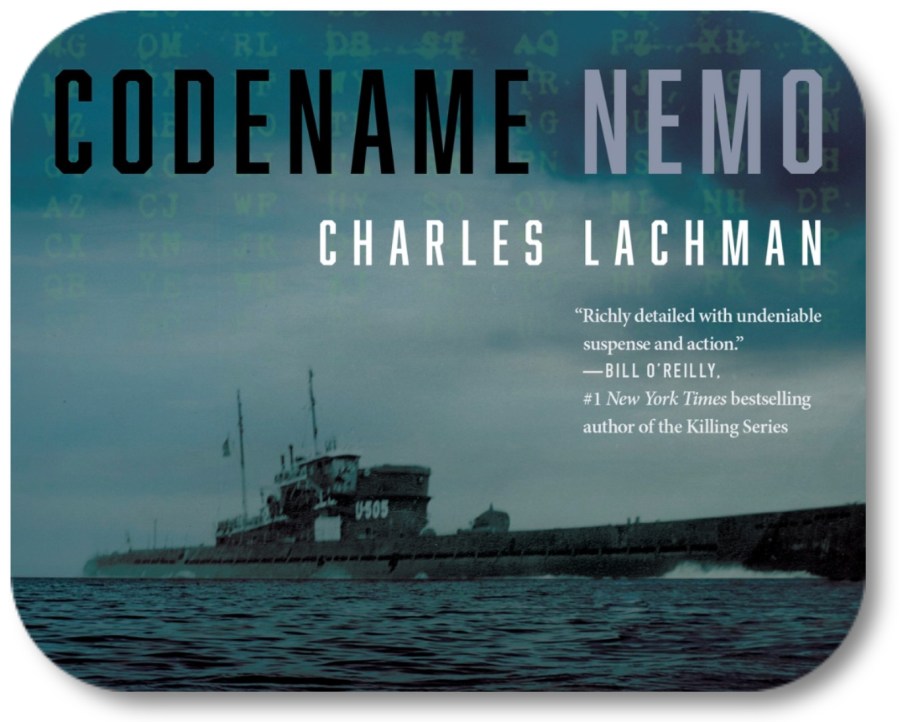
A German torpedo is slicing through the water, seconds away from blowing up the US cargo ship Thomas McKean on her maiden voyage. There are sixty-two men on board, and the ship’s hull is loaded with war supplies—tanks, trucks, food, and more. On the top deck are eleven Douglas medium bombers. Ammo is stored in hold #1. Aviation fuel fills hold #2. She is a ticking time bomb. General quarters ring out and all hands report to their battle stations. “She’s finished,” McCarthy shouts back at the captain. “Yep, the ship is a goner.” Just then, about a mile off, a submarine breaks the surface. It’s a German U-boat. The U-boat is about two hundred feet long yet impressively maneuverable. “We cannot help you. We haven’t got the time.” With that, the U-boat departs. In total, four crew members are dead. That makes fifty-eight men on four lifeboats who need to find a way back to the United States. The closest land is about two hundred miles away. And out there in the depths of the Caribbean is the U-boat that blew up their ship, heading west to find her next prey. Her name is U-505.
- “Where the Hell is Freetown” – fourteen months earlier
Kapitänleutnant Axel-Olaf Loewe has great regard for the sea and natural instincts for maneuvering big ships. Now, at age thirty-two, he is given his first command. U-505 is a large submarine, carrying twenty-two torpedoes. Fifty men are on board. It can go more than eight thousand miles without refueling. It is August 26, 1941. The war is going well for Germany. September 1, 1939, saw the invasion of Poland. The next year, Denmark surrendered in a day. Then Norway fell. In May 1940, Hitler turned his attention to Western Europe and, in a single day, established Nazi hegemony over little Luxembourg. Then the Netherlands. The German Army marched into Paris. Britain was under siege. Underwater, U-505 operates strictly on electrical battery power. This is her great advantage in battle—her capacity to go unseen by the enemy. She can move at a top speed of eight miles an hour, for a maximum of twenty-four to fifty hours, depending on conditions, before the batteries must be recharged by spinning the boat’s electric motor coils. And that can only be achieved on the surface, when the U-boat runs on diesel fuel. In Lorient, German engineers and construction crews have converted the rest of the bawdy port on the Bay of Biscay into a massive forward submarine base for the German U-boat fleet. Sixteen bunkers house the submarines. The bunkers—reinforced with twenty-two-foot-thick concrete walls—are impenetrable by Allied bombing. Storing food for fifty men to last one hundred days at sea is, for Loewe, a work of wizardry. It must be loaded on board into impossibly limited space. Necessity requires the two bathrooms be converted into storage units. So, the men use the “shit bucket,” located in the engine room, when they take a dump. The shit bucket is emptied when the U-boat surfaces. In all, U-505 will set sail with twelve tons of food. Hans Goebeler reports for duty. An eighteen-year-old machinist. Goebeler stands five-foot-two, an excellent height for submarine service. His small stature will be an advantage in the tight quarters of the U-boat. His primary responsibility will be operating the periscope during engagements with the enemy and maintaining the periscope’s hydraulic pump. “We have been ordered to hunt along the West African coast. Our operational area will be the Allies’ convoy assembly point off Freetown Harbor.”
- This Cold Strange Land – New Year’s Eve 1941
The world is still reeling from the Japanese sneak attack on Pearl Harbor twenty-four days earlier. In the opinion of commander Daniel V. Gallery, Iceland is a “cold strange land.” Put another way, it is a “Godforsaken hole.” Icelanders yearn for neutrality—and want to sit out the great conflict currently engulfing the planet. Gallery has been ordered to hunt and kill Nazi submarines prowling the North Atlantic. Hitler’s fleet of U-boats is threatening to starve England into submission. In these early days of 1942, the Allies are losing the Battle of the Atlantic.
On August 20, 1942, it’s confirmed! It’s a U-boat! Hoppy can see the blasts have crippled the U-boat. Unable to submerge, she’s limping along the surface, leaking thousands of gallons of oil. U-464, by the time the Brits board the Germans have thrown all the code books and other important documents over the side and destroyed the Enigma machine. The Enigma encryption machine scrambles ordinary words into gobbledygook. The Germans consider the machine unbreakable, unless, of course, you have the code books. Later the conquest of U-570. The RAF pilot flew in low, made a beeline for the submarine, and dropped his payload of depth charges. Of course, by the time the Brits boarded her, all the secret codes had been ditched overboard and the Enigma machine smashed to pieces, just like U-464. What if you were able to board a submarine before the crew scuttled the vessel and destroyed the code books and the Enigma machine? Capturing a German submarine . . . with all its secrets and technology intact. Was it even possible? Could it actually happen?
- KILL! KILL! KILL!
Due to the ever-present potential of a crash dive, only two or three sailors at a time are permitted on deck to relax and enjoy a smoke and fresh air. No one is permitted to stay longer than the time it takes to finish one cigarette. Inside the boat, it’s like a furnace. The temperature in the engine room exceeds a hundred degrees. And the stench! As soon as your shift starts, you jump out of your bunk and a crewmate hops in to take your place. It’s called “hot rack,” or hot bunk because the bunk is in use twenty-four hours and the mattress reeks from body odors. On March 8, 1942, U-505 at last arrives at its designated patrol zone, 210 miles southwest of Freetown, Sierra Leone. To stay sharp, the lookouts are replaced every four hours with fresh personnel.
“Torpedoes away! “Surface.” She is stopped dead in the ocean with a hole amidship. She’s British, all right. Her name is the SS Benmohr. She is out of Durban, South Africa, on her way to Freetown for refueling. Her ultimate destination is Oban, Scotland. She is carrying a cargo of war supplies: rubber, silver bullion, and pig iron for the manufacture of steel. Then U-505 makes a hasty departure before British forces can respond to the SOS distress call. U-505 is on the scoreboard with her first kill: a fully loaded British freighter. The next day a British tanker, larger than the Benmohr, apparently fully loaded with oil. Loewe orders U-505 to dive to periscope depth. She is hovering about thirteen feet below the surface. A monster shock wave hits U-505, knocking every German off his feet. It can only mean Loewe’s analysis is correct—the tanker is fully loaded with gasoline. But he never anticipated this ricochet. The blast has even cracked U-505’s diesel engine clutch, but not beyond repair. It could have been worse. When Loewe can look through the periscope again, he is taken aback because there’s no sign of the tanker. It no longer exists. All that’s left is a giant red ball of flames and thick clouds of black smoke. The tanker was pretty much obliterated. The Brits are ticked off. No Allied merchant ship is permitted to proceed out of Freetown without a Royal Navy escort. Air patrols also intensify. The crew of U-505 know they, the hunters, are now the hunted ones. The skies above are dotted with British “bumblebees”—bombers scanning the ocean for the submarine. Loewe is compelled to remain out of sight underwater for as long as his batteries last, frittering the hours away holed up in the stinking steel cigar. A new target comes into view. Loewe decides to wait for the camouflage of night before launching the attack. April 3, 1942. An SOS message is broadcast, and as Loewe’s radio operator monitors the distress signal, he learns the identity of the ship U-505 has just blown up. She is called the West Irmo. She’s an old-fashioned steamship, built in 1919. Two miles away is West Irmo’s escort, the HMS Copinsay. He steams for the lifeboats and hauls all ninety-nine West Irmo survivors aboard. Loewe figures it’s time to turn tail. No point in sticking around and picking a fight. By the end of the year, the Allies will have lost 1,570 ships and the Germans only 86 U-boats. Off the East Coast of the United States, an extraordinary 105 U-boats are in operation. A total of 524 Allied ships are sunk between July and December within the waters of the American security zone. America and Great Britain are on the brink.
- The Eyes of Texas Are Upon You
Wayne Pickels Jr. was the star quarterback and captain of the Alamo Heights High School football team in San Antonio, Texas—number 17. Just after the Japanese bombed Pearl Harbor, this lifelong Army brat rushes to enlist—in the Navy. On March 1, 1942, the day the heavy cruiser USS Sam Houston is sunk in a torpedo attack by the Japanese Imperial Navy during the Battle of Sunda Strait. Of the crew of 1,061, only 368 survive. On Memorial Day 1942, as a crowd estimated at two hundred thousand watches, the volunteers line up on Main Street in downtown Houston and are administered the Navy Oath. The Pillsbury is a feisty ship, smaller and slower than a regular destroyer and designed to escort merchant marine convoys. With a tighter turning radius, she is built for hunting and killing German submarines.
Meanwhile in the island nation of Iceland Commander Daniel Gallery has seen to it that the US Navy base is now a thriving little village with gravel roads and comfortable living quarters. He manufactures two palm trees, which he plants at the entrance to the base—aware that no trees grow in barren Iceland. Gallery authorizes a new certificate suitable for framing for any man serving one hundred days in Iceland—an “FBI,” as in “Forgotten Bastard of Iceland.” At last, in May 1943, his prayers are answered. Gallery is ordered home to take command of a fighting ship, the aircraft carrier USS Guadalcanal.
- Sin City
For the next two weeks, the ocean is empty. British bombers are a constant presence. Crash dives become a daily occurrence. The crew is exhausted and showing signs of scurvy—U-505 is in danger of running low on fuel. On April 27, Loewe clicks on the boat’s intercom to make the long-awaited announcement. “Beginning today, we start our trip home.” The men haven’t had a real shower in almost three months. After eighty-four days at sea, U-505 enters the port of Lorient in occupied France. Four pennants flutter in the wind, signifying four kills. The real lure of Lorient is the so-called sin strip. French mademoiselles in fancy dresses. Goebeler has never been with a woman before. He can talk a good game, but all he knows of the opposite sex comes from watching military training films. In time, he takes a special interest in a pretty French girl who calls herself Jeanette. A deep affection develops between them. The month passes quickly. By Sunday, June 7, 1942, this idyllic time of rest and relaxation is over. The entire crew has reported back to duty from their furloughs, and U-505 is ready to ship out again on its second wartime patrol. They leave with an exhortation that he and the crew do better. Time to open his sealed orders and read them to the crew:
“Men, we’ve been ordered to the Caribbean, and so we have a long run across the Atlantic to make. I don’t have to tell you, the bridge will have to keep an especially sharp lookout. We will be crossing many commerce routes. In fact, the success of our trip will depend on how well our bridge watch does its job.
On the twenty-seventh day out, they see a black smudge on the horizon. The USS Sea Thrush is one tough vessel. Two torpedoes, racing at them at a depth of three meters, are on the way . . . Loewe delivers the knockout punch, a third torpedo on the starboard side. Sea Thrush breaks in two and sinks to the bottom of the sea.
- Relieved of Command
A three-masted schooner. “Fire a shot over her bow so we can find out who she is,” Loewe tells gunnery officer Gottfried Stolzenburg. It’s meant to serve as a warning shot, but the cannon ball falls short of its intended target—the open sea—and demolishes the schooner’s mainmast. She’s the Roamar, out of Cartagena. He fears he has blundered his way into a diplomatic incident. “Sink that thing, but quick, Stolzenburg.” Medically, something is very wrong. They radio U-boat headquarters informing Admiral Doenitz that Kapitänleutnant Loewe is seriously ill. The response is swift: U-505’s mission is declared terminated, and she is ordered to return to Lorient. The seaport has been the target of an intense Allied bombing campaign. Although the thick concrete U-boat pens are impenetrable, the port of Lorient is under siege. Much of the city lies in ruins. Axel-Olaf Loewe struggles to make his way off the boat. Very quickly, German naval doctors diagnose chronic appendicitis. An emergency operation takes place two days later. As for the sinking of the Roamar, Loewe is correct to fret. The schooner is owned by a prominent Colombian diplomat. Colombia is now threatening to declare a state of war against Nazi Germany. Loewe’s reputation is sunk—just like the Roamar. He is relieved of command. U-505 undergoes repairs and modifications and is loaded with fresh supplies of torpedoes and provisions. On October 4, 1942, U-505 is ready to depart on her third mission.
- I Deeply Regret to Inform You
Flight Sergeant Ron Sillcock is the ace pilot of Squadron #53 of the Royal Australian Air Force. In his 550 hours of flying experience, he has demonstrated a flair for feats of daring and bombing accuracy. He has two submarine notches on his airplane: U-155 and U-173. On November 10, 1942, Sillcock takes off from the US Army Air Force base in Trinidad on seek-and-destroy submarine patrol. Then Sillcock sees her. It’s a U-boat and she’s about to become dead meat. He shuts down his engines, feathers the propellers, and glides in lethal silence toward his target. He lets loose with a 250-pound bomb. The aim is perfect, right on the foredeck. The deck is a twisted mess of steel and metal. The fuel tanks have split open! Off the starboard bow, through the smoke and fire, Bode can see the wreckage of Ron Sillcock’s plane and a strange object floating in the water. It’s a decapitated head. A blond head. The Allied pilot must have come in too low and dropped the bomb load before he was able to pull out of the dive. They plug the gaping hole in the hull with a rubber sheet and shore it with lumber. The severely crippled U-505 is utterly vulnerable to another air attack. Only one diesel engine is working, and she has no functioning antiaircraft weaponry. Nor can she dive. Using an acetylene torch and welding machines and banging away with sledgehammers, the crew proceeds to patch up the holes in the hull. A response comes back from headquarters several hours later. U-505 is to rendezvous with a milk cow, U-462, off the Cape Verde Islands in fifteen days. On December 12, U-505 limps into Lorient, having made the harrowing journey across Suicide Stretch, as the Bay of Biscay is now known.
- Call to Duty
Earl Trosino was enthralled by sailing vessels from childhood. Trosino is called to active duty as a full lieutenant in June 1941—six months before Pearl Harbor. The Navy dispatches him to a new ship, the USS Guadalcanal, where he reports to Captain Daniel Gallery as chief engineering officer.
- Sabotage
The British War Cabinet orders Air Marshal Arthur Harris—“Bomber Harris,” to target all U-boat bases in Germany and occupied Europe and attack them to “maximum scale.” First on the priority list of cities to bomb out of existence is the French seaport of Lorient. Leaflets are dropped over Lorient warning the civilian population of the impending blitz and notifying them there is still time to evacuate. On the night of January 14, 1943, as ninety-nine British planes drop seventy-six tons of bombs and incendiary containers filled with magnesium and thermite on Lorient. It’s a living hell as more than eighty fires break out—and that’s just for starters. The next evening, the Brits come back with even greater forces—140 tons of bombs, triggering four hundred fires. American planes take over on the third night with a sortie of B-17 bombers that destroy forty buildings.
Hans Goebeler boards a train for his hometown of Bottendorf for the first time in two years. Like the rest of Germany, Frankenburg has fully embraced Hitler and fascism. The town’s Jewish population is long gone, having fled due to systematic persecution or having been deported to death camps. When he returns to Lorient, Goebeler is taken aback. His cherished boat U-505 is ready for battle as never before. The relentless Allied bombardment has flattened most of the city and the population has fled. There were forty-six thousand French citizens before the war, falling to just five hundred people now. Barely an hour into the voyage. U-505’s diesel engines sputter. They shut down entirely around midnight. Ninety minutes of repair work. They again run out of the Bay of Biscay. All goes well, until forty meters down, when a leak springs in the starboard propeller shaft. Five days out of Lorient, three British destroyers, dead ahead. Coming this way. Six depth charges are dropped right on top of her. Zschech smells a rat. He suspects sabotage. Zschech has no choice but to return to Lorient. An enormous oil slick of diesel fuel is leaking out of U-505, creating a giant glowing rainbow that pinpoints U-505’s precise position. Damn those saboteurs. It’s a miracle that U-505 pulls safely into the submarine pen back at Lorient. Somebody has poured battery acid on the seals. Other U-boats are experiencing similar acts of sabotage. Half a dozen men are put to death by firing squad. Two weeks later, U-505 sets out again. At sixty meters, they hear hissing and gurgling, It sounds as if water is penetrating the pressure hull. Back to Lorient. An inspection reveals the pressure hull seams have obviously been tampered with. Two more weeks of repair are required. The main induction valve has buckled. Another case of sabotage! They try once again a week later. Oh no. Another diesel fuel leak! Then an engineer reports to Zschech that the lube oil is contaminated with sugar. On returning to Lorient, another shocking discovery: A saboteur has drilled a pencil-sized hole into the fuel tank. How the hell can this keep happening? The trim pump breaks down. U-505 turns back and is ordered to the Caribbean. After ten frustrating months, the crew is finally back in the thick of the war.
- USS Can Do
Captain Dan Gallery is hardly bowled over when he sees the USS Guadalcanal for the first time. It’s frail, homely. Most of the lads are fresh out of six weeks of Navy boot camp and know next to nothing about aircraft carriers or, for that matter, life at sea. Each sailor is handed a memo with these words, written by their captain: “The motto of the Guadalcanal will be Can Do, meaning that we will take any tough job that is handed to us and run away with it. The tougher the job the better we’ll like it.” Henceforth she is known as the USS Can Do. June 5, 1943, she is officially underway. There are lots of mechanical problems with the Guadalcanal to iron out. Everything seems to be breaking down. She has thirty-one officers and forty-seven enlisted personnel. Five FM-1 Wildcats and five Grumman TBF-1 Avengers are hoisted on board. More planes to come. Gallery is not just captain of the ship but also a capable aviator like them. The Guadalcanal is assigned to the Atlantic theater, which means the cornerstone of its mission will be escorting merchant ships and undertaking tedious anti-submarine patrols. What a grind. It’s a huge letdown for Gallery. After Iceland, he thought he was done with the Atlantic.
- Over the Side
All at once . . . Ping. Ping. Ping. The sound is so sharp it can be heard by everyone on U-505. It emits a signal at regular intervals, and when the sound hits a solid metallic body like U-505, it bounces back as an echo. Later, the world will come to call this breakthrough “sonar.” Each ping is getting shorter and sharper. It means the ship above them is zeroing in on U-505’s precise position. Boom! A depth charge—right on top of them. Here they come. Boom! Boom! Boom! Zschech shoots himself! Paul Meyer takes command of U-505, ordering the ejection of two Bold capsules. These are four-inch-wide metal canisters filled with calcium hydride. When calcium hydride mixes with seawater, huge masses of hydrogen bubbles churn out. The chemical reaction lasts twenty minutes. The ploy works. The enemy destroyer sends the next round of depth charges in the direction of the bubbles, and U-505 slips away at the slow speed of two knots. An hour later, she is safely out of range of the destroyer. The destroyer has again found U-505 and is in hot pursuit. The attacks continue for two hours before U-505 can shake off the enemy. Meyer orders U-505 to surface. Just in time, too. The air inside U-505 is reaching dangerous levels of carbon dioxide contamination. It is just before dawn. The boat is running the surface at top speed. Without any eulogy or words of respect for the fallen leader, the body of twenty-four-year-old Peter Zschech is dumped over the side. How could it be, that a German U-boat commander commits suicide in the heat of battle?
- Turkeys in the Air
In the Caribbean everyone on board is on high alert. These waters are crawling with Nazi U-boats. At any given moment, the Guadalcanal could be hit by a torpedo. After steaming northeast, Gallery swings his ship up the eastern coast of the United States, past North Carolina’s Outer Banks, where more than a hundred U-boats are believed to be patrolling the waters of the American defense zone. Meeting with the senior officers, he is to take command of hunter-killer Task Group 22.12 consisting of the Guadalcanal and four destroyer escorts. They will seek and destroy enemy submarines operating along convoy routes from the United States to Europe. Now American fighter jets and torpedo bombers can swoop down on the subs even a thousand miles from the nearest land base. In Berlin, Hitler issues a grim New Year’s message, “There will be no victors, but merely survivors and annihilated.” January 2, 1944, Guadalcanal sets off from Norfolk on her first wartime cruise, linking up three days later with the USS Pillsbury and three other destroyers. One of his most experienced pilots is killed coming in for a landing. The plane crashes off the side of the ship and the pilot disappears in a “big splash.” A U-boat has the upper hand only when she remains invisible. But the submarine’s electric storage batteries are only good for about twenty-four hours of continuous operation underwater, at which point the German sub must resurface and run on diesel engines while the batteries recharge. That is the narrow window in time when Gallery hopes to pounce, when the U-boat is exposed.
It’s now two weeks into the mission, and eight of Captain Gallery’s “turkeys” from the Guadalcanal are in the air, searching for U-boats. They find three Nazi submarines on the surface. One submarine is U-544, and she’s fatter than the other—she’s a milch cow, refueling a smaller submarine. The two boats are about a hundred feet apart, connected by a six-inch-thick rubber tether. The third U-boat is farther off, waiting her turn for refueling. In it all Gallery lost three planes, but at least all the pilots are safe. In the big picture, he’s earned one submarine kill, maybe two. Overall assessment: a helluva good day for the Allies. Unable to save any of the fifty-seven German sailors on U-544.
- A Fragile Character
On November 7, 1943, U-505 pulls into Lorient. Calamitous losses have hit the U-boat fleet in the last few weeks. The entire German U-boat fleet is on the brink of becoming obsolete. The tide is finally turning in favor of the Allies in the Battle of the Atlantic. By April 1943, the Nazi losses are staggering, with more than ninety U-boats failing to make it back to Lorient. At least half of Doenitz’s U-boat fleet lies dead on the ocean floor. But there’s a glimmer of hope for the Nazis, as German scientists invent a nifty new weapon, the acoustic torpedo, codename Falcon. It has an effective range of five thousand meters and comes equipped with a homing system that zeroes in on the sound produced by surface propellers. The obvious question, which is this: How the hell do the Allies seem to know the positions of every U-boat at sea?
- The Old Man
Kapitänleutnant Harald Lange stands before the crew and reads his orders. In doing so, he officially takes over as the third skipper of U-505. At six feet, Lange is the tallest man on U-505, and at forty he’s the oldest U-boat commander serving on the front lines in the entire German fleet. After a long winter’s leave, the U-505 crew is slowly reassembling in Lorient for their next patrol. Christmas Eve 1943, they set out for the first time under Harald Lange’s command. Paul Meyer, remains second in command. The German destroyer Z-27, which has been hit by shells fired from twelve miles away by the British light cruiser HMS Glasgow. In all, thirty-four shipwrecked sailors from the Battle of the Bay of Biscay are rescued by U-505.
- Lone Wolf
What a beautiful ship. Pity she must be destroyed. This is what Kapitänleutnant Werner Henke is thinking as he stands on the bridge of U-515 in the South Atlantic, west of the Azores, admiring the British ocean liner SS Ceramic through his binoculars. The date is December 6, 1942. Henke swings his U-boat around and fires another torpedo at a range of one thousand meters. It’s a direct hit. Henke observes the chaos as lifeboats are lowered and passengers and crew abandon ship. In six seconds, Ceramic is gone. Reporting the sinking of the Ceramic to Admiral Doenitz the reply is as follows.
Report at once whether troop transport was loaded with troops and whether there was any indication of its port of destination.
He proceeds to retrace his submarine’s path, but behind his bluster Henke is worried. In wartime, heroism and disgrace are often separated by a thin membrane.
The Ceramic is a luxury ship. Like the Titanic, she’s a White Star Line ocean vessel. The German U-boat rescues one person. No one else from the ship is found alive—they’re all gone, 656 passengers and crew. All the nurses and children and the soldiers, killed by the torpedo blasts or drowned in the raging storm. On January 6, U-515 pulls into Lorient, greeted by a band. Henke’s sinking of the SS Ceramic is about to make him a national hero in Germany. Washington counterpunches with a propaganda radio report that accuses Henke of mowing down the shipwrecked survivors of the Ceramic with machine-gun fire, as they sat in their lifeboats waiting to be rescued.
- Ping … Ping … Ping
Each night they trained, as the moon waned and the skies darkened, the pilots became more confident in their nighttime flying capabilities. In two weeks’ time, the moon disappeared and they were taking off and landing in pitch-black conditions. Until now, German submarine skippers operated pretty much without fear of a nighttime aerial attack, when they could recharge their batteries with impunity and hunt for prey. That’s done with. Henceforth, the U-boats surface at night at their own peril. Only they don’t know it yet. Four “turkeys” have taken off from Guadalcanal, en route to the U-boat’s last reported position based on Gould’s sighting. There’s the sub! A fighter pilot takes aim and drops two MK-47 depth charges. Ping . . . Ping . . . Ping. The U-boat is still alive. She’s now at six hundred feet—maximum dive range. At 2:10 p.m., nineteen depth charges fired by Pope finally delivers the dagger. It’s not a direct hit, but the U-boat is left battered. It breaks surface—and finds herself surrounded by four American destroyers: Pillsbury, Pope, Chatelain, and Flaherty. Aircraft carriers let the destroyers do the fighting. The carriers exist as floating runways for takeoffs and landings, and the destroyers exist to shield the carriers.
- Seriously, Dan?
Gallery informs Smith-Hutton that he’s about to embark on another sweep of the Azores with a new hunter-killer task group. Then he cuts to the chase: It is his intention to capture a German submarine. Imagine the gold mine of intelligence that could be gleaned. The Nazi code books! An Enigma machine! German submarine technology! He brings Gallery to the Office of Naval Intelligence’s Technical Section, where he is shown captured U-boat blueprints that pinpoint the location of the vessel’s scuttling valve—a doomsday mechanism capable of flooding the submarine with tons of seawater and sinking her to the bottom of the ocean. All U-boats are also believed to be rigged with fourteen booby traps, scattered in hidden locations throughout the vessel, and set to detonate fifteen minutes after the Germans have abandoned ship. The Tenth Fleet? The US Navy Fleet Admiral King assigned himself to its command. The existence of the Tenth Fleet is classified, and it is certainly the most unusual fleet in Navy history in that it has zero ships. The sole purpose of the Tenth Fleet is to bring intelligence and operations under one command in the hunt for Nazi U-boats. The entire staff of the Tenth Fleet consists of five hundred men and women. it is also known as the Phantom Fleet. Most of the personnel are WAVES, handpicked for their intellect and flare for cryptography. They are eggheads. Gallery proceeds on to Norfolk and the USS Guadalcanal, leaving Commander Kenneth Knowles with a lot to think about.
- Radio Silent
U-505 departs Brest, France, under cover of darkness and mired in a somber mood. Two weeks, Lange radios his position to U-boat headquarters in Berlin. Lange, and even the German High Command, are oblivious to the fact that the Kriegsmarine’s military code has been cracked by Allied military intelligence. About 3,600 miles away, U-505’s location is duly noted on the tracking map by US Navy Commander Kenneth Knowles’s squad of WAVES at the Old Navy and Munitions Building in Washington. the boat is at this moment positioned at 44-39N 14-30W. Then, for the next five weeks, U-505 goes radio silent.
- The Nine
Gallery informs his commanders that he’s been thinking for a long time about seizing a U-boat and towing her back to America. “We can put an inspecting party on board.” They will seize the boat, climb down the submarine’s hatch, close the scuttling valves, disarm all booby traps, and do “whatever else they have to do” to keep the U-boat afloat. In the ready room, sit the commanders of his five destroyer escorts—the Pillsbury, Chatelain, Flaherty, Pope, and a newcomer to the group, the USS Jenks. “I want each ship to organize a boarding party. Also, keep your towline where you can get to it in case we need it.” Lieutenant Junior Grade Albert Leroy David Is the lead man of the group. All members of the boarding party will be armed with a .45-caliber automatic pistol, ammunition belt, flashlight, and gas mask. They won’t be traveling light, as they’ll also be taking six hand grenades, six tear gas grenades, one Tommy gun, and a machinist’s toolbox with T-wrenches, four Stilton wrenches, and other utensils. Also, a ten-pound sledgehammer, a crowbar, and a thirty-foot steel chain. Once inside the sub, his orders are to proceed to the wardroom and pry open two safes. And what they contain are documents worth their weight in gold. Six out of nine are sons of immigrants; all are Americans to the core. They have a lot to think about. No one really knows what to expect. Are they about to embark on a suicide mission? Could be.
- Just One More Night
For three weeks Captain Daniel Gallery, on the USS Guadalcanal has been on the hunt for German U-boats, but so far, no submarine has come within his sights, and he is running out of time. The U-boat skippers are growing more skilled at evading detection. They’ve learned that the deeper you dive into colder water, the more difficult it is for aerial radar to penetrate. The trick is to catch the U-boat when she surfaces, which she must do at some point to recharge. A submerged submarine can only advance sixty miles or so before she runs out of juice. Another urgent coded message is handed to Gallery, from the Navy’s top-secret headquarters for anti-submarine intelligence. A U-boat, whose identity is not known—is still heading east, straight into the path of the Guadalcanal. Gallery orders the commanders of the five destroyer escorts in Task Group 22.3 to conserve fuel and operate at half capacity so they can wait for the submarine to come to them. That Nazi skipper is in a lousy situation, and he has to surface soon or he’s done for. Assuming Gallery doesn’t run out of fuel first.
- Battle Stations
Kapitänleutnant Harald Lange might not make it back to France. He’s low on fuel, but the real source of his anxiety is the steady corruption of the boat’s storage batteries. “They’re in bad shape,” says his machinist, Hans Decker. Life on board U-505 is becoming intolerable. The steamy air the crew breathes is turning noxious. It’s almost like inhaling smoke. Lange orders a course due north, he has no idea that the bearing he is charting is taking him straight to Captain Gallery and the Guadalcanal. Upon surfacing Lange finds three enemy destroyers! And what is that in the distance? An aircraft carrier! And flying above it—fighter jets! “Tauchen! he calls out. “Dive!” The Americans are almost upon him.
- “Away, All Boarding Parties!”
June 4, 1944 sunrise. Gallery, due to fuel shortage, has to concede it’s time to call it quits. He gave it his best shot, but he must abandon his quest to capture a U-boat on the high seas. Gallery is still fuming over how that damn submarine got away.
A submarine has been sighted. On the Guadalcanal, the squawk box blares awake. “Frenchy to Bluejay—I have a possible sound contact.” It’s his job to get the Guadalcanal the hell out of there and offer his five destroyer escorts some elbow room to do what they’re built to do. It’s a submarine. Definitely a submarine. Now the two fighter planes Gallery sent aloft from Guadalcanal see something. “Sighted sub!” U-505 rises from the depths like a great gray whale. Ripples of white water pour off her sides. She is about a hundred yards from Chatelain. For the next two minutes, the three American destroyers closest to U-505—Chatelain, Jenks, and Pillsbury—let fly with every small-arms weaponry they possess. U-505 is getting hammered with dozens of slugs fired from the arsenal of .50-, .40-, and .20-caliber weapons. Germans popping out of the conning tower and hurling themselves over the side of the U-boat. They are leaping for their lives amid the relentless hail of bullets ricocheting off the submarine and peppering the ocean surrounding them. Pickels relinquishes his boatswain’s post and runs to the whaleboat where he is to link up with the other nine members of the boarding party. Lieutenant Albert David hears the cry and rushes from his post in the aft engineer room where he is assistant engineer and electrical officer. In no time flat, he’s at the whaleboat. One by one the other volunteers also report for duty: Arthur Knispel. Stanley Wdowiak. Chester Mocarski. George Jacobson. William Riendeau. They’re all a bit bewildered. A truly monumental task lies head, and they can’t help but wonder: Is this really happening? U-505 seized, but barely afloat.
- Abandon Ship
The ocean water is so crystal clear the pilots can make out the outline of U-505 even at this depth. Lange orders a deeper dive. Fifty meters down, depth charges explode around them. U-505 shudders violently and all the lights go out. Machinist Hans Decker hears something that every submariner dreads—the sound of water flooding in. “Rudder taken out—water breach!” somebody screams. Major flooding is declared in the aft torpedo room, and Lange orders it evacuated. The main rudder is jammed, and the boat is out of control, turning in a clenched circle. It’s a runaway dive, down to 230 meters, and it’s only minutes before the pressure hull reaches the depth at which she will be crushed like a walnut. Without the ability to steer, there is no hope. U-505 is sinking to the bottom of the ocean. Then, somehow, the compressed air being pumped into the ballast tanks start blowing out the water, and the next thing the crew knows, they’re on a vertical climb upward. As they ascend to the surface, they all grasp the fact that Lange has no option other than to issue the orders to abandon ship. He is without a rudder, with no access to the torpedoes. There is nothing to do but surrender. Scuttling the submarine is the standard order of business for any well-disciplined U-boat crew. The Germans, above all, must keep their vessel from falling into enemy hands. Only three officers have the security clearance and technical know-how to set the fourteen demolition charges scattered throughout U-505. The submarine remains on the surface, circling widely, stubbornly refusing to sink, but definitely sitting lower in the water. What a tenacious boat.
- Hi-Yo, Silver!
At 11:38 a.m., the whaleboat is launched over the side of the USS Pillsbury and lowered into the Atlantic. On board are the nine sailors from the boarding party, ready to take a ride into the history books. The U-boat is about two thousand yards up ahead. Crazy thing is, the submarine is circling counterclockwise at six, maybe seven knots. Seaman First Class Jim Beaver Jr., who is brandishing the whaleboat’s bow hook is, about to make a leap that, he has been informed, could contribute to bringing about an end to World War II. The two vessels slam into each other—with Mocarski wedged between. His legs are crushed, and several ribs are broken. The hatch is open and David peers inside. He’s been told the Germans have more than likely set demolition charges that will detonate in a matter of seconds. He also knows that simply by climbing down the ladder he could trigger a booby trap planted by the Nazis. There doesn’t appear to be a soul on board except for them. Suddenly, their nerves are jangled by a strange noise coming from the control room, a ticking sound. A time bomb? No, it turns out it’s just the ticking of a gyroscope. Whew . . . Locating the source of the rushing water is their first priority. U-505 is tilting 10 degrees down by the stern. David wonders how much time they have left. They’ve got to plug up the leak or the submarine will sink for sure with all of them inside. Just off the control room Lukosius ducks behind the main periscope and encounters the source of the leak—a spout of water shooting up five feet. It’s the sea strainer that Hans Goebeler had unlatched to scuttle the submarine. The cover, it’s the right shape and size. Lukosius works feverishly to clamp the cover in place against the rushing water and tighten all the butterfly nuts. And in the nick of time. Another few minutes and the sub could have gone down, taking the entire boarding party with her. It’s an Enigma encryption machine that scrambles ordinary words into gibberish. Bingo! The German code books. They are the mother lode. The code books are printed with pale, red-colored ink that dissolves the instant it comes in contact with water. A warning in German is printed on the cover: Vorsicht! Wasserloslicher Druck! “Careful! Water Soluble Print!” The slightest spray of water and the ink bleeds. In no time the radio room is stripped bare. The Americans work at a speedy pace because they know the sub could sink at any moment. They find the skipper’s safe. He attacks it with a crowbar and the safe pops open with a sudden crackle that takes him aback. It sounds like an explosion. Then he digs in and stuffs all the paperwork he finds into a seabag. One more look around. A framed family photo on the captain’s desk. Must be the captain’s wife back in Germany. Jacobson flicks a switch. All at once, the steady hum of the electric motors goes silent. Success! send a message to Pillsbury via semaphore: They need a tow, right away.
- “Who’s in Charge”
Hans Goebeler watches with a smug and self-satisfied expression as the American boarding party chases after U-505, which is circling counterclockwise at a high speed. The scene recalls something out of the Keystone Cops. What a crazy sight. Goebeler informs the other sailors on his life raft that he left a parting gift for the Americans—he sabotaged the submarine by detaching the sea strainer cover. It’s only a matter of time before U-505 goes to the bottom. “Three cheers for our sinking boat!” All the Germans respond, “Hip hip hooray!” But he has to grudgingly admit that he has never witnessed anything as brave as these US sailors who are venturing into an enemy submarine that they know is about to go under. Unbelievable.
The first sensation that wallops Trosino like a punch to the gut is the smell. Lord have mercy. He tries to break down the components. Diesel fuel. Human body odor. Also, dank salt water floating with debris. Mildewed wet clothes. How in the world can men live in this environment for months on end? They have in their possession the Nazi code books, charts, submarine operating instructions, and an Enigma machine. It’s certainly one of the great intelligence windfalls of the war. Then, of course, there’s the submarine itself, intact and loaded with the latest German technology, including acoustical torpedoes. Assuming, of course, they can keep her afloat.
- Request Immediate Assistance
The Pillsbury should be approaching U-505 by her stern, while throwing the towline to the submarine’s bow. Ass to nose, so to speak. Instead, the ship is coming alongside. Sure enough, as the USS Pillsbury draws near—collision! U-505’s diving plane, which sticks out of the submarine like a flipper, slices a deep gash into the Pillsbury’s thin steel skin. The Pillsbury is at risk of sinking—not by a U-boat torpedo but by ineptitude. Gallery has heard enough. “I am going alongside myself to put towline on myself,” he radios. Then he roars, “Keep out of my way.” An inch-and-a-quarter-thick steel towing line is fired to Hampton’s crew on U-505. Guadalcanal eases ahead. The towline is stretched and as Gallery gathers speed, U-505’s stern emerges from the water until the tow is as “taut as a banjo string.” The sub achieves buoyancy. There is a five-inch-wide, twenty-inch-long gash in the Pillsbury’s hull. They install the collision mat, which is a large canvas square treated with a sealing agent and tied down with thick rope on all corners. It functions as a temporary patch and fits over the gash like a giant bandage. Back on Guadalcanal, the time has come for Gallery to let his bosses at Atlantic Fleet Headquarters and the commander in chief of the United States Fleet know about the day’s historic accomplishment. He keeps it short:
REQUEST IMMEDIATE ASSISTANCE TO TOW CAPTURED SUMARINE U-505.
Gallery is ordered to change course immediately for the British colony of Bermuda. And assistance is on the way. The tugboat Abnaki has been split off from a convoy bound for Africa and dispatched to take over the towing of U-505. Also, the oil tanker Kennebec will rendezvous with Guadalcanal and the destroyer escorts, and refuel Task Group 22.3 in the mid-Atlantic.
Before he gets going, Gallery sends a communiqué to Casselman over on the USS Pillsbury. He knows Casselman must have tossed and turned all night, sick with worry over that collision with U-505 and the impact to his naval career. He gets a message from Dan Gallery.
THIS IS FOR YOUR FILES REGARDING DAMAGE DONE TO YOUR SHIP THIS CRUISE. THIS DAMAGE WAS DONE EXECUTING MY ORDERS AND I ASSUME RESPONSIBILITY.
- Junior
All fifty-nine POWs are transported by whaleboats to the Guadalcanal. So, it’s undeniably true. U-505 has fallen into enemy hands. They have failed in their most sacred duty to scuttle or go down with the ship. Hans Goebeler is obsessed by a single thought, playing over and over in his head: This is all my fault. Lieutenant Jack Dumford makes sure the prior boarding parties haven’t overlooked anything and haul all the top-secret material back to the Guadalcanal for analysis. Inside it’s a gold mine of intelligence that, once analyzed, could expose the U-boat fleet’s methods of operations. He fills nine canvas bags before making a hasty retreat.
Captain Gallery and Trosino board the U-boat to see if they can open the door to the torpedo room. As they emerge out of the hatch there’s a big surprise, as well—seems that the boys on deck had gotten hold of a thick brush and a can of red paint to scrawl Can Do Junior in big bold letters across the conning tower. Gallery is delighted. ‘Can Do’ is his nickname for the Guadalcanal. U-505 now had a new name—Junior. He watches with pride as an American flag flies majestically on a jury-rigged flagpole atop the bridge of U-505. Below Old Glory is a smaller flag—the Nazi flag, with swastika. In Navy tradition, it is a symbol of victor over vanquished.
- “I Will be Punished”
Without the diesels running, they can’t charge the batteries. U-505 is running out of juice. There isn’t enough power to operate the pumps and suck the water out of the boat. The prisoner follows Ski to the master-at-arms office, where they sit across from each other at a table. His name is Ewald Felix. He is twenty-one and explains that he is half-Polish. He grew up on a farm in Upper Silesia, technically German territory near the border with Poland, but he considers himself more Pole than German. He blames the Nazis for the deaths of his mother and his uncle. He is a junior seaman, having served on U-505 on just two war cruises. Felix hates the Nazis, or so he says. He was compelled to serve on a U-boat under penalty of imprisonment. He says he is nothing but cannon fodder to these Nazis, another expendable Pole. It’s a huge gamble, but Gallery agrees that Trosino and Ski should take Felix over on a whaleboat and see what assistance the U-505 mechanic can offer. Gallery pulls Ski aside. He’s worried that Felix will do something to sabotage the U-boat and return to the brig a hero to his fellow POWs. “He’s not to leave your side,” he tells Ski. Felix flicks on the bulkhead fans, fresh air starts circulating inside the vessel. The temperature cools down and stench starts to dissipate. Next, he shows Trosino how to operate the bilge pump. The hose rears like a cobra. Water starts spouting out, forty feet into the air. They can actually feel U-505 rising to the surface as the bilge empties. Watching from the Guadalcanal hangar deck, the sailors give a great big roar of jubilation. The rotating coils of the electric motors start spinning, which charges the submarine’s electric batteries. Finally, there’s enough current to run the pumps and dry out the boat. U-505 achieves full surface trim for the first time since her capture. That night, Trosino makes his report to Gallery on the Guadalcanal. He expresses utmost faith in Ewald Felix. “He’s as loyal as any man in the United States Navy.” Together, this trio is back to U-505 for the night. spends the entire night awake, working on U-505 to ensure its stability. By now, Felix and his new American friends are developing a tight fellowship. Felix eats and bunks with the Guadalcanal sailors and everyone seems at ease around him. Felix even asks Ski to make a special request to Captain Gallery: Could he, Ewald Felix, most recently apprentice mechanic on U-505, switch sides and sign up with the United States Navy? If so, Felix promises to remain for the “rest of his life and never ask for pay.” When Gallery hears the request, he tells Ski, “No way can I do that. He’s still a POW. But I will do everything in my power when he comes ashore. I can’t express enough how much he’s done for this country.” It doesn’t take long for the POWs to put two and two together. Ewald Felix is a stool pigeon and a traitor. They vow to make him pay for this treachery. In Berlin, Nothing more is known about the submarine’s whereabouts. She is presumed lost at sea. On June 6, 1944—two days after U-505 is seized—a proclamation from General Dwight Eisenhower trumpets the launch of D-day.
- USS Nemo
The day after the D-day invasion, Guadalcanal and the task group rendezvous with the USS Abnaki. To safeguard secrecy, all the commander of the Abnaki has been told is that he is to rendezvous with Guadalcanal for a “towing job.” He assumed that the aircraft carrier has run out of fuel. Imagine his shock when he realizes that he’s expected to tow a captured U-boat! On board Abnaki is Lieutenant Horace Mann, an experienced submariner. He has been issued top secret sealed orders, which he is permitted to open only upon the rendezvous with Guadalcanal. “Take charge of the first thing you see,” it reads. That’s all. The U-boat is now underway to Bermuda, escorted by Guadalcanal and the destroyer escorts. The carrier is refueled and should sustain her on the long journey across the Atlantic. Fleet Admiral Ernest King is holding in his hands a top-secret dispatch from the First Sea Lord of the Admiralty.
IN VIEW OF THE IMPORTANCE AT THIS TIME OF PREVENTING THE GERMANS FROM SUSPECTING A COMPROMISE OF THEIR CYPHERS, I AM SURE YOU WILL AGREE THAT ALL CONCERNED SHOULD BE ORDERED TO MAINTAIN COMPLETE SECRECY REGARDING THE CAPTURE OF U-505.
The First Sea Lord of the Admiralty is the highest-ranking officer of the British Royal Navy. This is perhaps the war’s greatest secret, next to the development of the atom bomb. If the German high command learns that one of its submarines has been seized, along with the code books, they’ll ditch the current code books, enhance Enigma machine security, and in doing so blind Allied codebreakers. The harm to the Allied war effort could be catastrophic. If not handled with utmost secrecy, the capture of U-505 could turn out to be a debacle.
EMPHASIZE TO ALL CONCERNED NEED FOR ABSOLUTE SECRECY REGARDING CAPTURE. THE NAME U-505 NEVER TO BE UTTERED AGAIN.
The admiral selects Nemo, which is Latin for “no one” or “nobody.” She is now the possession of the United States Navy, and her newly commissioned name is the USS Nemo. As Task Group 22.3 approaches Bermuda, the time has come to take down the swastika flying below the American flag on the jury-rigged submarine flagpole. All evidence that the submarine being towed by the Abnaki is of German origin must be erased.
Gallery steps before his lads. He reminds everyone that regulations require all captured items and souvenirs, no matter how small or trivial, must be handed over to the Office of Naval Intelligence in Washington. “There is no use whatsoever having a souvenir unless you can show it around and brag about it. So, all those having souvenirs, turn them in tomorrow to the exec’s office and no questions will be asked. If souvenirs are found in anyone’s possession after tomorrow, no questions will be asked, either—but the boom will be lowered!” Gallery promises that everything will be returned to them once the mission has been declassified. Benjamin Franklin famously said that three people may keep a secret, if two of them are dead. But how about expecting three thousand to keep the secret, when these sailors are bursting with pride and anxious to let everyone back home know about one of the greatest war stories ever told? Even Gallery wonders how he’s going to get them to keep their mouths shut.
- Where Are My Men?
Bishop knows he’s sitting on one of the biggest stories of the war and it’s all his. He also knows that he’ll never write a word about it until the Navy gives him the go-ahead. Meanwhile, the monumental task of assessing U-boat technology and examining thousands of secret German documents begins. In Bermuda Lieutenant Jack Dumford, boards a DC-3 military plane from Kindley Field in Bermuda, along with eleven hundred pounds of top-secret documents and the two Enigma machines found on the German submarine. The goods fill a sea chest and nine bulging mailbags. The next day he’s taken to the Pentagon and ushered into the office of the big guy himself, Fleet Admiral Ernest King. Dumford has never seen so many admirals in one room—it’s wall-to-wall brass. The US Navy now possesses: an extraordinary cache, a buffet of Nazi secrets. Over the next ten months, three hundred U-boats are sunk.
- Medal of Honor
The Germans are transported to a remote camp in Louisiana. . . . They will be held there, not as prisoners of war, but under a classified program that allows us to deny that we are holding them. They will not be allowed to mix with the other prisoners and they will not be allowed any contact with the outside world, period. Nor is any information about their existence to be reported to the International Red Cross. Felix is taken to Fort Hood in Alexandria, Virginia, a secret military installation where high-value German captives are debriefed. From the USS Pillsbury, Albert David is told he will receive the nation’s highest military honor—the Congressional Medal of Honor. He will be the only sailor to win the Medal of Honor for heroism in the Battle of the Atlantic during World War II.
- They’re Alive
The Pentagon has constructed 680 prison camps across America to lock up 425,000 Axis POWs—Japanese, Germans, Italians, and other nationalities that fought for Hitler. Most of the camps are scattered in the remote South and West, where space is plentiful.
On April 30, 1945, facing total military collapse on all fronts, Adolf Hitler puts his Walther PPK pistol to his right temple and blows his brains out. His war has cost the lives of an estimated seventy-five million military personnel and civilians—3 percent of the world’s population. Eva Braun, Hitler’s wife of forty hours, bites into a cyanide capsule and is found next to the dictator on a small sofa. Doenitz’s regime lasts seven days. Germany signs the instrument of unconditional surrender at a little red schoolhouse in Reims, France, that serves as headquarters for General of the Army Dwight David Eisenhower. And so ends the Third Reich that Hitler vowed would last a thousand years. In London, Prime Minister Winston Churchill appears on the balcony of Buckingham Palace with King George and nineteen-year-old Princess Elizabeth, the future queen. In Washington, the Capitol Dome gleams with floodlights for the first time since a blackout was imposed in 1941 following Pearl Harbor. There is also sorrow that Franklin D. Roosevelt could not have lived to see this glorious day. President Harry S. Truman, in office just twenty-seven days, officially proclaims VE Day (Victory in Europe). The celebration is tempered by awareness that the war in the Pacific is yet to be won. The USS Pillsbury is given the mission of accepting the surrender of the first U-boat to turn herself in following the cessation of hostilities. She is U-858, skippered by none other than Thilo Bode, who was second in command of U-505 when Peter Zschech served as captain before his suicide. In rough seas, U-858 sails into the Navy port near Cape May, New Jersey, and Bode is sent to a POW camp in Fort Miles, Delaware, unaware that his old submarine, U-505, had been seized almost a year ago. At Camp Ruston in Louisiana, the U-505 sailors are finally permitted to write home to their families in Germany.
- Now It Can Be Told
Eight days after Germany’s unconditional surrender, the US Navy Department announces to the world that “one of the best kept secrets of the war” can now be told. “The boys did keep their mouths shut,” says Gallery. “I think this speaks very highly indeed for their devotion to duty. Nemo’s new mission is raising money for war bonds. Step right up! Buy a $25 war bond, and you get to board the world’s most famous submarine. Thousands of citizens line up to inspect the vessel once known as U-505. Five thousand youngsters who pitched in for a paper drive are permitted to climb on board for free. In all, $17 million in war bonds is raised. Death comes to Albert David not from a U-505 booby trap but from the ticking time bomb in his own chest. Nineteen days before the White House ceremony is to take place, David suffers a massive heart attack at home. It’s a widow-maker. The cause of death is determined to be coronary occlusion due to clogged arteries. He is forty-three years old. The Medal of Honor is posthumously presented to the widow at a ceremony held in the auditorium of the Naval Station Great Lakes training center in Illinois. The citation honoring her late husband reads, “For conspicuous gallantry and intrepidity at the risk of his life above and beyond the call of duty.” In 1946, the Pillsbury sails into Green Cove Springs, Florida, and is decommissioned—in other words, mothballed. The sailors went back to the way of life of ordinary Americans making a living and raising a family. Gallery explains that Ewald Felix must be protected against Nazi retaliation, and his collaboration with the US Navy must remain confidential. The USS Guadalcanal is decommissioned in July 1946 in Norfolk and put in mothballs. Guadalcanal will end her days sold, wouldn’t you know it, to the Japanese. For scrap.
- “Dear Mother!”
Hauser has had a rough time at Camp Ruston. He’s still blamed for allowing U-505 to fall into American hands because he failed to set the detonation charges. Hauser fears assassination at the hands of his own men. He works on a farm for a shilling a day. The hours are long, from 6:30 a.m. to 5:30 p.m., six days a week. He has Sundays off and freedom of movement but resents having been “sold” to the British as a forced laborer even if he has to admit the living conditions are comfortable and he probably has it better off than his family in Germany. Two years pass. Two years! At last, in December 1947, he is permitted to return home with the understanding that once back on German soil he is to participate in a “de-Nazification” program, designed to purge German society of Hitlerism and Nazi ideology and introduce returning military personnel to the principles of democracy. They are also required to watch films of concentration camps so that all Germans can understand the atrocities committed by the Nazis. As Goebeler boards a ferry and crosses the English Channel, he is stricken with inner conflict. His family has survived the war, and he is thrilled to be reuniting with them in the coming days, but the idea of de-Nazification deeply disturbs him. He leaps off just before crossing the frontier. No de-Nazification for this U-505 crewman.
In June 1946, Leon “Ski” Bednarczyk receives a letter from Ewald Felix. He’s back in Germany. Felix reveals that he has been repatriated to Germany, which has been split into four zones of occupation—American, British, French, and Soviet. Gallery heads over to the State Department and meets with the head of the visa section. He signs statements citing Ewald Felix as an anti-Nazi hero who provided “invaluable assistance” in the capture of U-505. Thanks to Gallery, the wheels of government start churning.
Harald Lange returns from the dead in May 1946, minus his right leg. And, yes, his wife, Carla, did remain faithful. They are living in Hamburg, raising their son and daughter. Lange finds work managing a fruit import business at the harbor in Hamburg. Loewe is briefly interned by the British. Upon his release, he reunites with his wife, Helga, and their two teenaged children. His parents had to flee the Loewe family estate in Mecklenburg ahead of the Russians. They have lost everything.
- Epilogue: The Quiet Men
Earl Trosino can’t believe this is really happening. Ten years have passed since the capture of U-505 and Trosino now finds himself back on the submarine, this time as her skipper. Her final destination—the Museum of Science and Industry in Chicago. A splendid permanent exhibit she would make for the Museum, as a memorial to the fifty-five thousand sailors and merchant marines who were lost at sea during the Battles of the Atlantic in the two world wars of the twentieth century. They had to transport her across one of the busiest thoroughfares in America—Lake Shore Drive. It’s like raising a house from its foundation and relocating it to the other end of the street, except this monster weighs 850 tons. U-505 is wheeled across the highway on a steel cradle at the rate of eight inches a minute as a crowd of fifteen thousand spectators watches and cheers. In 2004, after a half century of outdoor display in the harsh Chicago climate, U-505 would be moved once again to be preserved for future generations. Her new home is four stories underground, in a forty-two-foot-deep, temperature-controlled pen at the Museum of Science and Industry, where she remains on exhibit to this day. Imagine the mayhem to America and Great Britain if three hundred U-boats had not been sunk in the wake of U-505. On big anniversaries, the boarding party would run into former German sailors who were making their own pilgrimages to the science museum with their wives to show them the U-boat that had changed their lives. Time had worn away the grudges. “Yesterday’s enemies are today’s friends,” Pickels liked to say. Loewe responded to a letter from rear admiral Dan Gallery, “The loss of this boat was never known in Germany, and as far as I know, not even to the High Command.” He said the seizure of U-505 only received widespread attention in West Germany in 1954 when she sailed to Chicago. The letter ended, “With highest esteem, Your very devoted, Axel Loewe.” When Gallery ran into Hans Decker at the museum, Gallery put his arm around him and said, “I would have been proud to have had you as a crew member of my ship.” Decker replied, “I am sure, sir, that everybody now agrees that war is brutal nonsense.” Gallery later died at the Bethesda Naval Medical Center from emphysema at age seventy-five.
 Hidden in Plain Sight