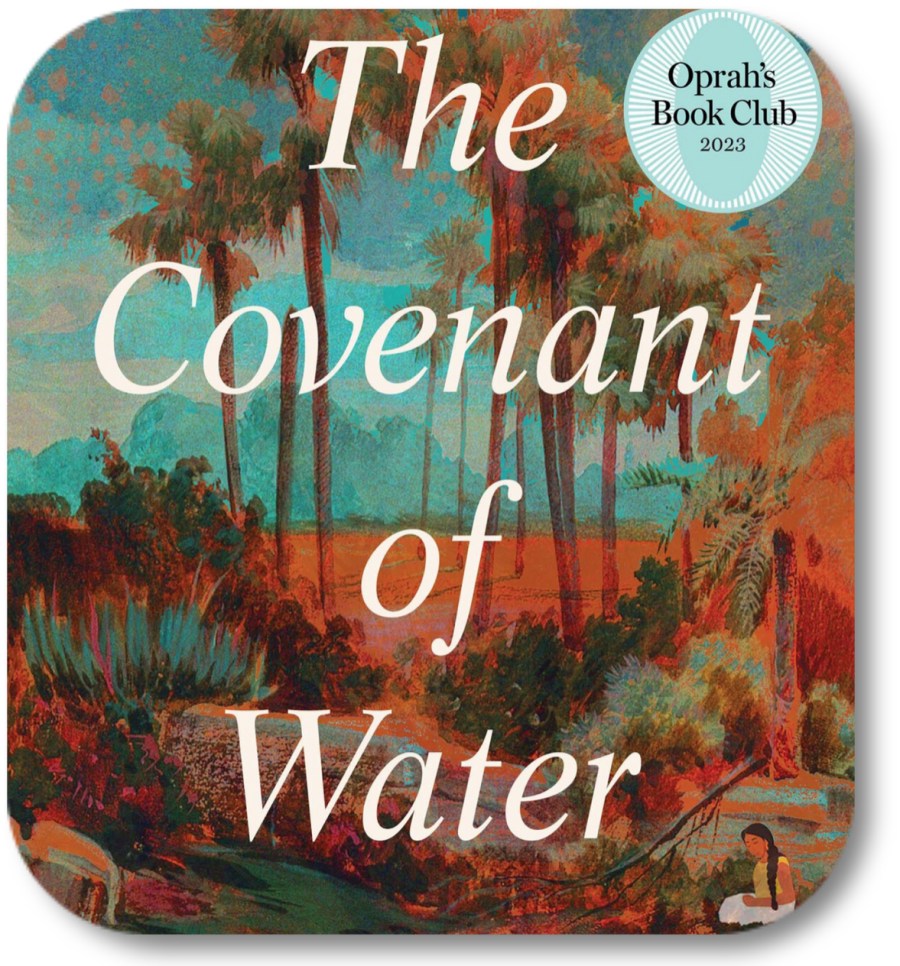
by Abraham Verghese (a summary by Pat Evert)
PART I
- Always… 1900, Travancore, South India
“The saddest day of a girl’s life is the day of her wedding,” her mother says. “After that, God willing, it gets better.” Losing Dad was the saddest day of her life. How could marriage be worse? She imagines his reply. A father’s worries end with a good husband. I pray he’s that. He promises us this in the Gospels. “I am with you always, even unto the end of the world.”
- To Have and to Hold… 1900, Travancore, South India
The journey to the groom’s church takes almost half a day. She realizes that she’s going so far away it won’t be easy for her to visit home again. What must it feel like to be forty years old? He’s older than her mother. “But this is just a child!” she hears him exclaim. The runaway groom is convinced to return and marry her.
She has a new house-name, a new home, unseen, to which she now belongs. She must renounce the old one. The home of the young bride and her widower groom lies in Travancore, at the southern tip of India. Somewhere in the Indian Ocean, da Gama captured and tortured an Arab pilot who led him to the Spice Coast—present-day Kerala. Did the idiot not know that fourteen hundred years before his arrival in India, Saint Thomas—had landed just down the coast on an Arab trading dhow? Almost two thousand years later, two descendants of those first Indian converts, a twelve-year-old bride and a middle-aged widower, have married. The grandmother is certain of a few things: A tale that leaves its imprint on a listener tells the truth about how the world lives, and so, unavoidably, it is about families, their victories and wounds, and their departed, including the ghosts who linger; it must offer instructions for living in God’s realm, where joy never spares one from sorrow.
- Things Not Mentioned… 1900, Parambil
Five hundred acres. The home she’d known till yesterday sat on barely two. The bride stared at what would be her home for the rest of her life. Why up there? Why not by the stream? Or by the river that brings visitors, news, and all good things? She’s awakened by an elephant. She’s surprised that the nostrils look so human, fringed by paler freckled skin, as delicate as a lip, yet as nimble and dexterous as two fingers. Hot exhalations puff down on her like benedictions.
- A Householder’s Initiation… 1900, Parambil
Damodaran is his own boss. I tease Unni that Damo is really the mahout, even if he lets Unni sit on top and pretend to steer him. Long before, they heard terrible cries. Trumpeting. The ground shook! The sound of trees cracking was like thunder. My father thought the world was ending. At dawn they found young Damodaran just over there, on his side, one eye gone, bleeding, with a broken tusk sticking out between his ribs. The bull elephant that attacked him must have been in musth. The thamb’ran tied a rope around that tusk and then, standing far away, he pulled it out. You’ve seen the tusk? It’s in thamb’ran’s room. Damodaran bellowed in pain. Thamb’ran—so brave he is—climbed up onto Damo’s side and plugged the hole with leaves and mud. He poured water little by little into Damodaran’s mouth and sat there talking to him all that day and night. He said more to Damo than he has to all the people in his life put together, that’s what my father said. After three days, Damodaran got up. A week later he walked away. He came to see the thamb’ran’s new wife. That’s what I think.” Under Thankamma’s guidance, she slowly eases into her new life at Parambil. This is the key to a happy marriage. Make your wish and then feed your husband this halwa. Whatever you want will come true!” Thankamma looks at her and adds earnestly, “What I’m trying to say is that my brother is like a coconut. The hardness is all on the outside. You’re his wife, and he cares for you.”
- Husbandry… 1900, Parambil
In the wake of Thankamma’s departure, silence descends on the house.
My Dear Ammachi, May this letter find you in good health. Thankamma was here all this time. I manage well. I cook several dishes. It’s just me and JoJo now. He is my shadow. Without him I think I would miss you so much more. The only trouble he gives me is when I want to bathe him.
Parambil is bursting with mangoes. Shamuel pulayan and his helpers bring in basket after basket. She pulps as much as she can for syrups and jams. With the remaining pulp she makes thera—mango-fruit jerky. Another evening she sees him seated near the well, bathing by soaping and rinsing his body in sections. He doesn’t see or hear her; she’s tempted to run away but is too mesmerized by this sight of his body to move. embarrassment, as if she were the one naked; and a fascination with this sight of her husband fully revealed. He has never looked more powerful and frightening, even if this piecemeal bathing renders him childlike.
- Couples… 1903, Parambil
She’s tired of chastising herself for not bringing a Bible with her to Parambil. It’s unthinkable for a Christian household not to have the Holy Book. Thankamma, who had promised to return, writes that her husband has taken ill and is bedridden, so she has put off her visit indefinitely. As for her mother, three monsoons have come and gone and they have yet to see each other! Her husband asks her a question that he might have asked a long, long time ago: “Sughamano?” Is everything good for you? He looks directly at her. It’s the first time he’s studied her so intently since he stood before her in church almost three years ago. Suddenly she understands why he has kept his distance since the day of their marriage, saying little, but from afar ensuring her needs and comfort; it isn’t indifference but the opposite. He recognizes that he’s someone who can so easily make her fearful. She has a strange impulse to go to him, an urge for affection, for human touch. At home she had daily hugs and kisses, her mother’s body to warm her at night. Here, but for JoJo, she’d wither to nothing. “I miss my mother. And it would be nice to go to church,” she says. When the service is over, “It’s five years ago that she died . . .” he says suddenly, his voice laden with emotion. JoJo’s mother. It’s strange to hear him speak of her with such feeling. “How can you forgive a God,” he says, “who takes a mother from her child?” studying his young wife who wears the clothes of his late wife, as though seeing her for the first time. “JoJo has no memory of his mother.” “That’s all right,” she says. “With her blessing, I’m his mother now. She aches for him, a man who won’t travel by water. All water is connected, and her world is limitless. He stands at the limits of his.
She’s in the arms of the man she married almost five years ago. She thinks of the quiet ways he’s attended to her needs, from arranging for the newspaper to escorting her to church for the first time, and now walking her to the boat jetty every Sunday. On this night during dinner he conveyed his feelings directly through precious earrings that are the sign of a mature woman, a wise wife. Until that moment, they had never touched. She rejoices as it dawns on her that she has survived the ordeal. She recognizes that she has blundered into full womanhood. In the days that follow she feels free to say much more to him at dinner, her feelings, and even her memories, without worrying about his response. After that night, all distance between husband and wife vanishes.
- A Mother Knows… 1908, Parambil
“I worry about my mother,” she says at last, weeping, relieved to finally confess what she has kept from him. “I know in my bones she is being mistreated, even starved.” She’d forgotten her mother’s tall forehead and her pinched nose, both of which are exaggerated because she’s so thin, her hair white, and her cheeks collapsed from missing molars. It’s as though fifty years and not eight have gone by. Mother and daughter cling to each other, their roles reversed: it’s the mother returning to the safety of her daughter’s arms, crying into her bosom, no longer hiding the misery of the intervening years. I was so embarrassed, because your uncle wasn’t pleasant—didn’t even offer water. Then she pipes up behind him to say I owed them money for . . . for breathing, I suppose. Your husband raised his finger.” And she holds up a digit as if testing the wind. “‘Not another word,’ he said. ‘This isn’t how my wife’s mother should be living.’ “My little girl is a woman now—My goodness, molay! You’re with child!” Early the next morning thamb’ran arrives. He has walked for eighteen hours and over fifty miles. She takes his hand and puts it on her belly, and smiles at him. He’s puzzled. Then, ever so slowly, understanding shows on his weary features and he smiles. The girl who shivered at the altar, who now lies beside her husband, who is now with child, cannot see that one day she will be the respected matriarch of the Parambil family. JoJo has christened her, “Big Ammachi.”
- Faith in Small Things… 1908, Parambil
With the birth of her daughter her previous life is swept away. JoJo swings on a vine from a tree and lands in an irrigation ditch and drowns. She’s named this thing that she has sensed from the time the marriage was proposed: the whispers about drownings running in the family, the house built away from water, his distaste for rain, his strange way of bathing—the very things that afflicted their son. The Condition. I need to know what you know. Why was JoJo so fearful of water? Why won’t you, my husband, get on a boat? Does Baby Mol have the Condition too?” She understands at once that it is a catalog of the malady that has shattered the Parambil family, this is a secret document, hidden in the rafters, to be viewed only by family members, and only when they absolutely must see it. Using JoJo’s name printed on a branch as anchor, she sees that the Parambil lineage goes back at least seven generations (not counting the slips of paper) and forward two. Her husband cannot read! “A cross over water. A sign they died by drowning.” He says, “Is Shanthama there? My father’s older sister?” She finds her, and points: the cross on water is by her name. “She drowned before I was born.” “There’s a death by drowning every generation,” she says, tracing with her finger. A few of the crosses have annotations, and she reads aloud: “In the lake . . . the stream . . . the Pamba River . . .” Her husband points with his chin in the direction of their sorrow. “Irrigation ditch.” It will be her task to write those words. “She never let me go to the church school because it was across the river. My brothers and Thankamma locked me up. Out of love, they claimed! But it was out of fear. Under JoJo’s name, she writes the year of his passing. She draws the three wavy lines, easy enough to do with her trembling fingers. How cruel, how viciously unfair that JoJo should die from the one element he worked so hard to avoid.
PART II
- A Fish under the Table… 1919 Glasgow
Digby’s mom cleans houses when she can; an invalid herself, she’s hired to care for invalids. Nana hounds her daughter. “Get yirsel’ oot. We’ve nae coal, and gey little food. If ye’te beg, if ye’te spread yer legs, do it. That’s how you got yirsel’ into this mess.” In the end, she disappoints him. By then he’s almost a man, with a Carnegie College scholarship, secured against all odds. He plans to study medicine, drawn as he is to the body and its workings. The smell in the room tells him that she’s soiled herself. She dangles from a rafter, her toes barely off the ground. His school tie bites into the blue flesh of her neck. This is what he feared, though he never dared put words to it. The polis take the body down. The neighbors gawp at the sheeted form. His mother’s soul has been dead for years and her body has now followed.
- Caste… 1933 Madras
They’re out of the Suez Canal. He’s never seen this confluence of waters, never discovered for himself that the English Channel, the Mediterranean, the Red Sea, and the Indian Ocean, despite their individual personalities, are one. All water is connected and only land and people are discontinuous. Digby, now a doctor, couldn’t shed the accent entirely but one could soften it. Not that such efforts have fooled Mrs. Simmonds, who largely ignores him. Now he overhears her say to the diner across from her, “We English know what’s best for India. When you get there, you’ll see.” Digby fell in love with surgery. Outside of Glasgow there wasn’t a chance. So he joined the Indian Medical Service, hoping to develop as a surgeon. He had lived under the yoke of British rule from birth, a victim of a caste system. “We’ve been doing the same thing to each other in India for centuries. The British just came along and moved us down a rung.” The only industry that thrived in Glasgow was violence. As a houseman, Digby sewed faces that had been expertly sliced by the warring razor gangs, etc. What he couldn’t forgive was that after all his slaving, after his singular and almost maniacal devotion to surgery, he’d come to the manned door and was denied entry. When he disembarks in Madras, he feels he’s arrived on a new planet. The city has a population of six hundred thousand. The senior official gives his subordinate an impatient look, stamps Banerjee’s papers, and lets him leave. Banny’s gaze falls on Digby. His hooded eyes have turned hard as stone, expressing the dogged resentment and the unwavering resolve of a subjugated nation that bides its time.
- Two Big Ones… 1933, Madras
Longmere Hospital, his new place of employment. Muthusamy is to be Digby’s cook and housekeeper. Licentiate Medical Practitioners (LMP’s) pass an abbreviated two-year diploma course and can practice medicine. “But it’s India, you know. Can’t do without them.” Before he knows it, Digby is scrubbed, gowned, and gloved. A scrotum ballooned beyond the size of a watermelon, now reaching the kneecaps. The penis is buried in the swelling like a belly button in an obese abdomen.
- Magnification… 1933, Madras
He’s ashamed to realize that here in British India, he’s white and that puts him above anyone who is not. “We have so much filarial infection in Madras. It clogs the lymphatics.” Digby immerses himself in running the native surgical wards. His LMPs, Peter and Krishnan, are masters of the minor operations: hydroceles, circumcisions, amputations, urethral strictures, draining abscesses, removing lipomas and cysts.
- The Art of the Craft… 1934, Madras
Aavudainayaki waits, unwavering in her determination that “Jigiby Doctor” take out her goiter. She earns her keep on the wards by being a willing helper to Matron and the nurses, and a support to new patients. She has become family. “I’ve assured her that the white man only is performing the surgery. I am merely assisting the great Jigiby Doctor.” Aavudainayaki’s goiter extends down into the chest; not even his long fingers can retrieve it. Digby kept vigil by her side through the night, but swollen as though the goiter has returned with a vengeance! Great surgeons take care of their own complications,” says Ravi.
- A Fine Catch… 1934, Madras
Editorials opine that if Indians are to be conscripted into the British Indian Army to fight again, they won’t settle for anything less than freedom in return. “I lost my older brothers in that war,” says Honorine. “It was the death of me poor mam. If women were in power, you’d not see us sending lads to their death.” If there’s war, Digby will be posted to a military unit. Digby is an attractive, eligible bachelor, but he cannot risk love.
A patient, Lena Mylin, her inflamed gallbladder has met Digby’s fingers. He doesn’t mince words. “I’m pretty sure a stone is obstructing your gallbladder and now it’s distended with pus.” He avoids the word “gangrenous,” so as not to alarm them further. “It’s urgent we operate.” He removes the infection, stones and gangrenous parts. After a pint of blood, Lena’s blood pressure rises and color returns to her face. “Whose blood was that?” Franz asks. “Mine,” Digby says. Franz roars at the retreating figure of Longmere’s chief surgeon: “Come back, you fucking coward! Who are you calling irresponsible? You’re not half the surgeon Kilgour is!”
- The Craft of the Art… 1934 Christmas, Madras
Digby goes to a Christmas dinner party to show good will. He meets Claude’s wife who discusses art with him. “You won’t make my mistake, will you?” Her gaze is soft and smiling once more, her wistful expression gone. “What mistake is that . . . Celeste?” “The mistake, Digby, of choosing to see more in your future mate than the evidence has already suggested.”
- A Race Apart… 1935, Madras
Owen and Jennifer Tuttleberry are Anglo-Indian friends of Honorine’s, and now of Digby’s. Jennifer works as a switchboard operator, while her husband is a locomotive driver. Digby is struck by the contrast: an enclave for Anglo-Indians that excludes natives, yet whose inhabitants are themselves excluded by the ruling race with whom they align. But then, he’s in the same spot. Digby Kilgour: oppressed in Glasgow; oppressor here. The thought depresses him.
- Stone Temples… 1935, Madras
Celeste’s driver parks outside Digby’s quarters. “A few months after I left India my parents died. Cholera,” she says matter-of-factly. “I was orphaned too,” he says shyly. They walk north through the dunes. Facing them is a massive yellow sandstone boulder, fifty feet tall and twice as long, its surface a sprawling narrative of gods, humans, and animals. “Descent of the Ganges. That cleft is the Ganga.” Digby reaching for his sketchbook. “Might we stay here a bit?” “Of course! I have my book.” “My word, you’ve been busy.” He hasn’t exaggerated the breasts any more than the sculptors have. “Digby, I’m speechless. Such a talent!” She turns to a page of a woman with tinted glasses and the tiniest gap between her lips that sip the air as she sleeps. The ancient artists were devotees above all else. Without love of their subject, they’d just be cutting stone; their adoration is what brings it to life. “You have a gift . . .” Has Claude ever come close to paying her this kind of a tribute? She’s overcome by a desperate urge to break free of her present life. On the drive back home she worries about her companion. They’re both cut from the fabric of loss.
- Pulsatile… 1935, Madras
Digby vows not to think of her. He thinks of her all the time. She’s chiseled in his memory like a rock sculpture.
As Digby passes the operating theater anteroom, blotting away the stinging sweat with his kerchief, he recognizes a patient on a gurney. “It’s nothing,” Jeb says, embarrassed to run into Digby. “A bloody abscess. Thought I’d get it drained by Dr. Arnold. As Digby feared, pulsatile, lifting and spreading his fingers with each heartbeat. I’m concerned, Dr. Arnold. Could this be an aneurysm and maybe not an abscess?” Then Jeb’s heart has stopped because there’s no longer enough blood to pump.
- In Glass Houses… 1935, Madras
Through the church window, Digby has a view of the adjacent cemetery. Claude, how many souls have you sent here? Digby shudders now as an inner voice warns him: Tread softly, Digby. No surgeon is infallible.
To the Editor, The Mail: The death of Jeb Pellingham, Olympic hockey hopeful, is a national tragedy. But the way his family is being treated is a national disgrace. Mr. Pellingham died because of the negligence of a surgeon at Longmere Hospital. Celeste lets The Mail fall to the table. Suddenly, she’s in a glass house with all of Madras looking in. The Letters section of The Mail is more popular than the front page. Claude’s brothers are ashamed and ask him to not contact them. Claude threatens Celeste with divorce. She visits Digby. The artist sees in the model a grander beauty than she sees in herself.
- Forewarned… 1935, Madras
Four days after they become lovers, Celeste rides to Digby’s quarters once more. She is seeing Madras through a new lens, no longer the Celeste she was five days ago. “Vande Mataram”—Hail to thee, Motherland—the slogan on the lips of the whole country. The sleeping giant is waking. Does it matter that she feels more Indian than British when she has all the privileges of the latter? Yet somehow, Claude’s craven, despicable lie to save his skin has become true—she is having an affair with Digby. She’s grateful to Digby for awakening the part of her that lay dormant, the truest part of her. He did it by adoring her in his portraits, by making her feel human again, by loving her. Does she need his validation, or the validation of anyone, for that matter, in order to exist?
At the Madra’s Club Digby receives a letter.
You should know that Arnold plans to file for divorce and name you as a co-respondent. By naming you, Arnold makes your testimony suspect.
- Still Life with Mangoes… 1935, Madras
“Claude, your only real talent used to be that you could hold your whisky. I don’t know why I stayed with you so long.” And she walks out and mounts her bicycle. There is someone else she must be honest with. “I want the divorce . . . Digby, I’d say I love you too. But I have no idea who ‘I’ is. I need to know. I want a life of my own, and on my own in order to find out. Janaki and I, if left to ourselves, can live very simply and happily.” Digby digests her words. She doesn’t need him—isn’t that what she’s saying?
PART III
- What God Knew before We Were Born… 1913, Parambil
In the aftermath of JoJo’s passing, Big Ammachi is struggling to find her rhythm. Parambil has lost its sole male heir. Her husband shows up silently outside her door at night while her mother and the baby are fast asleep. She understands: this is about Parambil needing a male heir too. One night, she awakes to see her husband once again at the foot of her mat, silent. She didn’t realize how much she had missed this closeness. Their task is both tender and urgent. Fourteen months pass, and many visits to her husband’s room until at last she misses her monthlies. Then she miscarries. She’s stunned. “Take nothing for granted,” God reminds her, “unless you want to feel its loss.” God only knows why miscarriages happen. God only knows—but doesn’t choose to explain. When Baby Mol is five, Big Ammachi arranges for the baptism, She asks Dolly Kochamma to be godmother. Even the little girl’s father, who has long ago renounced God, must see the divine in her ready smile and generous nature. Children develop like Baby Mol, the thyroid. The tongue. The broad face. The hoarse voice. The thickened skin. “She’s a smart child, but she’s slow to learn what others her age know. She’ll always be a child. What happened to Baby Mol will not happen to the next child. I promise you that.”
- A Change of Heart… 1922, Cochin
Dr. Rune heads to Bethel Ashram in Travancore. An abandoned monastic retreat. He is burning with a mystical sense of purpose. His first night alone is spent in the only one of the six crumbling redbrick buildings that has two intact walls and a sliver of thatch overhead. He awakes to see two terrifying faces, inches from his, their features exaggerated by the candle flame held under their chins. Sankar was a new father when he noticed a welt on his face, then more over the ensuing months. His hands turned numb. “I couldn’t hold my carpenter’s pencil. My wife’s brother threw me out. The whole village threw stones at me. My wife watched.” Bhava’s husband made her stay indoors. “‘Even the dogs run away from you,’ my husband said. When her fingers curled to her palm, her husband chased her out before she could say goodbye to her children. The mind must get scarred from being rejected in this manner. These two have died to their loved ones and to society, and that wound is greater than the collapsing nose, the hideous face, or the loss of fingers. Leprosy deadens the nerves and is therefore painless; the real wound of leprosy, and the only pain they feel, is that of exile. In a month, there is a signboard in two languages on the gate: SAINT BRIDGET’S LEPROSARIUM. The name honors his beloved Sister Birgitta of his Malmö orphanage. Thambi, Esau, Mohan, Rahel, Ahmed, Nambiar, Nair, and Pathros join his two angels. Like a teak forest with underground roots, the lepers have a network. Easter at the Thetanatt house marks the beginning of a lasting friendship. Rune becomes a regular dinner guest at the Thetanatt home on Sundays. Salomon Halevi ships Rune his stored surgical instruments, and now he has a clinic and a rudimentary theater. To raise money, Rune writes many letters. The Paradesi Jews fund the brick kiln, while a Lutheran mission in Malmö pays for the sawmill and a small carpentry workshop. Mr. Shaw, whose wife Eleanor was Rune’s patient, arranges the gift of two dairy cows and a stack of lumber.
- A Stranger in the House… 1923, Parambil
When she is thirty-five, she’s pregnant again. It feels like a miracle. Has it really been fifteen years since she brought a child into the world and three miscarriages? Her baby boy, his baptismal name is Philipose. A few weeks after she gives birth to Philipose, her husband takes to bed for five days with a crippling headache, along with alarming projectile vomiting. He cannot quite close the left eye, he’s now stone deaf in his left ear. She wakes up in the middle of the night and gets up to look in on her husband as has been her habit for some months now. He’s gone. Her silent husband who’d been so steadfast in his love for her. He expresses his love for her the only way he knows how: through his silence.
- Invisible Walls… 1926, Parambil
Ammachi tells Philipose, “Never go swimming alone?” They make a vow together. She tries to explain the caste structure simply to Philipose.
- The Brahmins—or Nambudiris, are the highest caste, the priestly caste, and like European monarchs they owned much of the land by divine justification. They stay free at guest houses maintained at state expense.
- The Nairs are upper-caste, and like the Nambudiris consider themselves polluted by contact with lower castes; they are the overseers for the vast Nambudiri holdings, but these days they are landowners themselves.
- On a lower rung, come the Ezhava—the craftsmen who were traditionally toddy tappers but increasingly are in the coir business, or are landowners.
- The lowest caste are the landless laborers: the pulayar and the cheruman. Christians haven’t rid themselves of casteism. In Parambil, just as in every other Christian household, a pulayan never enters the home.
- Up Is Good… 1932, Parambil
“I’ll never be able to swim for a reason, isn’t that so? My father also couldn’t swim for a reason. What is the reason, Ammachi?” “I will tell you what I know.”
- The Great Lie… 1933, Parambil
Big Ammachi can’t help feeling jealous. Once her son abandoned his efforts to swim, he’d turned his curiosity with a vengeance to learning about everything else in the world. His hunger for knowledge long ago eclipsed what Parambil could offer. “I know my English will improve because he won’t let me use a word of Malayalam.” Halfway through the book, Big Ammachi wants Philipose to ask Koshy Saar if this Moby-Dick isn’t all made up. “It’s entertaining. But isn’t it one big lie? Ask him.” Koshy Saar’s response is indignant. “It’s fiction! Fiction is the great lie that tells the truth about how the world lives!”
- Morning Miracles… 1936, Parambil
On a stormy weekday, Big Ammachi is full of misgivings as her teenager slouches to school and into the early-morning darkness. For twenty-eight years of Baby Mol’s life, the sun has never failed to come up, yet every morning she’s ecstatic at its return. To see the miraculous in the ordinary is a more precious gift than prophecy. Philipose rescues a choking baby on his way to school. Just like that they’re in the clutches of the river, sailing down the center at breakneck speed. They are flying past the stationary trees, moving faster than a speeding train. Clutching the baby, his legs wobbly, Philipose scrambles up the steep, slippery laterite stairs cut into the bank, the boatman breathing heavily behind him. The steps end at a wooden gate.
PART IV
- Dinosaurs and Hill Stations… 1936, AllSuch Estates, Travancore-Cochin
Digby’s memory of the inferno, of Celeste twirling in the flaming silk sari like a child playing dress-up, of the smoke searing his windpipe as he screamed out to her. He sees Celeste’s face, masked in melting fabric, contorted with fear, as he battles to get to her. No longer recognizable as Digby from Glasgow, Digby the faithful son, Digby the single-minded medical student, Digby the surgeon with the good hands. Every face that hovers over his bed—Honorine’s, Ravi’s, Muthu’s, and the probationer’s—pierces him with shame. Shame for disappointing them. Shame because he is Digby the adulterer, Digby the murderer. On the sixth day after the fire, while it is still dark outside, he rises. Wincing with pain, he takes off the bandages. The back of his right hand frightens him: from the wrist down to the knuckles the anatomy is laid bare, the shiny ribbons of the tendons are displayed, framed by blackened flesh. Were it not for the dark eschar forming on the surface, it would look just like an illustration in his Gray’s Anatomy. It is painless, and therefore must be a third-degree burn—the deepest kind—taking the cutaneous nerves with it. During the fire he must have reflexively made a fist, exposing the dorsum of his hand and sparing his palm and fingers. On his left, he has burns of both palmar and dorsal surfaces, the skin a fire-engine red, oozing and blistered, and the fingers like sausages, twice their usual size. These must be first- and second-degree burns, the nerves intact, and thus excruciatingly painful. The skin here will one day regenerate, albeit with scarring. The same cannot be said of the right. Claude Arnold, who killed Jeb, will get away because the blessed star witness was shacking up with the butcher’s wife. The shame, he says simply, was more painful than the burns. Lena must tell him of a friend who comes up from the plains to the mountains on weekends. “He’s a surgeon. He specializes in hands.”
- The Greater Wound… 1936, Saint Bridget’s
The normally voluble Rune has managed—by his silence, by his touch, by his presence—to convey a message: Before we treat the flesh, we must acknowledge the greater wound, the one to the spirit. “Will I ever operate again?” The voice is like dry twigs cracking underfoot. “Your left, I will do right away. I have a trick to release the scar on your palm. It will be functional. Your right . . . ? Well, it was a good try, covering it with those grafts. I propose that you come to Saint Bridget’s. We’ll leave in the morning.”
- The Wounded Warrior… 1936, Saint Bridget’s
When Digby yells with pain, the audience breaks into excited murmurs. “Well, you’ve convinced them you don’t have leprosy,” Rune says. “They scream for many reasons, but never from pain. Your right needs a lot more flexibility in the wrist before I think of operating. But the left? That we make right today, okay?” Every morning and evening Rune works to loosen Digby’s right wrist, torture sessions that leave Digby sweating. The next day, a groggy Digby walks the grounds, his hand imprisoned in his own marsupial pocket, his elbow, encased in plaster, winging out. As he passes the woodshop they invite him inside. They hold up hands and feet to display Rune’s carpentry on their flesh. He’s struck by the generous reception. He’s one of them, wounded, winged, and disfigured. And they want him to witness their usefulness, even if the world has no use for them. He is overwhelmed by their scarred, skewed faces, their stiff, deformed limbs; he ponders his own situation. He wonders if he’s avoided his fate or found it. Twenty days after the first surgery, Rune cuts the skin all around the entrapped hand until it comes free, but now sporting its new, puffy, living skin-coat. Honorine visits him. In the morning He’s thrilled by the sight of his right hand with its new skin cover; it makes the stinging pain on both his chest and flank bearable. “Yer human! Flawed. Ya’ think you’re alone. You deserve to be forgiven. We all do. I don’t know if you will ever forgive yourself, but you must try.” One can witness a spirit heal, Rune thinks, just as much as one can see a wound heal. It has begun to feel like home. He’s a pariah in a community of pariahs. “I feel I’m with my tribe here, Rune.” “Hands are a manifestation of the divine,” Rune says. “Our hands have thirty-four individual muscles—I’ve counted. But the movements are never isolated. It’s always collective action. We need to free your hands, Digby, by getting you started on natural, everyday movements—especially the right hand. So, what do you enjoy doing with your hands?” “I liked drawing, painting.”
- Hands Writing… 1936, Saint Bridget’s
Digby’s new therapist walks over in the afternoon from the Thetanatt house, her ink-black pigtails bouncing off her shoulders, art supplies in her schoolbag. A nine-year-old girl. Elsie sets out paper, hands Digby a charcoal stick, and sits beside him to do her own work. Digby picks up the sketch Elsie left behind. The gift Elsie possesses is breathtaking. The young artist shows no revulsion, no recoiling from the subject—without judgment she has rendered Digby’s hand the way it appears, and accepted it for what it is. He has yet to. That evening, a letter comes from Honorine; his clumsy efforts with the letter opener wind up tearing it down the middle. The commission ruled that Claude Arnold be dismissed from the Indian Medical Service. Jeb’s family will be compensated generously for his wrongful death. And what are you, Digby? Something less than a murderer? The torn halves of the letter remind him that his own hands are better at destroying than anything else.
He finds Rune on his back, unmoving against the concrete, a hand clutched to his chest, a bar of Saint Bridget’s homemade soap still in his fingers. The heart of the beached Goliath, the great Nordic heart is still. Despite Digby’s ministrations it will not restart. Those who knew and loved the giant Swede come to pay their respects, even if it means crossing the threshold of the leprosarium for the first time. The chapel air is redolent with the scent of fresh-cut jackwood, shaped in their own sawmill for the casket. Rune’s pallbearers are his flock, Sankar and Bhava at the head, limping, on crutches, swaying, shuffling forward in ungainly procession as they carry him to the cemetery in the clearing just within the front wall. Hands that are missing fingers, hands curled into claws, and hands that are not hands but clubs of flesh ease out the ropes so as to inter the mortal remains of the saint who dedicated his life to making theirs better. The laments of the flock tear at the firmament and break the hearts of the onlookers who, for the first time, can see past the grotesque disfigured faces and recognize themselves. At night, in the privacy of the bungalow, Digby’s grief spills out. Rune was not just his surgeon, but his savior, his confessor, and the closest he’d ever had to a father.
- Hand in Hand… 1936, Saint Bridget’s
Philipose, baby in his arms, drenched through wondering if in fact he really has drowned. The sign reads: SAINT BRIDGET’S LEPROSARIUM. “This child is dying,” Philipose says. “Summon your doctor.” Together, Digby and Philipose access some grace as they press the scalpel tip, hand over hand, into the trachea. They stitch the tube to the skin and close the wound. The doctor says, “Welcome back to the bloody world. Maybe you can do something to change it.”
- The Cure for What Ails You… 1936, Saint Bridget’s
A friend, Chandy, drives Philipose home. A crowd was there thinking the worst. He regales the assembled family with a much-embellished story, speaking with such authority that even Philipose, who was there, starts to believe his version. He ends with “Kochamma, this is a sign from the Almighty that your son must become a doctor, is it not? What a gift.”
- Auspicious Sign… 1937, AllSuch
Digby is with Franz and Lena for every meal; he has driven with Franz all over the estate. He has ridden with Cromwell on horseback, learning the intricacies of tea plucking, of harvesting cardamom and coffee. Early every morning he sketches in a disciplined way for an hour, seeking to restore fluidity, if not grace, to his fingers. His plan is to return to Madras and stay with Honorine. Now at a party in remembrance of Rune, he speaks of Rune’s surgical genius, Digby’s gesturing hands themselves a testament to the Swede’s skill. He even bashfully opens his shirt so they might see the glowing, shield-shaped scar on his left breast.
He and Cromwell are appointed as representatives of a consortium. Somewhere in the clouds is Müller’s Madness. Gerhard Müller was an early pioneer who never put in a ghat road. Sitting on a vast estate that he could never develop—hence the madness. Bernard Müller is selling it all and heading to Berlin, to a homeland that he’s never seen. Digby knows he can’t be a surgeon anymore. He simply cannot imagine doing anything else in medicine. Being a planter is more appealing than the thought of being a general practitioner. Should Müller take the consortium’s offer, the plan is for Digby, with Cromwell as manager, to run the estate, and in time be given a piece of it for his effort. If Müller accepts the offer, Digby will take it as a sign that this is precisely what he is destined to do.
PART V
- Parambil P.O.… 1938-1941, Parambil
After many bus trips by Uplift Master and Parambil achieves the “district village” designation, and with it an infusion of funds from the maharajah’s coffers for “Village Uplift.” The doubters are silenced. Government-paid laborers build culverts and drains so the new roadbeds will not wash away. The new designation brings an Anchal post office and a postmaster on government payroll. The day arrives to inaugurate the one-room office building, whose board reads, PARAMBIL P.O. Uplift Master insists that Big Ammachi, as the matriarch of Parambil, cut the ribbon. The only photograph ever taken of Big Ammachi appears in the paper the next day. She hears God speak to her as clearly as he did to Paul on the road to Damascus. Your husband does see it. He sees you. He’s smiling.
- Geography and Marital Destiny… 1943, Cochin
Philipose had Big Ammachi’s blessing to study literature. He had applied to the prestigious Madras Christian College. Uplift Master took him to the train station.
Shoshamma began meddling in affairs of business that she had always left to him. He decided to punish her with silence. When he tugged gently at her hip, she didn’t roll over. He tugged again. “Is that all that’s on your mind?” she said, in her playful, sleepy voice, her back to him. “After two children, surely we can be done with this.” Did she mean she’d suffered his lovemaking all these years? “Yes, I vow before Mar Gregorios that I will never initiate. From now on, Shoshamma, you must initiate.” At once he knew he’d made a horrible mistake: Shoshamma had never initiated. With her new Christian propriety, she never would! He hardly slept, while she slept the sleep of the sinless. Is the best part of his life already over? It’s as if a rock the size of an elephant has been sitting on his chest, ever since that regrettable night with Shoshamma.
- Labels that Take Away… 1943, Madras
Philipose and the other freshies are like the lowest caste, invisible as they conduct their masters’ menial tasks. He survives the ragging in the hostel through the course of the week. He despises labels that take away. Can’t swim. Can’t hear. Can’t . . .
- Advantage of the Disadvantage… 1943, Madras
Crushing, Philipose has had aplenty. He’d wanted to sail the seas like Ishmael, but the Condition dashed that dream early. He told himself he’d explore the world by land, but here he is in Madras and already eager to return. He’s had the crushing. What can success look like now? Janakiram has the answer. “Success is not money! Success is you are fully loving what you are doing. That only is success!” With his tuition refund he buys a radio and two trunks of books. He isn’t retreating to Parambil P.O. or fleeing the larger world. He’s bringing it to his doorstep.
- All Getting Along… 1943, Madras to Parambil
It has been his feud with water—the Condition—that has felt like the real handicap. Never his hearing. “I too was sent away from college. Issues with my hearing . . . they claim. But it’s all right. It’s probably a blessing. I won’t let it stop me. One thing I know, I love to learn. I love literature. With these books I can sail the seven seas, chase a white whale . . . I’m luckier than Ahab. I have been bent and broken but I hope into better shape.” We have no practice, he thinks, of seeing our real selves. Even before a mirror we compose our faces to meet our own expectations. A lifetime ago, a schoolgirl named Elsie had sketched him as he took his first-ever ride in her father’s Chevrolet. If Young Miss is none other than Chandy’s daughter, grown up and even more skilled with her pencils, then surely fate brought them together. He revisits their exchange on the train, and the way she looked . . . her wordless goodbye, her parting smile indelible in his memory. I won’t give her up. “But, oh, Elsie, please wait. Give me at least a few years.”
- To Thine Own House… 1943, Parambil
On a bright, sunny morning, not even a month after Philipose’s departure, Big Ammachi sits down with the Manorama. JAPANESE PLANE BOMBS MADRAS. MASS EXODUS FROM CITY. “God help me, how do I find my son?” Baby Mol bounces up and down excitedly, distracting and annoying Big Ammachi. To add to that, a bullock cart rattles up to the house. Philipose is on it. “Monay, you can never disappoint me. I am so glad you are home. God heard you. You weren’t meant to be there.” He recounts every detail of his meeting Chandi’s daughter as though he’s reciting a mythical tale, from the time he boarded to when she put that drawing in his hand. “Ammachi, I’m going to marry her one day,” he says quietly. “God willing.”
- In a Land of Plenty… 1943, Parambil
Philipose was lucky to get out of Madras when he did. He’s haunted by the faces of the starving who show up every day. Philipose quotes Gandhi: “There are people in the world so hungry, that God cannot appear to them except in the form of food.” An accompanying photograph in the Manorama shows Sultan Pattar, Uplift Master, and Philipose standing behind Pattar’s Army, the youngest of whom is only five, the oldest fifteen. The article triggers donations, volunteers . . . and more hungry people. Inspired by their example, other Feeding Centers open up across Travancore. Philipose writes an article for the magazine.
But I thought, Why complain? I’m soon leaving this world. The moral is give as generously as nature gives.
After his first published story, the Manorama editor is willing to see more. In that year and the next Philipose has a few more of his Unfictions published. Uplift Master brings electricity to Parambil P.O. Philipose fires up the radio that has sat idle for so long. He has brought the world to his doorstep.
- The Engagement… 1944, Parambil
Chandy is interested. They can proceed to the pennu kaanal (interview). “Elsie, I want this. I wanted to be sure that . . . that you want it too. That it’s not being forced on you.” She turns and smiles, wordlessly conveying, Yes, I want this. “I thought that of all the men I might marry, you would take my art, my ambition seriously. If I must marry, who will respect me as an artist and allow me to be what I think I was meant to be? I thought you would. When the proposal came, I was happy. I thought, here’s someone who sees the world the way I do.” His heart leaps, his pulse pounds, not in fear or panic but in recognition of having found what it sought. He’s proud of himself. The Ordinary Man has managed something extraordinary.
- Wedding Night… 1945, Parambil
After six years of war, the Great War, the British never appointed any Indian officers, worried that they’d be training future rebel leaders. They were right. Now the returning Indian officers are men decorated for their valor; men who witnessed soldiers under their command die to free Abyssinians, to free the French, to free Europe of Hitler’s yoke. They won’t abide anything less than freedom for India. Two hundred thousand British civilians in India could be slaughtered overnight by three hundred million natives.
Philipose and Elsie wed. Damodaran pays a visit, who understands the significance of the occasion. When they emerge from the car, Damo nuzzles Big Ammachi, who reaches up to stroke him. Then Damo hooks Philipose roughly to him and musses his hair as the Thetanatt party gasp. Damo places the jasmine garland that Unni hands him over the bride’s head. His trunk lingers, sniffing her cheeks and neck as Elsie laughs in delight. ‘I don’t think if I had married anyone else, I would feel as safe as I do with you.’ “I want you to be happy here, Elsie,” he whispers. “Any wish that I can fulfill, just say . . . Anything.”
- Fear the Tree… 1945, Parambil
Construction begins. Their bedroom (once his father’s bedroom) is enlarged to thrice its size. A third of it becomes Philipose’s study. For Elsie’s studio, they pour cement to make a patio. “Being sketched by you gives the model a profound insight into who they really are.” Elsie is an artist of the highest rank, a painter with her own vision. Philipose ruptures the evening quiet with a cheer that brings everyone to the radio. “Nehru is free! After nine hundred and sixty-three days in prison! It’s the acknowledgment by the British that it’s over.” He pictures Brits in the remaining colonies—Nigeria, Burma, Kenya, Ghana, Sudan, Malaya, Jamaica—sitting by their radios, nervous, because Britain is soon to lose the jewel in the crown. Negotiations for a free India are already underway. He says, “How did a small island wind up ruling half the globe? That’s what I want to know.” In August, in the space of three days, atomic bombs level Hiroshima and Nagasaki. A hundred thousand people die in an instant. Going to Madras, brief as his stay there was, gutted him. He had to come home to reclaim himself, to reconstruct his being. His fears are irrational, and he’s ashamed. He simply cannot admit them to her without diminishing himself, without sounding like a weakling, a complete failure as a man and husband. His thoughts are bouncing around his brain, hurting his head. This allusion to his other handicap further shames his shrinking, retreating, anxious self, and an ugly defensive and reflexive response bubbles out before he can pull it back. “Elsie, I forbid it,” says someone he doesn’t recognize. It’s on the tip of his tongue every moment they are together to say, “Forgive me, I’ve been an idiot.” But a belligerent voice inside him warns against it, or else he’ll be making concessions for the rest of his married life. He watches helplessly as his wife is driven away. Over the next week he has time to get accustomed to the shock of Elsie being pregnant, of her absence, of his idiocy. “Elsie, I’m sorry. I was wrong to behave as I did. After Madras . . . things that take me out of my routine make me feel unsettled.
- Rain Gods… 1946-1949, Parambil
Baby Ninan arrives in the year of our Lord 1946. Big Ammachi thinks it’s too early, too small, too blue, too cold, and the father isn’t here. Elsie sequesters herself from visitors for the next two months. Baby Ninan’s life mission is very simple: UP! He takes every opportunity to climb. Big Ammachi knows that he’s like his grandfather and his father in another way: water poured over his head disorients Ninan, sends his eyes bobbing. He has the Condition. On August 14, 1947, at the stroke of midnight, when the world sleeps, India will awake to life and freedom. But India’s awakening proves bloody. Twenty million Hindus, Muslims, and Sikhs are forced to uproot themselves from the lands where their families have lived for generations.
The Portrait of Lizzi won the gold medal at the Madras exhibition. And the Decency Kochamma portrait got Honorable Mention. The news is in the Indian Express the next day. The Express reporter asks why it has taken so long to recognize this artist’s skill. By using a name that didn’t reveal her gender, she won the gold medal. Philipose fulfills a promise and removes the plavu (jackfruit tree). The monsoon rains come faithful after all.
- The View… 1949, Parambil
Baby Mol is now forty-one years old, not a baby at all yet always a baby. Elsie screams a full-throated shriek of terror that chills his blood. Baby Ninan. Suspended upside down, his face white, bloodless, frozen into a surprised expression, his body crooked in a manner that defies the senses. He is high in the plavu, impaled on a branch. Philipose limps on what are clearly broken ankles. Shamuel bears in his arms with great solemnity his late thamb’ran’s last-born’s firstborn, who now joins his ancestors in the blessed hereafter. After the burial, without asking anyone, Shamuel has cut down the remnant of the plavu. The air between Philipose and Elsie is thick with the bile of recrimination and contempt. She dares him to accuse her, and he dares her to give words to what she’s thinking. He senses her primal urge to launch herself at him, strike him, claw at his eyes, flay his cheeks with her nails. He can see the trajectory of this assault in his mind’s eye, and his own feral leap to block the charge with his hands, to shove her away, curse her for wanting what she should never have wanted, accuse her of killing his son, condemn her for coming into his life and bringing nothing but tragedy.
PART VI
- Hazards in the Hills… 1950, Gwendolyn Gardens
It has been fourteen years since he acquired Müller’s estate for the consortium that consisted of the friends who had gathered around the Mylins’ dinner table on a New Year’s Eve. Digby named his 900 acres, Gwendolyn Gardens, after his mother. He’s forty-two now. A woman comes to him with a slit of a wound in the belly of its very pregnant and utterly frightened mother. The tiny, clenched hand looks intact, uninjured. The mother, in her twenties, lies on the table, conscious—quite alert, in fact. Behind that façade, this lovely woman is terrified. And embarrassed. Digby brings the glowing end off a cigarette to those infant knuckles, the red-hot tip a tenth of an inch from its skin. The tiny fist makes a slithery retreat into its watery world, snatched back in response to the noxious insult. As quickly as he can he passes the needle through the wall of the womb. The mother doesn’t flinch. He puts in four more uterine stiches. “My husband lost his mind suddenly last night, Doctor. He thought I was the devil.”
- The Willingness to Be Wounded… 1950, Parambil
Ninan has been dead six months, and Elsie gone from Parambil for just as long. Big Ammachi and Uplift Master travel to the Thetanatt house in their somber finest. Chandy is in a coffin in the center of the room, wreaths of jasmine and gardenia around him. The chariot’s wheels are always turning, bringing us closer to the journey’s end, to our sweet home. Elsie wouldn’t let go of Ammachi’s hand; the poor girl looked like a haunted child that was trying to find a place where life could not inflict more pain. And so Big Ammachi offered herself; she offered her arms, her hands, her kisses . . . and her willingness to be wounded. No one is spared the pain. All these people will one day be shades, just as she too will be buried and forgotten. Philipose is down to one crutch. The broken right ankle has healed, but the shattered left heel remains painful. He has become an opium eater due to the pain.
Dearest Elsie,
Baby Mol is dying. Call it starvation or heartbreak, they are really the same thing. As one mother to another, I beg you to visit.
Philipose stares at the wife he hasn’t seen for a year. Gaunt and grey haired.
- As It Once Was… 1950, Parambil
Torrential rain and typhoon-force winds bend the palm fronds into peacocks’ tails before snapping them. Shamuel ventures out and returns shocked: past the burden stone is a new lake with no sign of its far shore. For the first time in Big Ammachi’s memory, it can be seen from the house, stalking the dwelling that her husband made certain was out of its reach. By the fifth week, their awe at nature’s violence gives way to dejection. One night Philipose wakes just before midnight and, out of habit, he pushes aside the curtain and peers out. A stone woman, an apparition perhaps, staring at the sheeting rain. His stomach knots with fear till he recognizes Elsie. Seeing her weeping, he feels pity despite himself. “It’s my fault. Did I already say that? Elsie. Forgive me. The world knows my dignity is gone. My legs are gone. My son is gone. My wife is gone. But as far as who did wrong, that’s mine. Don’t rob me of the only thing that I own.” Feeling a flood of tenderness, he embraces her. She doesn’t stop him. The knotted mundu comes fully undone. I didn’t make that happen. It’s the universe. He wants only to console her, but he’s also overcome with a familiar awe, the old wonderment that this exquisite woman is his wife. Lord of disappointments, lord of sorrows, tell me, why bless me only to take away? This could be the balm they need to make the unbearable bearable. After their loss, they never gave themselves the chance to weep on each other’s shoulders. They’d turned viciously on each other instead. His lips are on hers, but hesitantly. He doesn’t want to force himself on her. He will stop if it distresses her. He imagines she responds. Yes, he tells himself, there was movement in her lips—not passion, but that will take time. He is too far gone, and he collapses into her, and inside her, the barrier between them dissolved. A stranger stares back at him, a soul already departed from this world but granted a backward glance at her former life. She pads out without a word.
- Stone Woman… 1951, Parambil
They learn that hundreds have drowned, thousands are displaced, and cholera and dysentery are rampant. Watching Elsie, Philipose thinks, The God who failed us is making amends, making overtures after urinating on our heads. He feels such lightness. The weight of disappointment is lifted. Baby Mol announces, “Baby God is coming.” His conviction is unshaken: the child in Elsie’s womb is Baby Ninan reincarnated. Baby Ninan is coming back! The weeks and months pass, and Elsie labors steadily on her great stone carving. Philipose understands that it’s a woman on her hands and knees.
- An Antenatal Angel… 1951, Parambil
Anna is a young woman Big Ammachi knows from church. Anna’s husband had vanished, and she and her daughter were struggling. With a new baby coming she could use some help, and if Anna is willing, the arrangement could be mutually beneficial. Elsie is building another sculpture out by her old bathing spot, a place her husband never visits. It began as a bundle of twigs, then grew into a curved wall, and slowly it became a giant bird’s nest. Just when you thought the pain couldn’t get worse, it did. The thread between her and the world snapped, and she had been utterly and completely alone, battling God, battling the miraculous creation that He had allowed to grow inside her, and was now ripping her—also his creation—in two. But it has taken Elsie with it: she is limp, her breathing coarse, her eyes half open and gazing to the left. She is unconscious. They stare helplessly at the torrential hemorrhage. By pinching the womb they stayed the bleeding. “Lord, You saw this coming. You sent me this angel.” “Your daughter,” Big Ammachi says. Philipose mumbles, “God has failed us again.” “A woman risks her life to give birth and at the end a man who’s done nothing—less than nothing—in nine months says, ‘God has failed us’? Yes, God failed us,” she says. “When he was handing out common sense, he overlooked you. If he’d made you a woman, then maybe dung wouldn’t come out of your mouth in place of words! Shame on you! I said your wife lives, but barely. And what you see here is God’s grace manifest in this perfect, perfect child. The baby’s name is Mariamma.” Yes, it is Big Ammachi’s very own Christian name. Mariamma.
- The Issue Is a Girl… 1951, Parambil
Elsie is conscious but confused, and so very weak from blood loss. She looks at her daughter with great tenderness, but drowned out by inexplicable sorrow. She makes no attempt to reach for the child. The child’s father sequesters himself in his room, marooned in his own home, unable to do more than observe through his window. He doesn’t come out, or if he does it is when the household is fast asleep. But a new baby should bring joy to its parents. This one has done just the opposite.
- Missing… 1951, Parambil
Elsie disappears. They all search for days. Big Ammachi finds a simple drawing: mother and child. Her body tells her with certainty that Elsie will never return; that Elsie gave herself to the river deliberately. The thought of Elsie leaving this message here, moments before she went to the river and took her life, is wrenching. She clutches the paper to her bosom and gives in to her sorrow.
PART VII
- Invictus… 1959, Manager’s Mansion in the Village of M____
Lenin Evermore is a week short of his ninth birthday when the smallpox pestilence descends on the one-room shack that is their home. Lizzi sold her last pieces of jewelry to buy a shack on a tiny plot; it was to ensure she was never again homeless. The shack is where they had lived ever since, the place his father calls “Manager’s Mansion.” Her husband cannot find work or hold down a job. It is Lizzi’s skill as a midwife that brings in coin, or meat and fish. His dead father’s face is sunken, and almost unrecognizable. His sister is stiff, like a wooden doll. He drapes his mother’s arm over him. It exposes her belly, and he sees the scar where his father, crazed on asthma cigarettes, stabbed her, and where Lenin’s hand pushed out. Doctor Digby put it back and christened him Lenin Evermore. Lizzi has died during the night.
- Kind Oppressors and the Grateful Oppressed… 1960, Parambil
Lenin felt God had spared him for one reason: to be a priest. Big Ammachi rejoiced at the thought of Lizzi’s son becoming a priest.
Shamuel, Joppan, and his mother was what kept Philipose on the right path. That year when Shamuel died—1952—the Communist Party won twenty-five seats to Congress’s forty-four. The merger of Malabar with Travancore-Cochin to form the state of Kerala was imminent, and it would bring new elections. A few years later, the Party won the majority of the seats in Kerala and formed the first democratically elected Communist government anywhere in the world.
- The Revelation of the Hospital… 1964, The Maramon Convention
Malayali Christians are drawn to that great February revival meeting, the Maramon Convention. The Parambil family is no exception. Ever since the first convention in 1895. Reverend Rory McGillicutty’s eyes are overwhelmed with his first glimpse of the mass of humanity and the sprawling tent city. The biggest shock for McGillicutty was the crippled honor guard lining the approach. The lepers were on one side and the non-lepers on the other. He’s a last-minute replacement for Reverend William Franklin (“Billy”) Graham. “Monay, you’ve heard the saying, Easier to control an elephant than to control desires!” We are enslaved even after we are free, Uplift Master thinks. We assume a white man’s message is better than what our own might say. “Yesu! Yesu! Yesu!” cries the potten, thrilled when his words turn into sound waves that buffet his body. He hears! He speaks! He dances with joy. A potten has just spoken for the first time! A miracle! The Lord says, ‘Build my hospital!’ Did you not hear it? Did you not call out His name? Let’s make history. The ushers jump to life, passing baskets left and right, and even those faithful outside the tent. Big Ammachi, all by herself, surprising her family stands there, a tiny figure on the stage, and unscrews her kunukku from each earlobe. Then she unfastens her chain. Now her thirteen-year-old granddaughter, Mariamma, as well as Anna Chedethi rush up to join her, slipping off their bangles and necklaces. Now a line forms to go onstage, as if gold is being handed out and not handed in. To the astonishment of the clergy, men and women are peeling gold from ears, fingers, wrists . . . It’s a day when no one holds back.
- The Calling… 1964, Parambil
I understood for the first time that they weren’t always blind, or always lame. Maybe they were born normal like me before a disease affected them. I thought, This can happen to me! It left me frightened. “Mariamma, it takes a special person to see those poor beggars as human beings. A hospital can care for the sick. That’s why I want a hospital closer to our people. Sometimes when you are most afraid, when you feel most helpless, that is when God is pointing out a path for you. Fear comes from not knowing. If you know what it is you are seeing, if you know what to do, then you won’t be afraid.” If one imagines what God is saying, is that the same as God actually speaking? That event, now referred to as the Revelation of the Hospital, is followed by an even bigger miracle: a generous donation of 150 acres of land at Parambil in the heart of old Travancore. It makes it hard to think of reasons to put the hospital anywhere else. Mariamma will set her sights on medical school. When she shares her decision with the family, her grandmother’s joy is something to behold. Her father couldn’t be happier.
- Tonight… 1967, Parambil
Mariamma, she’s in college. Premedical. “Baby Mol? Is this my night?” For all these years, the answer has been the same. “No, Ammachi. It can’t be.” But tonight, Baby Mol is silent. Still, can anyone really replace a mother? Nothing more I can do, is there, Lord? If it’s my time, then let it be so. This is the moment when I can stop worrying, isn’t it? So be it. And if so, there are two faces she must see once more. Anna Chedethi, the angel who came when they most needed her, and who became her companion of so many years. Then she rises and goes to Philipose. She loves her son so much, loved him even during the times when he’d been so unlovable, so enslaved by opium. She’d loved Elsie too, like a daughter. How terribly the couple had suffered. She laughs, conjuring up her husband and his silences. I’m becoming more like you all the time, old man. Letting the spaces between words speak for me. I’ll see you soon. She’s thinking of Elsie, of the drawing Elsie left behind: a newborn and an older woman—herself. Drowning accidentally is terrible, but to drown oneself deliberately is… She kisses the sleeping Baby Mol, her eternal child. She says a prayer for everyone. She saves her husband for the end. They have been apart for over four decades now, even though he, like Shamuel, is here in every particle of Parambil. In the morning, it is Philipose, to see why the house is so silent, who finds Big Ammachi and Baby Mol wrapped in each other’s arms, unmoving, their faces peaceful. It will take time, he knows, to begin to trace the outlines of the massive rent in his life, in the lives of everyone who knew the matriarch of Parambil and who knew Baby Mol.
PART VIII
- The Embodied and Disembodied… 1968, Madras
The night Big Ammachi died, Mariamma had the curious sensation of her grandmother being in the room, as though if she turned around, she’d see the old lady standing in the doorway, smiling. The feeling was there when she woke up, and still there when her father appeared in a hired car to bring her home.
Her gift was being able to translate a two-dimensional figure on the page into a three-dimensional one in her head. Then, like a child stacking blocks, she reproduced the figure by going from the inner layer out, till she had the whole. Professor Cowper says, “we are merely renting these bodies of ours. You came into this world on an in breath. You will exit on an out breath. Hence, we say that someone has . . . ? ‘Expired’! I know what happens to the body when it is no more, but not what happens to you, to the essence of you. Your soul.” He adds wistfully, “I wish I did.” Mariamma, a cell from Philipose and a cell from Elsie. The two became one, and then divided. “We know so little. What little we do know leaves me in awe. The stages of the development of the human embryo—yolk sac, gills, even a tail—echo the stages of human evolution, from one-cell amoeba, to fish, to reptile, to ape, to Homo erectus, to Neanderthal . . . to you.”
- The Ginglymoarthrodial Joint… 1969, Madras
A brief letter from Lenin in the first week:
Dear Doctor: May I be the first to call you that? I am seriously thinking of leaving. Sometimes we have to “live the question,” not push for the answer.
She writes Philipose:
Appa, after over a year of studying the body, my passing or failing will come down to six essay questions.
Mariamma dreams that a handsome man kisses a spot in front of her ear. “That,” he whispers, “is a ginglymoarthrodial joint.” The “ginglymoarthrodial” joint, one that both hinges and slides: the TMJ, or temporomandibular joint. At the viva voce part of the final she is in the room with the examiner, Dr. Brijee. He asks her to put her hand in his pocket. After a pause she does and finds nothing more than his firm penis. She panics and strangles it as the head of a snake. They both scream and it take her colleagues to separate them.
- If Only God Could Speak… 1971, Madras
Brijee’s heart attack, his disgrace, his suspension from government service aren’t enough punishment. He should be jailed. But she has no appetite to draw more attention to herself by pursuing this cause. One shouldn’t just hope to be treated well: one must insist on it.
Lenin tells his story. “Three jeeps arrived, packed with tough-looking men carrying cycle chains and bamboo sticks. Kochu paniyan was in the hospital with a broken leg and jaw. Arikkad and Raghu were beaten badly too. He fell on his knees, calling to God to right what was wrong. Oh, Mariamma . . . if only God had answered Achen. The government responded by charging a secret paramilitary force to go after Naxalites with no oversight, no limits on their powers. The Naxalite movement had been particularly strong in Kerala. I was in pain. It took me a long time to heal,” Lenin says. Mariamma. She’s in a room with a Naxalite, not the boy she grew up with. She feels terrible sadness, despair. Her body and mind are numb, in shock. She listens. “I saw them murder my friend Arikkad. I was weeping uncontrollably.”
- The Dividing Line… 1971, Mahabalipuram
If only the immensity of these elements—sky, stars, and sea—could erase the enormity of what Lenin has told her. She’s saddled with knowledge that weighs heavily on her. If she’s never to see him again, at least she has some idea of what he’s doing. From now on he’ll be on the run. He will likely die or be captured while still young. She kisses, for the first time ever; kisses the man she loves. If she had doubts, she doesn’t any longer. He loves her too. “How do I live in a world without you? Never getting to set eyes on you. I can’t even write to you!” She’s fighting back tears. “How come I didn’t hear you say you’d give up your fight and come live a normal life with me, sacrifice your dreams for me? For the love we have . . . My reward should have been you, Lenin. But not a Lenin in hiding. Or in prison.”
- Better Out than In… 1971, Madras
She has no hope of seeing Lenin again unless it’s in prison or a morgue, and still her feelings for him grow. In the second week of her posting in L&D—Labour and Delivery—she awakes feeling nausea. It recurs on successive mornings. “Better out than in” is the rule Staff Akila preaches. The Five-F Rule: “Flatus, Fluid, Feces, Foreign Body, and Fetus are all better out than in.” Lord, will that be me in eight months? My symptoms are unmistakable. The daily tide of babies gives the medical students abundant experience—Mariamma reached her required twenty normal deliveries in the first four days. “Doctor Mariamma’s here! She’s a forceps I’m saving for you only.” The woman is fully dilated. The chalkboard says she has been in labor for seven hours, yet the baby’s head hasn’t budged past the pelvic floor. Heart rate, less than eighty is cause for alarm—this baby comes in at sixty. She numbs the vulval skin with novocaine to one side of the midline and cuts. The hand of the Goddess Akila appears over her shoulder, makes a small adjustment to one blade, and now the handles articulate and lock. Mariamma squats and gives it everything she has. Mariamma reveals her secret to Akila. “So, we’ll do test, but only so you are not worrying, understood?”
- The Hound of Heaven… 1972, Madras
With the negative pregnancy test, her “morning sickness” vanishes. Christmas holidays. She’s heading home at last, a visit that is long overdue. When she gets her first glimpse of Parambil, she’s struck by its serenity, so removed from the chaos of her two years away. She senses that her father and Anna Chedethi have learned to live with the loss. “The Naxalite business seemed so far away to us till now,” her father says. “Suddenly it’s here in our laps.” She reads, “Love the sick, each and every one, as if they were your own.” The concrete for the foundation for the hospital has been poured. Already the bamboo scaffolding lashed together with rope suggests a much bigger structure than she could’ve imagined. She tries to picture what the completed building will look like. It pleases her to think that the gold bracelet she peeled off at the Maramon Convention is embedded in there in some fashion, part of the hospital’s bones. Philipose is well known for his Unfictions. Once or twice a year he writes long investigative pieces that appear in the weekend magazine section of the Manorama. “So, I’ve been talking to Joppan about managing all of Parambil for us. I made him an offer. I’m hopeful. Joppan may well find that the very thing he ran away from is what will save him and make him happy. You resist fate, but the hound finds you anyway.” They’ve reversed roles. She’s the parent leaving her child to fend for itself, but the child clings to her. As the train pulls away…
- Seeing What You Imagine… 1974, Madras
Dr. Uma Ramasamy asked her over to see if she wanted to work on a project with her on her research on peripheral nerves. On Hansen’s disease. She must find the trunks of the median and ulnar nerves in the forearm and dissect out their branches to the fingers, or rather to the stumps, since this specimen lacks fingers. It takes a week and aching wrists and a stiff neck to complete the first dissection. “I hired you because I can’t spare the time to do this. But I confess, I tried. I butchered it! What’s your secret?” Mariamma hesitates. “It’s partly my eyesight. I haven’t been using your magnifying glass because it makes me dizzy. But during anatomy dissection I felt I was seeing differently. I mean, we could all be looking down at a flat, squashed mess of formalin tissue. But I could see it in three dimensions, I could rotate it in my head. The only letters she gets now are from her father, full of the news from home.
The hospital outside walls are almost complete. I look at it and think I am dreaming to see such a beautiful modern building in our Parambil.
Uma says, “I often think about Armauer Hansen. So many scientists looked under the microscope at leprous tissue before him, but they didn’t see the leprosy bacillus. It’s not that hard to see! It’s because they’d decided no such thing could be there. Sometimes we must imagine what is there to find it. That, by the way, I learned from you!” Uma floats toward her in slow motion like a sleepwalker and gently clasps her shoulders. “Mariamma,” she says, “there’s been an accident.”
- Take the Plunge… 1974, Cochin
Philipose spends a rare night away from Parambil at Cochin’s famous Malabar Hotel, courtesy of his newspaper. He’d proposed an article with a different take on Robert Bristow, the man viewed as a saint in this port city. Bristow pulled off an engineering feat as formidable as digging the Suez Canal: he removed the obstacles and, in the process, threw up enough silt and rock to create Willingdon Island. The canals and backwaters, which are the lifeblood of Kerala and feed into the lake, are exposed to salt water. Immeasurable damage occurred. The precious rock-oyster, Crassostrea, is vital to a food chain that goes from fish larvae to adult fish to young children with growing brains! After dinner he walks to his room. On a pamphlet cover is a black-and-white photograph of a large outdoor stone sculpture. Her shoulders and arms are overdeveloped—a woman, but a superhuman one. The woman’s face is not revealed, still locked in the stone. His gut coils: The magnified proportions, the posture, the attitude—it’s all Elsie. We never found a body. In its absence, we presumed. In all these years, he’d never ever considered a possibility other than her drowning; he’d never pictured a scenario in which her living, breathing self still existed in the same universe as his, still practiced her craft. Oh, Elsie. What kind of beast were you married to if the only way you could pursue what mattered to you was to sacrifice Mariamma? The auction is to take place the day after next, in Madras. He will go. He must go. Not just for answers, but to make amends.
My darling daughter, I’m boarding the train to Madras soon. I have much to tell you. The voyage of discovery isn’t about new lands but having new eyes. Your loving Appa
If you changed, Elsie, I did too. I learned to be steadfast. I walked my daughter to school every single day till she forbade me. I read stories to her every night. Thank God she’s a reader, and there’s nothing she likes better than to be buried in a book. Oh, Elsie, how much you missed of our daughter’s life! I never accomplished very much in my life, I’ll be the first to admit. But what accomplishment could be bigger than our daughter? You need say nothing to me. You owe me nothing. Elsie, I’m coming to say I am sorry. I was someone different then. I’m someone else now. But Elsie—what is the meaning of this statue? Could this be from the year you were away? If not, does it mean you live? But Elsiamma, if you’re alive and hiding, then hide no more. Let me see you, show me your face. We don’t have children to fulfill our dreams. Children allow us to let go of the dreams we were never meant to fulfill.
On the train the lights go out. There’s a resounding crash and the compartment cracks like an egg on impact. Water gushes in. He breaks the surface and gulps in fresh oxygen. He sees the broken remnant of the trestle bridge from which the train plunged. The water is cold. He feels no pain, but his right leg fails to respond. The one face he so desperately wanted to see, the face of the Stone Woman, was never meant to be seen. What did it matter? We are dying while we’re living, we are old even when we’re young, we are clinging to life even as we resign ourselves to leaving it. For once in his life, freed of indecision, freed from doubt, he is absolutely sure of what he must do.
- The Dead Shall Rise Incorruptible… 1974, Madras
She holds an unopened letter from her father in her hands. In this letter her father is alive. That morning in the morgue he was not. The world had come to an end. Through tears she asked her father what made him get on a train. Why that train? She opens her father’s letter. She reads once, twice. He says that he’s en route to see her. But not why. “The voyage of discovery isn’t about new lands but having new eyes”? At the church the next day, there are so many faces she doesn’t recognize, admirers of the Ordinary Man who’ve come to offer condolences. Mariamma carries a secret that none of the mourners can know: Her father’s body in the casket has had all its viscera removed; the abdomen and thorax are just a hollow shell. Uma took his entire spine out en bloc as well, inserting a broomstick in the gutter left behind. His scalp was peeled forward and his calvarium opened to remove his brain. The morning of the funeral, her father’s beloved newspaper runs his column for the last time. Under his photograph and byline the only words are: The Ordinary Man, 1923 to 1974.
- The Disease of von Recklinghausen… 1974, Madras
“So . . . Mariamma, on the general autopsy, there were no injuries sufficient to have caused your father’s death . . . He drowned.” In the brain room on a tray on the table by the window, and covered by a green cloth, sits her father’s brain. This is a variant of neurofibromatosis that causes acoustic neuromas on both sides. I actually think it may be a quite separate disease from von Recklinghausen’s, but for now they are lumped together. Her father got unreliable signals or no signals from his labyrinths, he must have compensated for this deficiency quite unconsciously by relying heavily on his eyes to see the ground, to find the horizon. In the dark when he couldn’t see well, couldn’t see the horizon, or whenever his feet were in water and had nothing to push against, he was lost. The Condition now has a medical name and an anatomic location, which explain its strange symptoms: deafness, an aversion to water, and drowning.
This is what I imagine, Ammachi, and I’ve never been more certain—I’ll be a scientist and a neurosurgeon.
Mariamma spends two more years in Madras after graduation, when she completes the two years she qualified to apply for a training spot in neurosurgery. Since she applied for a “sponsored” training slot supported by her diocese in Kerala, she must fulfill a two-year service obligation at a mission hospital before she begins her training. Then, after becoming a fully-fledged neurosurgeon, she must serve for two more years in a mission hospital to complete her bond. Seven years after she first stepped into the Red Fort, she will begin her two-year bond in a brand-new, but unfurnished, four-story mission hospital that is to have the absolute best equipment. She’ll be its first, and for now its only, physician. The location of this mission hospital is a stone’s throw from where her grandmother lit the lamp on the occasion of her birth: the district village of Parambil.
PART IX
- Three Rules for a Prospective Bride… 1976, Parambil
Under Joppan’s watch, Parambil is becoming a lush Eden, a model farm, the plantain and mango trees sagging with fruit, and young palms sporting thick yellow necklaces of coconuts. Their thriving dairy sells milk to a cold-storage business, providing an additional source of revenue.
The Mar Thoma Medical Mission Hospital is the tallest structure around for miles. The people began calling it ‘Triple Yem Hospital’! Mariamma is forced to inaugurate the operating room before she’s ready, performing an emergency caesarean section at midnight for a baby in distress. But every visit to the theater is nerve-racking; there’s no senior surgeon to turn to and no one competent to assist. Mariamma refuses to do elective surgery till she has an anesthetist and more nurses. The dream of a referral hospital with specialists is still far away, but with Uplift Master working behind the scenes and Mariamma as his amanuensis, there’s more momentum. Cherian’s extraordinary admission, they are related. They share the same ancestors in the original families that Doubting Thomas converted to Christianity. Her task is to find many more spokes, more families with the Condition. There’s one man she knows who can help. Every family has secrets, but not all secrets are meant to deceive. What defines a family is not blood, molay, but the secrets they share.
- A Mind Observed… 1976, Parambil
Dear Uma, Ever since my father’s editor wrote the feature article about the Condition and how it caused the Ordinary Man’s death, my relatives are suddenly willing to talk to me. It’s fascinating how the women with the Condition are all remembered as “eccentric.” But I must say, as far as eccentricity goes, my grandfather, my father, Ninan, JoJo, and my cousin Lenin would all be considered eccentric, in their own ways. They had a gravitational pull that was different from others’. It was either climbing trees, or a compulsion to walk a straight line, or walking distances others couldn’t imagine. My father had the habit of obsessively keeping journals (more eccentricity! All those thoughts are preserved here in nearly two hundred notebooks.
That’s my next project: to systematically look into these journals for this “tumor of thought.” From his journal:
Last night as Elsie sketched in bed… I’m nothing by comparison, blessed to be in the presence of such greatness. My only real claim to lasting fame will be this: Elsie chose me. She chose me and therefore I am worthy. That’s all the ambition I need: to remain worthy of this remarkable woman.
- States of Consciousness… 1977, Parambil
Dear Mariamma: I’m a physician who knew your grandfather, Chandy. I seek your professional assistance for someone who is desperately ill. Someone you know. For your safety and mine, please allow me to explain further in the car. Till then, please speak to no one. May I also ask you to discreetly bring with you a trephine and such tools as you might need to open skull and dura?
She doesn’t ask who, Digby notes. “Not well. Barely arousable but worsening by the hour. There’s a reward for Lenin’s capture. His presence puts us at risk. I wouldn’t involve you. Mariamma, I’m here because he asked for you. He’s vomiting and complained of a terrible headache. He kept saying you would know what he has. I think I know too. I read about your family and the inherited disorder.”
- Awakenings… 1977, Saint Bridget’s
His scalloped belly and the prominence of his rib cage make him look like a man on the brink of starvation, not a guerilla fighter. “Just the right side of his face moved. A left facial nerve paralysis,” she says. Lenin’s tumor is down near the brain stem. It’s blocking the flow of cerebrospinal fluid. He has hydrocephalus. That’s why he’s unconscious. They drill through the skull and tap into the right ventricle to drain the fluid. Digby cannot say which of them—Mariamma or Lenin—is more astonished. The theater becomes utterly still as the two stare at each other. “Mariamma,” says the recently comatose patient, his voice weak and hoarse. “I am so happy to see you.”
- Revolutionary Roads… 1977, Saint Bridget’s
The resurrected Lenin has his eyes fixed on her. A few hours’ delay and she’d have come to see a corpse, not this conscious, conversant being, this man who, despite everything, she loves. Mariamma says, “Lenin, you urgently need the tumor out. But we can’t do it here.” She puts her hand on his chest. “We must get you to Vellore. They have experience in such operations.” She sees him recoil. The fugitive calculating his escape routes. She marvels at where her mind is trying to take her. She’s gone from thinking she’d never see Lenin again to plotting a future. “Lenin, I beg you. Let us take you to Vellore. When the tumor is gone, then let whatever happens happen.” “Mariamma, it’s no good. I’ll die anyway. The police will kill me, tumor or no tumor. Mariamma, you know, don’t you? You know how I feel about you . . . ?” “Before I woke up in this car, I’d already come to a decision. If I was ready to die for something that I don’t believe in, surely, I must be willing to live for the one thing I do believe in.” She doesn’t dare breathe. “And what’s that?” He smiles. “By now you must surely know.”
“I think it might be a good thing for you to call the editor of the Manorama. Tell him what’s going on. If they connect Lenin to your family, your father, the Condition, it might serve notice to the police not to harm him. This is the first time anyone in my family who suffered this disease has had it treated. What you did . . . removing such a tumor in that tiny space seems . . . impossible. A miracle.” She’s envious of the chief’s kind of faith. “Right now only Dr. House and a few surgeons he trained perform the surgery. In time I’d like to send someone to train with him. Who knows, maybe that’s God’s plan for you, Mariamma. Let’s see. Let’s pray about it.”
- Watch This… 1977, Vellore
Without this tumor that defined his whole life, will he be the old familiar Lenin or somebody new? The Manorama runs the “Naxalite Priest” the day after Lenin’s surgery. A saintly altar boy was bedeviled by a slow-growing brain tumor that drove him to be a Naxalite; now, after heroic brain surgery, he’s whole again, repentant—that’s the tale the reporter spins. Who knows, it might even be the truth. “Do you know that a fungus called blister blight did more for the class struggle than all the Naxalites put together? It wiped out tea estates. The owners abandoned the land to the tribals. It was their land in the first place.” We learned that I’ll be handed over to the Kerala police tomorrow. They’ll transport me to the Trivandrum jail.” She likes this Lenin. No. She loves him. Had there been no witnesses, Mariamma feels certain the DSP would have bludgeoned and bloodied Lenin before taking him away. Lenin doesn’t protest when a constable handcuffs him. Mariamma embraces him, feeling the cold metal cuffs press against her. Lenin kisses her forehead.
- God’s Plan… 1977, Parambil
After Ninan’s death, my Elsie left. She was gone for just over a year. When she came back, Elsie was already with child. My writing “already with child” is proof that my eyes are open. I am her father—yes, I am—by my choice. Were she of my own blood, then she would be a different child, not my Mariamma.
My beloved father—who tells me he is not my father—what are you saying?”
I see. I remember. I understand. I have it now, this terrible knowledge I never wished for.
PART X
- Failure to Blink… 1977, Saint Bridget’s
“The only thing you can be sure of in this world is the woman who gave birth to you.” Mariamma never knew her mother, and now it turns out that she never knew her father either. “The brain thinks it’s impossible. It has to be convinced that things aren’t what they seem. Rune was one of the first to really understand that these fingers get damaged from repeated trauma. Not from leprosy chewing them away, but because they lack pain sensation . . .” Digby has given his life to those whose affliction has turned them into pariahs. Doesn’t Digby understand why she’s here? He must at least know that he could be her father, even if he never saw Elsie again, and never knew he had a child. And if he does know, then he’s part of the deception that hid the truth from her. “They fail to blink, the cornea desiccates, and blindness follows. Most of the residents didn’t come here blind. When it happens, it’s a sad moment.”
“For years I’ve wondered if you would come, Mariamma. And if you would ask me what you propose to ask me.” Their eyes are locked on each other. “You’re the spitting image of your mother,” he adds. “I knew one day you’d come looking for her.” In the courtyard, clad in pure white, the unblinking woman still sits, sorting the millet. “Mariamma, the woman there in the sun . . . She’s probably the greatest Indian artist alive. She’s the love of my life, the reason I’ve spent twenty-five years at Saint Bridget’s. Mariamma, that is Elsie. Your mother.”
- The Past Meets the Future… 1950, Gwendolyn Gardens
Since Independence in 1947 and the departure of many white estate owners, Indians made up the majority at this gathering. Yet to Digby’s amazement, the tenor of Planters’ Week was unchanged. The cup challenges in cricket, tennis, snooker, polo, and rugby were more intense, and the beauty pageant and the dances bigger than ever. Indian national pride was at its height. A tall Indian woman in a white sari appeared. She looked up, directly at Digby. He felt a jolt. Then she vanished. Franz dropped his voice. “Digby, did you ever meet Chandy’s daughter? Elsie?” So she wasn’t an apparition. “Yes!” Franz recounted the horrific death of Elsie’s child the previous year. Elsie’s fathomless look on the lawn was branded into his brain. “. . . so she fled the house, left her husband.” He’d never forgotten the solemnity with which she’d taken on his “drawing therapy,” Now she was the wounded one. Seventeen years Elsie’s senior, at that moment he felt they were equals. He was an expert on violent, tragic loss; now she had joined his ranks. He knew a simple truth: there was never anything healing one could say. One could only be. The best friends in such times were those who had no agenda other than to be present, to offer themselves. Elsie was, he thought, without blemishes on the outside. Flawless. Her scars, her burns, and her contractures were all on the inside, invisible . . . unless one gazed into her eyes: then it was like looking into a still pond and gradually making out the sunken car with its trapped occupants at the bottom. You’re not alone, he wanted to say. Elsie met his gaze and didn’t look away.
- The Work of Art… 1950, Gwendolyn Gardens
He was certain she’d imagined stepping off, that she’d intended to shame God, shame that shameless charlatan whose hands stayed behind his back when children fell from trees, when silk saris caught fire; she’d imagined sailing out with outstretched wings just like the raptor, gathering speed and reaching that place where pain ended. He lifted her by her waist, as if she were no heavier than a feather . . . and then he held her tight, clasped her to him out of anger, out of relief, out of love. Elsie, if you step away from death, that means you’ve chosen life. He spoke of his love of surgery, it was in the language of a man mourning the death of his one and only mother. And then he described another death, that of his lover, Celeste, an agonizing death by fire. He described his months of despair, the many times despair returned, and his desire to end it just as she had wanted to end her own. “Nothing stops me. I turn a corner and there it is again, the choice to go on or not go on. But I have no confidence that ending my life would end the pain. And pride keeps me from choosing to leave as my mother did.” He’d thought of Elsie often; the ten-year-old schoolgirl who unlocked his hand, a schoolgirl whose talent for art, whose genius was so evident. The grown woman before him, now in her midtwenties, orphaned, robbed so cruelly of her child, feels to him like someone altogether different. “Elsie, that portrait we drew in Rune’s bungalow, our hands bound together? That beautiful woman was her. That was my mother’s face, what I’m trying to say is you restored me. I’ll always be in your debt.” She clutched both his hands, his mangy and mismatched paws, but still functional, doing everything they possibly could. “Digby,” Elsie said. “Since Ninan’s death, I’ve had the urge to use big tools. Like a sledgehammer, a bulldozer . . . or dynamite.” “Digby, are you in love with her? If staying at Gwendolyn Gardens helps heal her wounds, I can offer her that, at least. She’s rediscovering herself by working. It might be her salvation.” Be prepared, Digby. She might float off as suddenly as she arrived. Be prepared. One night, outside her room he said goodnight, but she held on to his hand. She walked backward, leading him into her room, closing the door behind them.
- To Love the Sick… 1950, Gwendolyn Gardens
But he wasn’t prepared to lose her. Not after that night. They had been sharing one bed. When Elsie put the letter away her face was ashen. “It’s Baby Mol. She’s ill. She may be dying. I know that it’s pointless to blame him, or for him to blame me. But knowing doesn’t stop it. Digs, we’ve not talked about the future. We’ve just lived each day. I’ve been able to breathe, to live and want to live, to feel love when I thought I never could again. I know I can’t stay in Parambil.” She sighs. “Digby, what I’m trying to say is I’m only going to visit. If you’ll have me, I’ll come back. There’s no place else, no one else I’d rather be with.” Trying to hold on to the people you loved was the recipe for disappointment. Being angry with them was just as futile. He sank into a black abyss, a profound sadness. He was alive, but life felt over. The nature of the happiness that came from love was that it was fleeting, evanescent. Eight months and three days after Elsie’s departure, a letter…
Dear Digs, I just had a child, Digby. I want more than anything in the world to feed, and hold, and raise, and love my daughter. For her sake I must leave now. I will tell you all in person. She is in danger if I stay. She will be better off with her grandmother and those here who will love her, even though I love her more than all of them. But my staying endangers her. Wait at the north side of the bridge. There are no shops or houses there and it should be deserted at night. I will walk across that bridge by 8 p.m. at the latest. I can only hope I will see your car. Please bring dry clothes. If you come, I will explain all. If you are not there, I’ll understand. You owe me nothing. With love, Elsie
Her fingers felt stiff and rough with cold, waterlogged from her long immersion. All too soon she was in the deep slumber of someone who had not slept for days. She’s been through hell. A hell he didn’t quite understand. They had no son of God to touch the leprous sores and make them go away. He understood why she’d left their daughter. The reason stared at him in the curling of her fingers, the beginning of a claw hand. A newborn baby was in grave danger of contracting leprosy from the mother. “I almost died giving birth to her, Digby. She’s better off motherless than being the daughter of a leper. She couldn’t be raised in a better home than with my mother-in-law. Big Ammachi is love itself. And she’ll have Baby Mol and Anna Chedethi.” “And your husband?” She shook her head. “He’s in bad shape. He took opium for his broken ankles, but he couldn’t stop. Now it’s his whole world.” I died last night so that my daughter might live a normal life. Do you understand? That means I need to go where I can never be found. Ever! She’d felt no pain. The disease that afflicted her was now his, too. Elsie had died to the world for the sake of their child. She couldn’t make this sacrifice alone. It was now clear to him what he must do. This is the end of one life. And the beginning of another that I could never have imagined. I have no choice, which is the best kind of choice. “If Saint Bridget’s is the one place where no one will find you, then my fate has been decided. Wherever you go, whatever happens to you, it happens to me. I’ll always, always be with you. Till the end.”
- The Known World… 1977, Saint Bridget’s
Mariamma feels something burning her fingers. She drops the cup of hot tea. Pain has no past or future, just the now. She’s very far from all right. The mother she has never known in her twenty-six years of life—sits oblivious on the beautiful lawn. “She’s been here almost as long as you’ve been alive,” Digby says. How is she to reconcile that long-dead mother with this living apparition on the lawn? She came here broken, came here to question the man who fathered her but who was not her father. Instead, she found her dead mother, who somehow lives. Who has been alive all the years Mariamma pined for her. The canal flows past, this water that links all canals, water that is in the river ahead, and in the backwaters, and the seas and oceans—one body of water. The water she first stepped into minutes ago is long gone and yet it is here, past and present and future inexorably coupled, like time made incarnate. This is the covenant of water: that they’re all linked inescapably by their acts of commission and omission, and no one stands alone. The burbling mantra, the chant that never ceases, repeating its message that all is one. Whatever else the young Elsie imagined, surely, she never imagined that she would end up here. Her mother did not choose to be a leper. Her mother’s mind must have been intact. The artist forced to witness the creeping ruin of her once-beautiful body, the progressive diminution of her capacity to make art. Mariamma cannot even begin to fathom such suffering. This scarred man stayed by her mother’s side all these years, bearing witness to her suffering and suffering himself in watching her deterioration. Her sense of smell is intact, thank goodness. She can name thirty species of roses just by their perfume.” What this disease does to flesh is bad enough, but the fear of contagion rips families apart. “Every week we take in mothers chased out by husbands. Fathers ejected and stoned by their sons. Only here do they all find a home. Your loved ones will never see you again. They never want to. We never get relatives visiting. Ever. To keep her terrible secret there was only one place she could safely be. Here. As for me, I had no choice. I wasn’t going to lose her again. The hardest blow was when your mother’s sight failed. Now I read to her every night. When we learned about your father’s passing, she was heartbroken. She stopped working. Mourned for days, wept for him. For you. She lives and breathes her guilt every day, but once you were orphaned, it reached new heights. That’s the only kind of pain your mother can feel now, pain of the soul. Your poor mother could only express her love by erasing herself, by becoming faceless, anonymous, unknown to her child. Mariamma, I gave up you. I gave up the chance to know my only child. I longed to know you. That’s not just her wound. It’s mine too, you know.” Mariamma is shaken by the intensity of his emotion, by the anger and ache in his voice. She cannot hold his gaze. “The only thing that eased the pain of not having you with us is that we had each other. Your mother and I have had a quarter century together! It’s been hard. My heart breaks with every setback. Look at what time and Hansen’s bloody disease have done to her,” he says bitterly. “But at night, in each other’s arms, we try to forget. I’ll take that, Mariamma.” She doesn’t know what to say about this kind of love. She’s envious. “When your father’s columns eventually resumed, full of wisdom and humor—and pain—she knew he’d overcome the addiction. I dare say she was the Ordinary Man’s most avid reader. She’d translate them for me. Before she became blind, that is. “Does she know anything about my life?” “Oh, God yes!” He smiles. “As much as we could find out. When your father’s editor wrote that article explaining the mystery of the Condition, the autopsy . . . she couldn’t stop thinking about it. It made her sad that the knowledge came too late for him, too late for Ninan. She felt she’d unfairly blamed him for Ninan’s death—in their grief, they’d turned on each other. By the time he was freed from the clutches of opium, Elsie of Parambil was long dead. She never got to say how sorry she was.” Love the sick, each and every one, as if they were your own. Her father had copied out that quote for her; she still has it. Appa, am I to love this woman who declined to engage in my life? A woman who staged her death so that I’d never think to look for her? I might understand, but can I forgive? Can there ever be sufficient reason to abandon one’s child?
“Digby, I know her! Yes, lepers look alike. But I know her! She’s the beggar who’d come to Parambil. Always before the Maramon Convention. She’d walk up and stand there, unmoving. Digby, I’ve put coins in her cup!” His guilty expression confirms it. She’d dress as a beggar and wait for hours until she spied you before she walked up to the house. Once she became blind, it was all over. One year, it was Anna who put coins in her cup. “Digby, as much as you knew of leprosy, couldn’t you preserve her sight? Or her hands?” “She’s my worst patient! Her active leprosy is gone, thanks to dapsone and other treatments, but nerves—once they’re deid, they’re deid! She were robbed of the gift of pain. If I could’ve protected her from repeated trauma, she wouldnae look like this!” She’s taken aback by his indignation, the anger in his voice, and the flushed cheeks. It’s the first time she’s heard his accent twisting through. “But all that mattered to her was her bloody art. I’d pad her hands every morning, but if the dressing got in the way, she’d pull it off. She might still have sight, but when her facial nerve was affected and her cornea dried out, I’d patch the eye shut so the cornea could heal and she’d pull it off! We battled over this. We still battle over it. She says that I might as well ask her not to breathe! She says if she stops work, then she has no life . . . That cuts me deep. I suppose I want to hear that I am her life. Because I’m living for her. Ah, well . . . I always knew I was in the presence of genius. Your mother’s kind of talent only comes along once in a great while. Her art is bigger than me, her, or this wretched disease! Believe it or not, she’s still making art. When her sight deteriorated, she was in a frenzy to complete her unfinished projects, further damaging her hands. Sometimes she has me strap charcoal sticks to her fist, and then I bind my hand on top of hers, and we draw.” All she has is her palms. She holds the clay against her cheeks, or even her lips, to feel the shape. She wanted her work to be seen, but not if it revealed who she was. I wanted it seen. Years ago, we tried cautiously. I moved several pieces to a dealer in Madras, someone I knew, a former patient. I said it was the work of an artist who never wished to be named. It sold at once at an exhibition, four of the seven pieces going abroad. Then an article about this anonymous artist ran in a German magazine. People were intensely curious. The possibility of discovery terrified her. We never tried that again. I’ve two sheds here full of her work. She wants her secret to die with her. So . . . would she want to talk to you? Do we shatter the illusion she worked so hard to create? I don’t know.” Mariamma thinks about her own shattered illusions. Should she thank or curse the Condition and Lenin for bringing her here? The Condition takes away, but it also gives gifts that one might not have wanted. She suddenly longs for Lenin. She studies the woman seated on the lawn—Elsie. Her mother. She looks strangely at ease in that disfigured, broken body—or is that a daughter’s wishful thinking? All her mother has of what once defined her is thought . . . that and the remnant of a body that barely gets around but still tries to make art. And she has this man who loves her, even as less and less of her remains. Every family has secrets, but not all secrets are meant to deceive. The Parambil family secret, which was hardly a secret, was the Condition. Her father kept another secret: that his beloved daughter was not his. If Big Ammachi knew, she kept it a secret. Elsie and Digby’s shared secret was that she lived, she never drowned, but she lived with leprosy. And now she, Mariamma, who had been privy to no secrets, knows everything; they are one big, bloody, happy family.
Elsie, mother of Mariamma, gathers herself and slowly rises. She takes her first step, counting. Mariamma feels her short life on earth compressed into this moment, this one moment that’s weightier than the sum of all those that came before. Her heart pounds. Her mother raises her hands before her to shoulder height, those strange, diminished implements held out like offerings. Her mother comes closer, even closer, until at last both her palms touch the clear windowpane, arresting her progress. They rest there. Digby is about to place his hands on the inside of the pane, overlapping hers . . . but he stops and looks at his daughter, his eyebrows raised questioningly. Without thinking, without having to think, Mariamma feels herself drawn forward. She puts both her palms on the glass pane, pressing and overlapping her mother’s hands, so that at that moment, all is one, and nothing separates their two worlds.
 Hidden in Plain Sight