by Larry McMurtry (a summary by Pat Evert)
PART I
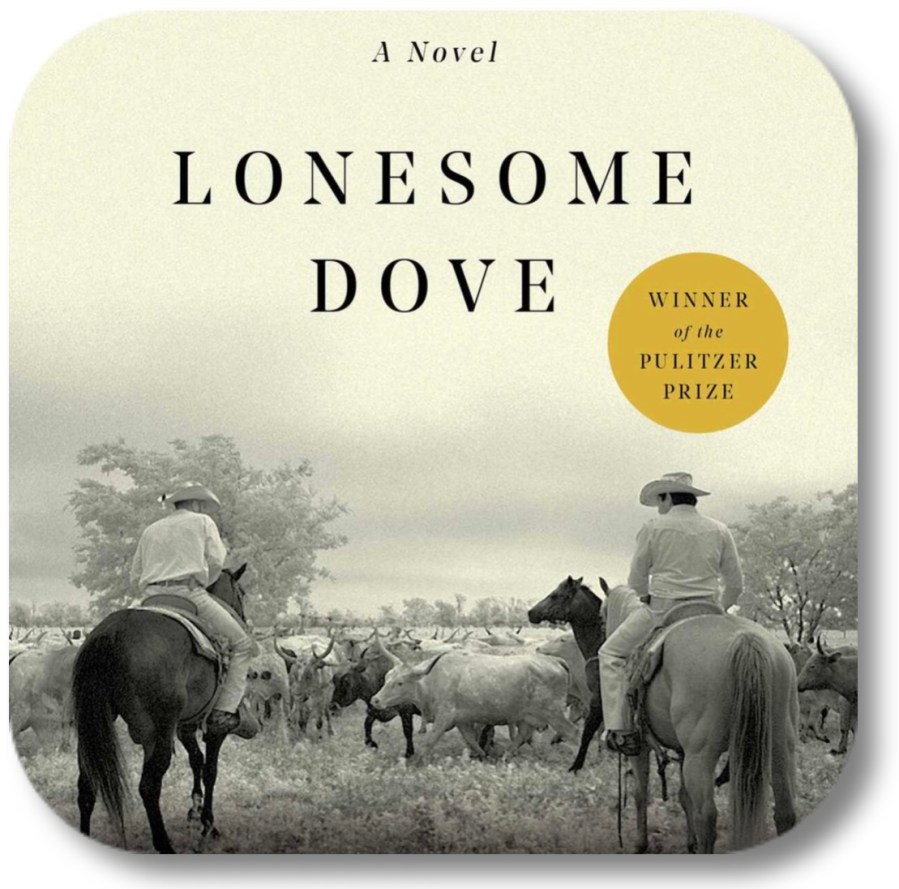
1. The Hat Creek Cattle Company – Every now and then, about sundown, the Captain and Augustus and Pea and Deets would strap on guns and ride off into that darkness, into Mexico, to return about sunup with thirty or forty horses or perhaps a hundred skinny cattle. It was the way the stock business seemed to work along the border, the Mexican ranchers raiding north while the Texans raided south. Men he’d ridden with for years were dead and buried, or at least dead, because they’d crossed the river under a full moon. The quarter moon was the right moon for a swing below the border.
2. Call liked to get off by himself, a mile or so from camp, and listen to the country, not the men. The country talked quiet; one human voice could drown it out, particularly if it was a voice as loud as Augustus McCrae’s. They ran a livery stable, trading horses and cattle when they could find a buyer. Newt knew that Lorena was a whore. He was not absolutely sure what whores did, but he assumed that Lorena had come by her profession as accidentally as he had come by his. It was pure accident that he happened to be a horse wrangler. Mention of Indians woke Pea Eye from an alcoholic doze. He hated Indians, partly because for thirty years’ fear of them had kept him from getting a good night’s sleep.
3. Lorena had never lived in a place where it was cool—it was her one aim. She was nearly twenty and hadn’t got a mile past Lonesome Dove. John Tinkersley, clean and tall and pretty as he was, he turned out, in the end, to be no better bargain than Mosby. Once Gus became a regular, she had no trouble making a living in the town. Silence happened to be how she felt when men were with her. Lorena had never particularly looked at life as if it was something funny, but Gus did. Even her lack of talk struck him as funny.
5. It perked Newt up that Dish didn’t treat him like a kid. Someday, if he was lucky, maybe he and Dish would be cowboys together. Newt could imagine nothing better. Dish had been able to prevail on Lorena.
6. Jake Spoon was the man who came most often to see her. It had begun to be clear to Newt, that his mother had been a whore, like Lorena. No man had been kinder, either to him or his mother—her name had been Maggie. When the fighting gradually died down along the border the Captain and Mr. Gus and Jake and Pea Eye and Deets all quit rangering and formed the Hat Creek outfit. But the settled life seemed not to suit Jake, and one day he was just gone. It seemed to him that Jake might even be his father. Basically Jake just dreamed his way through life and somehow got by with it. “You boys,” he said. “You got me down for lazier than I am. but I’ve seen something that you haven’t seen: Montana. Just because I like to play cards don’t mean I can’t smell an opportunity when one’s right under my nose. “It was bad luck all around,” Jake said. I did shoot, but I missed, which was enough to scare him off. But of course I shot that dern buffalo gun. It was just a little plank saloon we were sitting in. A plank won’t stop a fifty-caliber bullet.” “So where was the dentist?” he asked. “Walking along on the other side of the street,” Jake said. “We went to the door to watch the mule skinner run off and saw the dentist laying over there dead, fifty yards away. He had managed to get in the exact wrong spot.” All the gunfighter business went back to one lucky shot Jake had made when he was a mere boy starting out in the Rangers. It was funny how one shot could make a man’s reputation like that. It was a hip shot Jake made because he was scared, and it killed a Mexican bandit who was riding toward them on a dead run. It was Call’s opinion, and Augustus’s too, that Jake hadn’t even been shooting at the bandit. But Jake shot blind from the hip, with the sun in his eyes to boot, and hit the bandit right in the Adam’s apple, a thing not likely to occur more than once in a lifetime, if that often. Call and Augustus had always worried about Jake because of his unearned reputation. It was ironic that the shot which finally got him in trouble was as big an accident as the shot that had made his fame. But the three of them were compañeros still, no matter how many dentists he killed. Call and Gus had been the law themselves and didn’t always bow and scrape to it. They would not likely let some young sheriff take him off to hang because of an accident.
7. They prospered in a small way; there was enough money in their account in San Antonio that they could have considered themselves rich, had that notion interested them. They had been in Lonesome Dove nearly ten years, and yet what little property they had acquired was so worthless that neither of them would have felt bad about just saddling up and riding off from it.
8. The Captain never passed Newt a kind word. The Captain did not go around handing out kind words—but if he was in the mood to do so he knew he would be the last to get one. No compliment ever came to him from the Captain, no matter how well he worked. Deets noticed his discouragement and did what he could to help pick his spirits up. Sometimes he helped out with jobs that were too much for Newt, and whenever a chance for complimenting a piece of work came, Deets paid the compliment himself.
Now Dish was hearing it, standing with his shirttail half tucked in, while someone else was making it with Lorena. She was part of the sound—he knew just what chords she contributed to the awful music. A man in the room above him, who was also above Lorena, using her body to produce the crackling and the creaking. Dish holstered his pistol and stepped around the corner. He felt himself lose belief in what was happening. There was no place he would rather not be than at a table with Lorie and another man, yet that appeared to be where he was. For a time Dish lost all sense of what life was about. He was just a fellow with a glass in his hand, whose life had suddenly turned to mud. Though the day was hot and bright, Dish felt cold and cloudy, so puzzled by the strange business called life. By the middle of the second bottle he had stopped worrying about Lorie and Jake Spoon and was sitting by the piano.
9. “I happen to be responsible for three thousand cattle and eleven men. If I could buy forty horses, good horses, I’d feel happier. Can you oblige me?” “We expect to have a hundred head available at sunup tomorrow,” Call said. “You men won’t disappoint me, will you?” he asked. “I’m mean as a tom turkey when I’m disappointed.” “We’ve always been taken at our word,” Call said. “You can count on forty horses at sunup, thirty-five dollars a horse.” “Where are we aiming to steal a hundred horses?” “The Hacienda Flores,” Call said. The Hacienda Flores was the largest ranch in Coahuila. “If I didn’t know better I’d say you were trying to scare up a war,” Augustus said. “Old Pedro Flores ain’t gonna make us a gift of a hundred horses even if he did steal all of them himself.” Dish, in the depths of his drunkenness realized he would have to answer for it all to Captain Call. And now the Captain had come, and it was time to begin the ride. As the day died and the afterglow stretched upward in the soft, empty sky, the Hat Creek outfit, seven strong, crossed the river and rode southeast, toward the Hacienda Flores.
10. The closer they were to action, the more jocularity bothered him. It seemed to him that men who had been in bad fights and seen death and injury ought to develop a little respect for the dangers of their trade. But Gus loved to live and had no intention of letting anyone do him out of any of his pleasures. He treated danger with light contempt or open scorn, and scorn was about all he seemed to have for Pedro Flores, although Pedro had held on to his stony empire through forty violent years.
11. Augustus soon found the horse herd in a valley south of the old line camp. Call had predicted its location precisely, but had overestimated its size. Then he saw that they were looking at the horse brands—H I C on the left hips. “It just goes to show that even sinners can accomplish Christian acts,” Augustus said. “Here we set out to rob a man and now we’re in a position to return valuable property to a man who’s already been robbed. That’s curious justice, ain’t it?” An hour later they found the main horse herd in a narrow valley several miles to the north. Call estimated it to be over a hundred horses strong. Here he was below the border, about to run off a huge horse herd, and in a few days or weeks he would be going up the trail to a place he had barely even heard of. Most of the cowpokes who went north from Lonesome Dove just went to Kansas and thought that was far—but Montana must be twice as far. He couldn’t imagine what such a place would look like. Jake had said it had buffalo and mountains, two things he had never seen, and snow, the hardest thing of all to imagine. Snow, however, was an entirely mysterious thing. They circled the herd and quietly started it moving to the northwest, waving a rope now and then to get the horses in motion but saying as little as possible. Newt could not help feeling a little odd about it all, since he had somehow had it in his mind that they were coming to Mexico to buy horses, not steal them. It was puzzling that such a muddy little river like the Rio Grande should make such a difference in terms of what was lawful and what not. On the Texas side, horse stealing was a hanging crime, and many of those hung for it were Mexican cowboys who came across the river to do pretty much what they themselves were doing. The Captain was known for his sternness where horsethieves were concerned, and yet, here they were, running off a whole herd. Evidently if you crossed the river to do it, it stopped being a crime and became a game. The only thing he knew clearly was that he was scared. The thought of hanging—a new thought—wouldn’t leave his mind. The peaceful night suddenly went off like a bomb. Over the confused neighing of what seemed like hundreds of horses he began to hear yells and curses—Mexican curses. To his shock he saw a rider engulfed in the mass like himself, and the rider was not the Captain or Pea Eye. He realized then that two horse herds had run together, theirs headed for Texas, the other coming from Texas, both trying to skirt the same thicket, though from opposite directions. It quickly became clear that their herd was much the larger, and was forcing the new herd to curve into its flow. He was grateful for the dust—it was choking him, but it was also keeping him from getting shot, a more important consideration. He heard a sound that was deeply reassuring: the sound of the Captain’s rifle, the big Henry. Newt heard it shoot twice. He had never been in a situation in which he felt so uncertain about everything. The Captain and Pea could be ten miles away, and he himself could be riding into Mexico with Pedro Flores’s vaqueros. He saw something that gave him heart: a thin silver ribbon to the northwest that could only be the river. Across it, Texas was in sight. Ahead, waiting on the bank of the river, was Captain Call, the big Henry in the crook of his arm. He watched the huge herd of horses—well over a hundred of them—pour over the low banks and spread out down the river to drink. Call knew that it had been rare luck, running into the four Mexican horsethieves and getting most of the horses they had just brought over from Texas. The Mexicans had thought they had run into an army—who but an army would have so many horses? The sun had finished lifting itself clear of the horizon. “Let’s ease on home,” he said to the boy.
12. Newt had never known what to think about women. The Captain left them strictly alone, and had all the years Pea had been with him, excepting only one puzzling instance that had occurred years before, which Pea only remembered once every year or two, usually when he was dreaming. He had gone down to the saloon to get an ax someone had borrowed and not returned, and while he was getting the ax he heard a young woman crying out words and grievances to someone who was with her in her room. The woman doing the crying was the whore named Maggie, Newt’s mother. Maggie had been talking to the Captain, and had even called him by his first name, which Pea had never used in all his years of service. The knowledge that the Captain was in the room with a whore struck Pea hard. By the time they came back, Maggie had had her child, and soon after, Jake Spoon moved in with her for a while. Then he left and Maggie died and Gus went down one day and got Newt from the Mexican family that had taken him upon Maggie’s death. Some nights, laying on the porch, he felt a fool for even thinking about such things, and yet think he did. He had lived with men his whole life, rangering and working; during his whole adult life he couldn’t recollect spending ten minutes alone with a woman. He was better acquainted with Gus’s pigs than he was with Mary Cole, and more comfortable with them too. The principal aspect he worried over most was that marriage required men and women to live together. He had tried many times to envision how it would be to be alone at night under the same roof with a woman—or to have one there at breakfast and supper. What kind of talk would a woman expect? And what kind of behavior?
Call felt his impatience rising. The night had been far more successful than he could have hoped. They could keep the best horses and sell the rest—the profits would easily enable them to hire a crew and outfit a wagon for the trip north. Then all they would have to do would be gather the cattle and brand them. If everyone would work like they should, it could all be accomplished in three weeks, and they could be on the trail by the first of April—none too soon, considering the distance they had to go. The problem would be getting everyone to work like they should. Call saw there was no point in losing any more time. If Augustus was not of a mind to be serious, nothing could move him. “It’s work we’re looking for,” Allen said. “What we don’t know we’ll gladly learn.”
13. Lorena preferred older men to young ones. The older ones were more likely to be content with what they paid for; the young ones almost always got in love with her, and expected it to make a difference. The majority of them were harmless, with nothing worse than a low capacity to irritate—they were worse than chiggers but not as bad as bedbugs, in her view. When she got through with her story, Jake explained that he had killed a dentist in Fort Smith, Arkansas, and was a wanted man, but that he had hopes of eluding the law, and if he did, he would certainly try to see that she got to San Francisco, where she belonged. All the cowboys along the river knew that the only sporting woman in Lonesome Dove had abruptly given up the sport.
14. They didn’t understand that Jake talked of pleasant things and faraway places just to create a happy prospect that they could look forward to for a while. It wasn’t meant to really happen, and yet women never seemed to grasp that.
16. By the end of the first day’s hiring, Call had collected four boys, none of them yet eighteen. Young Bill Spettle, the one they called Swift Bill, and his brother Pete only a year older than Bill. He paid the widow a month’s wage for each boy, knowing she would need it. The next morning he got a promise from Maude that her two oldest boys would get themselves to Lonesome Dove by the end of the week, Jimmy and Ben Rainey. Call rode off feeling satisfied, believing he had enough of a crew to start gathering cattle. Word would get out, and a few more men would probably trickle in. “Didn’t Pedro make a try?” “No, he didn’t, and for a very good reason,” Augustus said. “What reason would that be?” “Because he died,” Augustus said. “I’d like to know what took him,” Call said. “He might have choked on a pepper,” Augustus said. “Them that can’t be killed by knives or bullets usually break their necks falling off the porch or something. Remember Johnny Norvel, dying of that bee sting? I guess Johnny had been shot twenty times, but a dern bee killed him.” It was an odd thing, but true, that the death of an enemy could affect you almost as much as the death of a friend. “We might as well go on to Montana,” he said. “The fun’s over around here.” “First you run out of Indians, now you’ve run out of bandits, that’s the pint,” Augustus said. “You’ve got to have somebody to outwit, don’t you?”
17. After a week, Lorena became aware of a curious thing: Jake was more attached to her than she was to him. It was clear to her already that he was one of those men somebody had to take care of. He had fooled her for a few days into thinking he would do the taking care of, but that wasn’t so. Before the week was over it seemed to her that he was all play.
“I want a poke,” Augustus said, as casual as if he were asking her to loan him two bits. He paid her the fifty dollars at once—it had not been a bluff. When he had had the poke and was dressing, she found that she felt pretty cheerful and was not in a mood to hurry him out. After all, Gus had paid her many visits and given her nothing to hold against him. The fifty dollars was flattering, and she rather liked it that she was his preference even though he was Jake’s best friend.
18. Every night Call went across the river with five or six hands and came back with two or three hundred Mexican cattle—longhorns mostly, skinny as rails and wild as deer. Whatever they got they branded the next day. “If we have a good drag tonight we can start north on Monday,” Call said. “How does that suit you, Jake?” “Oh, fine,” Jake said. “But you boys don’t have to try and suit me with your drive. I’ve been thinking of spending some time in San Antonio.” Call knew there was no point in reminding Jake that the whole drive had been his idea. The man was willful as a child in some respects. Show him what he ought to do and he would dig in his heels and refuse. It was particularly irritating in this instance, because nobody in the outfit had ever been farther north than Kansas. Jake knew the country and could be a big help. “Are you aiming to marry Lorie?” Augustus asked. “She does seem to be looking forward to San Francisco,” Augustus said.
19. “Yes, I had a pa, the bastard,” Sean said grimly. “He only came home when he was a mind to beat us. Beat Ma and all of us whenever he could catch us. We laid for him once and was gonna brain him with a shovel, but he was a lucky one. The night was dark and we never seen him.” “What happened to him?” Newt asked. “Ha, the drunkard,” Sean said. “He fell down a well and drownded. Saved us killing him and going to jail, I guess.” Newt had always missed having a father, but the fact that Sean spoke so coldly of his put the matter in a different light. Perhaps he was not so unlucky, after all. Deets was going, but he felt uneasy in his mind. He remembered one thing the Captain had drilled into them many times during the rangering years: that a good start made for a good campaign. It was nearly April, late to be starting out to go so far. He had been on the plains in summer and seen how quickly the water holes dried up.
20. “I plan to leave when you leave,” she said. “With the herd or not.” It seemed to him there was never much time with women. Before you could look at one twice, you were into an argument, and they were telling you what was going to happen. “I ain’t out of sorts,” Lorena said. “You are. You don’t want to stay and you don’t want to go. Let’s leave tomorrow,” she said.
21. “Is it true, what Jake says?” Xavier asked. “You are leaving today?” “You should marry me,” he said. “I will be good to you. I am not like these men. I have manners. You would see how kind I would be. I would never leave you. You could have an easy life.” He put the money on her little chest of drawers and turned to her. Lorie shut the door and leaned against it, lifting her shift. With a grateful look Xavier dropped his pants. Soon his legs were trembling so she was afraid he would collapse before he was done. But he didn’t. When he finished he put his head against her bosom for a moment, wetting her breasts with his tears even as she felt his drip on her thigh. She turned and hid the money. It was just one more secret she had from Jake.
22. Jake and Lorena rode into camp. They were riding two good horses and leading a pack horse. The most surprising thing was that Lorena was wearing pants. They had never seen a woman in pants. Augustus walked over to help Lorena dismount. The sight of the boys all sitting like statues made him want to laugh. That in itself was a luxury he wouldn’t have at home, for a disappointed woman was not easy to ignore.
23. “Well, we’re barely an outfit,” Augustus said, “though we got two fine pigs that just joined us last night. Are you looking for employment?” “Yes, my wife died,” Soupy said.“Well, you’re hired, at least,” Call said. Bol was indeed feeling terrible. They only talked of going, not of coming back. It might be he would never see Mexico again, or his lovely daughters, if he left. And yet, when he looked across the river and thought of his village, he just felt tired. He was too tired to deal with a disappointed woman, and much too tired to be a bandit. Who could have predicted Jake would be the one to take Lorena out of Lonesome Dove? She had been meaning to leave since the day she arrived, and now Jake, who had slipped from the grasp of every woman who had known him, was firmly caught by a young whore from Alabama.
24. “Deets, I want you to be the scout,” the Captain said. “We got plenty of men to keep the stock moving. I want you to find us water and a good bed-ground every night.” It was proof that the Captain thought highly of his abilities. Call had no affection for the border, and a yearning for the plains, dangerous as they were. “It’s a funny life,” Augustus said. “All these cattle and nine-tenths of the horses is stolen, and yet we was once respected lawmen.
25. Augustus had ridden through the cattle and had come back with a count of slightly over twenty-six hundred. Newt noticed his bandana got sweaty, and the dust caked on it so that he felt he was inhaling mud. He had to take it off and beat it against his leg once in a while. He was riding Mouse, who looked like he could use a bandana of his own.
PART II
26. July Johnson, it had been the hardest year of his life: a year in which so many things went wrong. His deputy, Roscoe Brown—forty-eight years of age to July’s twenty-four—assured him cheerfully that the increase in trouble was something he had better get used to. “You went and got married. Makes me glad I stayed a bachelor.” “Uh-oh, here comes Peach,” Roscoe said. “Ben must have been a lunatic to marry that woman.” Now Peach still talked a blue streak and Ben was dead. “When are you aiming to start after that murderer?” she asked July. “Why, pretty soon,” he said, although he felt tired at the thought of starting after anybody. “I expect to find him down around San Antonio,” July said. “I believe he has friends there,” Roscoe said. “Two of the most famous Texas Rangers that ever lived.” It was a shock and a surprise to find Ben lying in the street with a big hole in him. Everyone else had been surprised too—Peach herself had fainted. Now six weeks had passed.
Elmira also often lectured Joe as freely as she lectured July. One result was that he and Joe had become allies and good friends; both of them spent much of their time just trying to avoid Elmira’s wrath. Benny had been the oldest and he himself the youngest of the ten Johnson boys. He could tell July was in a touchy mood—and who could blame him, with a wife like Elmira and a sister-in-law like Peach.
27. So far as Joe was concerned, marrying July was the best thing his mother had ever done. She scolded July as freely as she scolded him, which didn’t seem right to Joe. But then July accepted it and never scolded back, so perhaps that was the way of the world: women scolded, and men kept quiet and stayed out of the way as much as possible. As for July, it had been no trick to marry him. He was like some of the young cowboys who had never touched a woman or even spoken to one. His habits never varied. He did the same things in the same way every day. July knew that for some reason he irritated Elmira—she reacted crossly to almost everything he said or suggested. At night it had gotten so he could hardly put a hand on her, she looked at him so coldly. She could lie a foot from him and make him feel that he was miles away. It all made him feel terrible, for he had come to love her more than anything. Despite his politeness and constant kindness, Elmira felt a bitterness toward him. The thing he didn’t know was that she was with child. She wanted July and Joe to be gone, suddenly, so she would not have to deal with them every day. Their needs were modest enough, but she no longer wanted to face them. She had reached a point where doing anything for anyone was a strain.
28. Joe was her son and July was her husband—if she didn’t love her husband and her son, who did she love? He felt he was being carried along through his life as a river might carry a chip. There seemed to be no way he could stop anything that was happening, although it all felt wrong. Then July turned his horse away from the river and the glowing sky, and he and little Joe were soon out of town.
29. “Maybe she just don’t want to answer the door,” he said. “She takes a lot of naps.” “Nope, I went in and looked,” Peach said. “There ain’t a soul in that cabin, and there wasn’t yesterday, neither.” “We think she’s gone,” Charlie Barnes said again. “If she wandered off, anything could have got her,” Peach said. “Could have been an animal or it could have been a man.” “Why, Peach, I don’t know why a man would want her,” Roscoe said, only to realize that the remark probably sounded funny. “We think she’s gone,” Charlie Barnes said, for the third time. “We all seen it coming. July’s a fool or he wouldn’t have married her.” It was just the worst luck. Men’s wives didn’t usually leave on a whiskey barge. All he really knew was that he hated to ride out of the one town he felt at home in. That everyone was eager for him to go made him feel distinctly bitter. Roscoe took one last look at the river and headed for Texas.
30. The first good wash Lorena got was in the Nueces River. They had had a bad day trying to fight their way through mesquite thickets. From every clearing she could look back and see the dust the herd raised. She saw it was going to be harder than she had imagined. Here it was only the second day and she had already had a fright like death. Now lightning was coming. For a moment it all felt hopeless.
31. Call had never been out in a sandstorm at night, with thousands of cattle to control, which began almost immediately. Behind the little sand streams came a river, composed not of water but of sand. Newt only glanced once, to get his directions, and the sand filled his eyes so that he was immediately blind. It was in his first moment of blindness that the cattle began to run, as if pushed into motion by the river of sand. The wind keened like a cry, its tone rising over the lower tone of the pounding hooves. Over the roar of the wind and the running herd he suddenly heard the popping of tree limbs. A second later a mesquite limb hit him in the face and brush tore at him from all sides. In the short lulls in the wind he could hear the clicking of long horns, as the cattle bumped into one another in the darkness. Lightning, it flickered again and soon was almost constant, though still far away. Newt welcomed it—it enabled him to see that he was still with the several hundred cattle, and also helped him avoid thickets. Rain began, pelting down in big scattered drops that felt good after all the grit. But the drops got thicker and less scattered and soon the rain fell in sheets, the world simply turned to water. The rain was so heavy that at moments he felt it might drown him right on his horse. The night went on and on. The lightning died and the hard rain stopped, but a drizzle continued.
33. By dawn the rain had stopped completely and the sky was cloudless. The cattle had walked themselves out and were docile for the time being. Deets had been to look, and Soupy, Jasper and Needle had the rest of the herd a mile or two east. When asked how many cattle he thought might be lost, Dish estimated no more than twenty-five head, if that many.
34. The fact that Gus had found her horse was a good sign. Lorena felt like riding, even though the country was brushy. She felt like a lope, in fact. Jake could sulk if he wanted to. She was looking forward to the trip.
35. As they got close to the river they began to encounter swarms of mosquitoes, which attacked horses and men alike, settling on them so thickly that they could be wiped off like stains. Suddenly a scream cut the air, so terrible that it almost made one faint. Sean was barely clinging to his horse, under a swarm of water moccasins. His eyes were closed, his body jerking slightly. Augustus cut the boy’s shirt off—there were eight sets of fang marks, including one on his neck. It only went to show what he already knew, which was that there were more dangers in life than even the sharpest training could anticipate. The cowboys mounted and went off to the herd, many of them taking a quick last look at the muddy grave under the tree.
36. The whiskey boat stank, and the men on it stank, but Elmira was not sorry she had taken passage. The fleas made her sleep uneasy, but it was a small price to pay for escaping from Fort Smith. One trader was killed in a fight over her.
37. Roscoe began to feel more and more of a grievance against people. The start of it all was Jake Spoon, who had no business coming to Fort Smith in the first place. It seemed to him that a chain of thoughtless actions, on the part of many people he knew, had resulted in his being stuck in a cabin in the wilderness with a difficult widow woman. To his extreme astonishment, Louisa squatted right atop his middle and reached into his long johns and took hold of his tool. Nothing like that had ever happened to him, and he was stunned, though his tool wasn’t. Meanwhile Louisa was wiggling around without much interest in what he thought about it all. Despite the chickens and the weeds and the danger of witnesses, he felt a sharp pleasure. Louisa apparently did too, soon afterward, for she wiggled even more vigorously and grunted loudly.
38. Joe knew that something was bothering July, it just seemed he didn’t want to talk at all. He knew the boy was starved for talk, and that he himself had been a sorry companion on the trip, but in fact he had no talk in him. He was so filled with worry that the only way he could contain it was just to keep silent and concentrate on the travel. It was all to do with Elmira. “It’s a great mistake to hurry. Because the grave’s our destination,” Mr. Sedgwick said. “Those who hurry usually get to it quicker than those who take their time.“
39. The death of the young Irishman cast a heavy gloom over the cow camp. For the next week it seemed no one talked of anything but the death. Everyone had been dreading the next river, which was the San Antonio. And everyone knew there were plenty snakes in the San Antonio River. “It’s curious how things get in your head,” Newt said. “I’ve got an Indian in mine.”
40. As the days passed, Lorena found she liked the traveling more and more, while Jake cussed the weather. She felt that a life of travel was what she was meant for. She might love the traveling, but it was clear that Jake didn’t. Deets, who stopped by their camp almost every day to see that they were all right, had shown her how to make a fire. He had also taught her how to pack the mule and do various other chores that Jake mostly neglected. If he didn’t like the way she did things, he was free to do them different—but he never did. He just fussed at her. He had no business traveling north with a woman like Lorie, who had her own mind and wouldn’t obey the simplest order unless it happened to suit her.
41. Bolivar, the cook, while driving the wagon fell off it and the the shotgun went off. This scared the two mules and the run-away wagon went off the river embankment and flipped end to end. Thinking he would be fired he quit. But his departure surprised and saddened Newt. It spoiled his relief that Lippy was alive—after all, he had lost another friend, Bol instead of Lippy. How could Bol just go? He had always been the cook, and yet in five minutes he was as lost to them as if he had died. As he rode away he decided he had made another stupid choice. So far, in his opinion, almost every decision of his life had been stupid.
42. Call got on his horse, hoping to shake off the low feeling that had settled over him. After all, nobody was hurt, the herd was moving well, and Bol was no great loss. But the low feeling stayed. It was as if he had lead in his legs. Augustus hitched the new mules to a new wagon. The streets of San Antonio were silent and empty as they left. “We’ll be the Indians, if we last another twenty years,” Augustus said. “Next thing you know they’ll have to round up us old rowdies and stick us on a reservation to keep us from scaring the ladies.”
43. It seemed Roscoe would never find Texas, a fact that preyed on his mind. From all indications it was a large place, and if he missed it he would be laughed out of Fort Smith—assuming he ever got back. The girl rapidly skinned the cottontail, which was indeed plump. Then she whacked the knife into the frog, threw the top half into the creek and peeled the skin off the legs with her teeth. The girl made a little fire and cooked the rabbit and the frog legs. “Don’t you have no folks?” he asked, She shook her head. “They died,” she said. “I had a brother but the Indians run off with him. Ma died and Pa went crazy and shot himself. I lived with a Dutchman till Sam got me.”
45. “Jake come along and started you expecting again.” “I didn’t expect this,” Lorena said. “No, but he got you hoping, at least,” Augustus said. “The trouble is, Jake ain’t a man to support nobody’s hopes but his own. If you want one thing too much it’s likely to be a disappointment. The healthy way is to learn to like the everyday things, like soft beds and buttermilk—and feisty gentlemen.” The man called Blue Duck was much more frightening. He might not hit at all—or he might do something worse. “Pack up, Lorie,” Augustus said. “You best stay near us for a night or two.” “Who is he?” she asked. “One we ought to have hung ten years ago,” Augustus said. “Couldn’t catch him. He’s a Comanchero. He’s got a greasy bunch of murderers and child-stealers. They’d butcher the grown-ups and take the horses and kids.” “Gus, we could go to California,” she said. “I’d go with you and let Jake take his chances.” “No, I’m bound for Ogallala, Nebraska,” he said.
46. Blue Duck stole white children and gave them to the Comanches for presents. He took scalps, abused women, cut up men. What he didn’t steal he burned, always fleeing west onto the waterless reaches of the unscouted country where neither Rangers nor soldiers were eager to follow. When he and Call quit the Rangers, Blue Duck had been a job left undone. If one stopped to think about it, it was depressing how little most men learned in their lifetimes. Deets looked solemn. “I lost him,” he said. “You think it was Blue Duck?” “Don’t know, Captain,” Deets said. “Do you think he’s gone, then?” Call asked. Deets shook his head. “Don’t think so, Captain,” he said. “We better watch the horses.”
She had such frightened eyes. Call had not expected to see it in Maggie on that occasion. Yet despair was what he saw. She had had the boy, lived several years, and died. He had not asked her to care for him that much, yet she had. He had only asked to buy what other men had bought, but she had singled him out in a way he had never understood. “Broke her heart,” Gus said, many times. “She ain’t in love with me, she’s in love with you,” he pointed out. “You like to have everyone needing you, but you’re right picky as to who you satisfy,” Gus had said in the bitterest of the fights. All his life he had been careful to control experience as best he could, and then something had happened that was forever beyond his control, just because he had wanted to find out about the business with women. For years he had stayed to himself and felt critical of men who were always running to whores. Then he had done it himself and made a mockery of his own rules. A great pain had been concealed, one that had hurt him far more than the three bullets he had taken in battle over the years. The man he had wanted to be would never have gone to Maggie in the first place. He felt like a cheat—he was the most respected man on the border, and yet a whore had a claim on him. He had ignored the claim, and the woman died, but somehow the claim remained, like a weight he had to carry forever. Such had never happened in battle, such failure. Yet it had happened in a little room over a saloon, because of a small woman who couldn’t keep her hair fixed. He had seen terrible things in battle and had mostly forgotten them, and yet he couldn’t forget the sad look in Maggie’s eyes when she mentioned that she wished he’d say her name. He felt, almost, that he didn’t belong with the very men he was leading, and that he ought to just leave: ride west, let the herd go, let Montana go, be done with the whole business of leading men. It was peculiar to seem so infallible in their eyes and yet feel so empty and sad when he thought of himself. He wondered if all men felt such disappointment when thinking of themselves.
47. “You go on back,” she said. Newt almost wished something would happen—a sudden attack of Mexicans or something. He might be killed, but at least he wouldn’t have to make a choice between disobeying Mr. Gus and disobeying Lorena. He trotted the last two hundred yards to where he had tied Mouse. But the horse wasn’t there!
48. That night, true to his word, Po Campo fried some grasshoppers. Before he got around to it he fed the crew a normal meal of beefsteak and beans and even conjured up a stew whose ingredients were mysterious but which all agreed was excellent. Then grasshoppers were a hit, with molasses they taste like candy. Jake came racing into camp, Lorena was missing.
49. Lorena didn’t see the man come. Without her hearing a step or feeling any danger, Blue Duck was standing in front of her, the rifle still held in his big hand like a toy. A cold fear struck her. She knew she had been wrong not to go to the cow camp. Once again they rode all night. Lorena slept in the saddle and would have fallen off if she hadn’t been tied in the stirrups. At dawn he let her down again, by another creek, and this time she did as he did—peed and drank. They rode all day again through empty country, never seeing a horseman, a town, even an animal. “Monkey John will like that yellow hair,” he said. “He’ll ’bout have to marry you when he sees that.” They’ll probably give me most of their money and all their hides when they see you.” If she ever got a chance she would kill the man, in revenge for all the painful hours she had spent watching his indifferent back. At the sight, Blue Duck laughed. “I guess they don’t want to take no chances on you getting away,” he said. “Fresh women is scarce in these parts.” Lorena began to wish there was some way just to die. If there was, she would have done it. But she was tied, and there was no way. Lorena had expected death, but it wasn’t death she got—just the four men.
50. July would decide to test his luck in Fort Worth, if he could run into Jake there it would save himself and little Joe hundreds of miles. It would also mean he could get back to Elmira quicker. Getting back to Elmira occupied his mind a lot more than catching Jake Spoon.
DEAR JULY— Ellie took off just after you did. My opinion is she won’t be back, and Charlie thinks the same. We think Ellie left on a whiskey boat, I guess she took leave of her senses. If that’s the case it would be a waste of time to go looking for her, YOUR SISTER-IN-LAW, Mary Johnson
“It’s bad news,” July said. “Did Ma leave?” Joe asked. July nodded, surprised. If the boy could figure it out so easily, it must mean that he was the fool for having missed something so obvious that even a boy could see it. “I don’t think she’d lie to me,” July said out loud. Probably Dee Boot was alive, in which case Elmira must be married to two men. The longer he lay awake, the stranger he felt. He felt he was probably going crazy from all the strain.
52. The amazing thing about Janey, in Roscoe’s view, was that she knew her way. “I’ll walk and all you have to do is keep up,” she said. Once they got settled in a camp at night she would disappear and come back five minutes later with a rabbit or a possum or a couple of squirrels. She could even catch birds. But she was tormented by bad dreams and whimpered at night. “You should have shot her,” Hutto said. “I know you expected to amuse yourself, but look how it turned out. The girl got away and the deputy only had thirty dollars and some dirty underwear. This beats all I ever heard of,” Hutto said. “Here we are in a rock fight with a girl no bigger than a minute, and she’s winning. If news of this gets out we’ll have to retire.” Then a miracle happened—for in Roscoe’s mind a miracle it was. He stood there, naked and wet, sure to be murdered within a few minutes unless a slip of a girl, armed only with rocks, could defeat two grown men armed with guns. He himself was so sure of being killed that he felt rather detached from what was happening, and invested only faint hope in Janey’s chances of saving him. It was July Johnson, standing behind Jim with his pistol drawn and cocked. Jim looked up, and just as he did, the rock Roscoe had been hoping for sailed in and hit him right in the throat. He dropped his gun and fell over backwards. They rode all night and delivered the bandits to the sheriff in Fort Worth. “Where did you get her?” July asked. “I didn’t get her, exactly,” Roscoe said. He felt on the defensive. It was clear that people would think the worst of him, whatever he did. Joe didn’t know what to make of her, and neither did July, or even Roscoe, who had found her.
53. Long before the whiskey boat stopped, Elmira knew she was going to have trouble with Big Zwey. The man had never approached her, or even spoken to her, but every time she went out of her shed to sit and watch the water, she felt his eyes on her. “Are there many towns up north?” she asked, remembering that Dee had mentioned going north. “Big Zwey wants to marry you,” he said finally, “He’ll take you to Ogallala, if you’ll do it,” Fowler said. She was pregnant. It became amusing to her, her power over the man. He had never spoken to her, not one word, and yet he would sit for hours, thirty yards away. It was something, what must go through men’s minds where women were concerned, to cause them to behave so strangely. Big Zwey and her started across the prairie with Luke.
54. Augustus knew it was his fault. He should have packed her into camp the minute he discovered who Blue Duck was. It was the kind of lapse he had been subject to all his life: things that were clearly dangerous didn’t worry him enough. Blue Duck might be dealing with some renegade chief with a taste for white women. Lorena would put a nice cap on a career largely devoted to stealing children. With those of animals gone, and the Indians mostly gone in their wake, the great plains were truly empty, unpeopled and ungrazed.
55. Monkey John hated it that she wouldn’t talk. “By God, I’ll cut your tongue out if you ain’t gonna use it,” he said, and he knocked her down and sat on her, his big knife an inch from her face. Monkey John was bad, but Blue Duck still scared her more. His cold, empty eyes frightened her more than Monkey John’s anger or Dog Face’s craziness. She didn’t expect to live to the end of any day—only the fact that the men weren’t tired of her yet kept her alive. At night she wondered sometimes if she could just learn to die. “I don’t want the woman,” Blue Duck said. “You men can have her back as a gift, and your horses too, provided you do me one favor.” Blue Duck chuckled. “There’s an old man following me,” he said. “He went west, but he’ll be coming along one of these days. I want you to kill him. “Somebody better settle him,” Blue Duck said. “Otherwise you’ll all be dead.” It was Gus Blue Duck wanted the Kiowas to kill. She had almost forgotten he was following her, life had gotten so hard. The Kiowas had been sent to kill him, so Gus might never arrive.
56. The remaining Indians were discouraged. Five Indians were dead, and the battle not five minutes old. Augustus replaced his cartridges and killed a sixth as the Indians were retreating, in which case he had killed half of them. As soon as it was too dark to shoot, Augustus yanked his saddle loose from the dead mount and walked west. He hated carrying the saddle, but it was a shield of sorts; if he got caught in open country it might be the only cover he would have. “I can go find them,” another voice said. It was a girlish voice, which surprised him. “They were shooting at me,” he said. “I’m Captain McCrae, and I’m coming in.” He took a few steps to the side when he said it, for he had known men to shoot from reflex when they were frightened. “July Johnson?” Augustus asked. “We were expecting you down in Lonesome Dove, and here you are practically in Kansas. If you’re still after Jake Spoon, you’ve missed him by about three hundred miles. It’s a steep-banked river,” Augustus said. “If we have to fight Indians we’d be in a lot better position there than out on this plain. Have you ever killed?” “No,” July said. “I’ve never had to.” I wish you’d stayed with your party, Augustus thought, but he didn’t say it.
57. “The Kiowas can have her.” I want them to carve her up,” Blue Duck said. The Indians jumped for Dog Face. Before Lorena could even turn her head, they castrated him. Another slashed a knife across his forehead and began to rip off his hair. Augustus and July stormed into their camp killed Monkey John, Dog Face and the six Kiowas. “I can’t leave this girl and she ain’t in shape to travel fast. Go back to your camp” said Gus.
58. July found them an hour later, already stiff in death. He was a sheriff, paid to fight when necessary, but nothing in his experience had prepared him for the slaughter he had just witnessed. He felt a terrible need to turn things back, all the way back to the time when he and Roscoe and Joe and Elmira had all been in Arkansas. He knew it could never be. He had done nothing but ride twice over the same stretch of prairie, while death had come to both camps. He had no doubt that if he had stayed with Roscoe and the children, it would have come to him too. Gus carried the bodies up to the prairie, laid them in their shallow graves and helped July pile rocks on the graves, “Son, this is a sad thing,” Augustus said. “Loss of life always is. But the life is lost for good. Don’t you go attempting vengeance. Don’t be trying to give back pain for pain,” he said. “You can’t get even measures in business like this.” He shook hands with the young sheriff and watched him mount and ride across the river. “Come on, Lorie,” he said. “Let’s take a little ride.” She stood up obediently, like a child. “We’ll just ride over east a ways and see if we can find us some shade,” Augustus said. “Then we’ll loll around for a couple of weeks and let Call and the boys catch up with us. They’ll be coming with the cattle pretty soon.
59. They camped west of Fort Worth and Call allowed the men to go into town. It would be the last town they would see until they hit Ogallala, and it might be that some of them wouldn’t live to hit Ogallala. Call began to be very worried about Gus. It was unusual for him to be gone so long with only one man to chase. Of course, Blue Duck might have had a gang waiting. It haunted him that Gus had just ridden off and might not ride back.
61. Gus decided to risk Adobe Walls—the old fort offered the only promise of shelter. He had a pack of cards in his saddlebags, which he quickly produced. “Don’t you cheat, Gus,” Lorena said suddenly. “If you cheat I won’t give you no pokes.” Augustus was so pleased to hear her talk that tears came into his eyes. “We’re just playing for buttons, honey,” he said. He happened to see a deer and that night they had venison and Lorena ate with real appetite for the first time. “Eat like that, and you’ll soon be the most beautiful woman in Texas again.” She didn’t want to see other men, for any reason at all. She didn’t want them to see her. There was a strong feeling within her that she should stay hidden. She wanted Gus to hide her. “Now we ought to be set,” Augustus said, once he had the tent secured. “I imagine the boys will be along in a week or so.” A little of the hollowness left Lorena’s cheeks, and her bruises healed. She still slept close to Augustus at night and her eyes still followed him when he went out to move the horses or do some errand. She bathed and was surprised to see how white her skin looked, once the dirt was all washed off. The sight of her own brown legs and white belly surprised her so that she began to cry. Once the crying started, she couldn’t stop.
62. “How many did the lightning hit?” Newt asked, remembering the sight of the cattle falling dead. “Thirteen,” Dish said. “That ain’t the worst, though. It kilt Bill Spettle. Knocked him right off his horse. They’re burying him now.” They had happened to glance across the river and had spotted a horseman riding toward them. The crew on the north bank had their backs to the rider and hadn’t seen him. “Why, I swear, it’s Gus,” Pea Eye said. “He ain’t dead at all.”
63. “Is the girl all right?” “She’s had an ordeal but she’s young,” Augustus said. “She won’t forget it, but she might outlive it.” Mr. Gus back with the crew. In the bright sun, with the river crossed and the cattle grazing on the wet grass, and Lorena rescued, life seemed like a fine thing. She still got the shakes. Blue Duck wasn’t dead. He might come back and get her again, if Gus didn’t watch close. She remembered his face and the way he smiled when he kicked her. Gus was the only thing that kept the memories away. But her brain wouldn’t stop—only Gus could distract it with talk and card games. Only his presence relaxed her enough that she could sleep. “This trip is hard on boys,” Augustus said. “We’ve lost two already, and the young sheriff lost a boy and a girl.” “Well, I got to admit I still like a fight,” Augustus said. “They sharpen the wits. The only other thing that does that is talking to women, which is usually more dangerous.” “Now you’ve ended up the caretaker of that girl,” Call said. “She ain’t the woman you’re after.” “You don’t like to take chances.” “I could argue that,” Call said. “I’ve taken my share of chances, I guess.” “In battle, not in love,” Augustus said. “Unless you want to call what you done with Maggie taking a chance.” Here you’ve brought these cattle all this way, with all this inconvenience to me and everybody else, and you don’t have no reason in this world to be doing it. You take your pick of the land,” Augustus said. “I’m in the mood to travel.
64. Jake spent most of his days in a place called Bill’s Saloon, He also liked a long-legged whore named Sally Skull. She ran the whoring establishment for Bill Sloan, who owned the saloon. Jake hit it off with her at once, and she let him sleep in her bed, but the bed and the privileges that went with it cost him ten dollars a day. “She never would mind,” Jake said, wishing the Hat Creek outfit had kept their mouths shut about Lorena. Somehow, in fighting over the one gun, Sally and the deputy managed to shoot each other fatally. They died together on the cell floor in a pool of blood, both half naked. The deputy had nine children, and his death caused an uproar against whores and gamblers, so much so that Jake thought it prudent to leave town. He searched Sally’s room before he left and found six hundred dollars in a hatbox; since Sally was dead and buried, he took it. Had it not been for the threat of July Johnson somewhere around, he would have let the Suggs brothers head for Kansas without him. But three days later Jake found himself riding north with the three Suggs boys and a tall black man they called Frog Lip.
66. What he was doing—indeed, his whole life—now seemed to him completely futile. He rode through the empty land without hope of anything, simply going on because he had to do something. July didn’t see how things could get worse, since he had lost his wife and led three people to their deaths. But four days after he left Augustus, his horse went lame and died. A few days later, sore from riding bareback on a little sharp-spined bay, he trotted into Dodge City.
66. Long before they struck the Republican River, Elmira had begun to wonder if any of it was worth it. If she lost the baby in such a place, she felt she would probably die. She was driving a mule wagon across northern Kansas. Luke kept climbing up on the wagon and putting his hands on her, but Elmira kept saying no. She had no interest in men. Zwey caught him abusing her and beat him. He lay in the wagon for four days, trying to get his breath through his broken nose. One of his ears had been nearly scraped off on the wheel; his lips were smashed and several of his teeth broken. His face swelled to such a point that they couldn’t tell at first if his jaw was broken. Elmira took pity on Luke and sewed on the ear.
67. Lorena watched the cloud, which came down on them faster than any rain cloud. She could plainly hear the hum of millions of insects. The cloud covered the plain in front of them from the ground far up in the air. When the cloud of grasshoppers hit the Hat Creek outfit, they were on a totally open plain and could do nothing but watch it come, in terror and astonishment. The air was so dense with them that Newt couldn’t see the cattle and could barely see the ground. At every step Mouse crunched them underfoot. The whirring they made was so loud he felt he could have screamed and not been heard. From the way the ground shook he knew the cattle were running. The sky had turned to grasshoppers—it seemed that simple. It lasted for hours. A few of them tried to stop and graze, but there was nothing left to graze on except grasshoppers. So, with a sinking heart, he slowly followed the five Indians and the cattle. Instead of stealing him, the Indians had just been keeping him from getting lost.
68. Almost at once, before the group even got out of Texas, Jake had cause to regret that he had ever agreed to ride with the Suggs brothers. Jake had no doubt that he was riding with accomplished killers. Dan Suggs seemed to hate everybody he knew—he spoke in the vilest language of everyone, but his particular hatred was cowboys. The Suggs brothers seemed to live on the edge of fratricidal warfare. Jake would have tipped his hat and walked off. But the old man had whacked him and offered to do it again—Jake had only shot to protect himself. Another accident. This time he was up against twenty or thirty nesters. In neither case had he meant to kill. If he rode across the river with a hard bunch like the Suggses he would be an outlaw, whereas if he stayed, the nesters might try to hang him or jail him in Fort Worth or Dallas.
69. It took July only a day or two to determine that Elmira was not in Dodge City. The town was a shock to him, for almost every woman in it seemed to be a whore and almost every business a saloon.
DEAR PEACH— Roscoe Brown was killed by a bad outlaw, so was Joe. A girl named Janey was also kilt, I don’t know much about her, Roscoe said he met her in the woods. I don’t know when I will be back—the folks can hire another sheriff if they want to, somebody has to look after the town. YOUR BROTHER-IN-LAW, July Johnson
70. Newt was sure he had never seen anyone as beautiful as her—that he was getting to share breakfast with her was like a miracle. He was enjoying the rare privilege of having breakfast with Mr. Gus and Lorena. Lorena laughed—a delightful sound to Newt. As she blew on her coffee, she looked at Gus. She had spent many hours looking at him since he had rescued her. It was comfortable traveling with him, for he never got angry or scolded her, as other men had. In the weeks when she trembled and cried, he had expressed no impatience and made no demands. When Newt rode back to the herd he practically floated over the ground, he felt so happy.
72. Deets found Wilbarger by backtracking his horse. The horse, with dried blood on the saddle and crusted in its mane, was waiting for them on the north bank of the Arkansas. “Old Wilbarger had a sense of humor. He’d laugh right out loud if he knew he had the skull of a buffalo cow for a grave marker,” Augustus said.
74. “Jake with them?” Pea Eye asked. “He’s there,” Call said. “It’s a bad situation, but he put himself in it.” Dan Suggs was the name Wilbarger had mentioned—he had called his killers accurately. “We’ll hang him for the killings and the rest of you for the horsetheft,” Augustus said. “Out in these parts the punishment’s the same, as you well know. “Ride with an outlaw, die with him,” he added. “I admit it’s a harsh code. But you rode on the other side long enough to know how it works. I’m sorry you crossed the line, though.” “I’m tired of justice, ain’t you?” he asked. “Well, I wish he hadn’t got so careless about his company,” Call said. “It was that that cost him.”
PART III
75. Bob had the mare snubbed to a post with a heavy rope and only turned his back on her for a second. But the mare struck with her front feet, quick as a snake. They had been so sure he would die that they even dug the grave, up on the knoll east of the house where their three boys were buried: Jim and Jeff and Johnny, the three deaths Clara felt had turned her heart to stone. His eyes were open, but he could neither speak nor move. The shadow of Augustus McCrae had hung over their courtship; Bob had never known why she chose him over the famous Ranger, or over any of the other men she could have had. In her day she had been the most sought-after girl in Texas, and yet she had married him, and followed him to the Nebraska plains, and stayed and worked beside him. There Bob lay, barely alive, his ribs showing more every morning, still wanting a boy. It was Elmira, Luke and Big Zwey that happened upon Clara’s place. The exhausting journey over the plains had left her too weak for the task at hand. She fainted many times during the night. It was wearying, trying to adjust to all the paces life required. The baby looked dead, and Elmira looked as if she were dying—but in fact both lived. Elmira didn’t want the baby. Maybe it’ll die, she thought. Dee won’t want it either. It was July’s. “They left,” Cholo said.
76. “I wisht she’d brought the baby,” Zwey said. “I always wanted us to have one.” Zwey had always been considered the dumbest of the dumb. It occurred to the deputy that the couple might have come to try and break Dee Boot out of jail. “I’m his wife, I want to see Dee,” the woman said. “They’re gonna hang me, Ellie,” he said. “Why, Dee?” she asked. Dee shrugged. “Killed a boy,” he said. Zwey shifted Ellie a little and saw to his shock that the wetness was blood. “She’s bleeding,” he said. She couldn’t say the things she wanted to say. She tried, but no words came out. Her eyes wanted to close, and no matter how hard she tried to keep them open and look at Dee, they kept trying to close.
77. From the bluff July could see far north across the Republican, almost to Nebraska, he supposed. It was terribly bad luck, to be snakebit almost in sight of where he needed to be. He grew delirious and in his delirium would have long talks with Roscoe. He could see Roscoe’s face as plain as day. Roscoe didn’t seem to blame him for the fact that he was dead. July didn’t die. His leg felt terrible, though. He almost wished he could go on and die, it was so uncomfortable.
July said. “Is Ogallala near here?” “Twenty miles,” the old man said. “I’m Cholo. Come to the house. You must be hungry.” Clara said. “I didn’t get your name.” “I’m July Johnson,” he said. “I come from Arkansas.” The girls had told her the little scarfaced man had said the woman they were with was married to a sheriff named Johnson, from Arkansas. Besides, the little man had whispered something to the effect that the big buffalo hunter considered himself married to her. The girls thought it mighty exciting, having a woman in the house who was married to two men. And if that wasn’t complicated enough, the woman herself claimed to be married to Dee Boot, the gunfighter they had hung last week. Clara had already grown attached to the baby. She had never seriously supposed a father would turn up, but now one had, standing in her kitchen, dirty, tired, and with a badly discolored leg. She turned and looked at July. “Mr. Johnson,” she said, “are you looking for your wife, by any chance?” July almost fell over from surprise. “Have you seen her?” “Yes,” Clara said. “She stopped here for the night about three weeks ago in the company of two buffalo hunters.” To July it seemed too much of a miracle—that with the whole plains to cross he and Ellie would strike the same house. He began to tremble and then to cry—he couldn’t help it. Might as well tell the man, she thought. “Mr. Johnson, I guess I’ve got another piece of news for you,” Clara said. She looked from the baby’s face to his, seeking resemblances. “If that woman was your wife, I guess this child is yours,” Clara said. “She had it the night she was here. Then she left. “I’ve been calling him Martin,” Clara said. “Since he’s yours, you may want to change it.
78. He had only been gone three days, but it seemed longer to her. “She won’t hardly even look at me,” Dish said. Lorena’s indifference pained him more than anything he had ever experienced. “Yes, hung them all, including Jake Spoon.” “Well, I’ll swear,” Dish said, shocked. “I didn’t like the man but I never figured him for a killer.” “He wasn’t a killer,” Augustus said.” Jake liked a joke and didn’t like to work. I’ve got exactly the same failings. It’s lucky I ain’t been hung.” Lorena felt a dread she couldn’t get rid of. She might lose him to the woman. The strange trembling started—it was beyond her control. Gus put his arms around her to make it stop. He held her tight all night, and when the sun woke her, the herd was already gone.
79. Newt couldn’t get Jake out of his mind—how he had smiled at the end and given him his horse. He liked his gait so much that he soon became his favorite horse. Newt didn’t know it, but Call, too, lived almost constantly with the thought of Jake Spoon. He felt half sick from thinking about it. He couldn’t concentrate on the work at hand, and often if spoken to he wouldn’t respond. He wanted somehow to move time backwards to a point where Jake could have been saved. At night, alone, he grew bitter at himself for indulging in such pointless thoughts. It was like the business with Maggie that Gus harped on so. His mind tried to change it, have it different, but those too were pointless thoughts. Augustus said, “You’re so sure you’re right it doesn’t matter to you whether people talk to you at all. I’m glad I’ve been wrong enough to keep in practice. You can’t avoid it, you’ve got to learn to handle it,” Augustus said. “If you only come face-to-face with your own mistakes once or twice in your life it’s bound to be extra painful. I face mine every day—that way they ain’t usually much worse than a dry shave.” The next day he passed the word that everyone would be paid half wages in Ogallala. Call was not enthusiastic but the men had worked well and he couldn’t oppose giving them a day in town.
80. The doctor said. “Hung him right on schedule about a week after they brought you in. Buried him in Boot Hill. It’s a good joke on him, since his name was Boot. He killed a nine-year-old boy, he won’t be missed around here.” Elmira shut her eyes, hoping she could be dead. From then on she spat out her medicine, letting it dribble onto the gown the doctor had given her. The last thing she wanted to do was get well and have to live. One day, with no warning from anyone, the door to her room opened and July walked in. She wasn’t happy that he had found her. The news about Joe didn’t touch her. She didn’t care about the baby—didn’t even care that Joe was dead. He was reminded of all her difficulties, how nothing he did pleased her, not even finding her in Ogallala. She had married him and carried his child, and yet she wouldn’t turn her head to look at him. Before the sun set she and Zwey left Ogallala, going east.
81. “The point is, I don’t want to keep him a year or two and then give him up. If I have to give him up I’d rather do it soon.”“I’ve lost three boys,” Clara said. “I don’t want to lose another to a woman who keeps changing her mind.”
82. “Stay here,” Clara said. “Do you hear me? Stay here! Martin needs a pa and I could use a good hand. If you go trailing after that woman either the Indians will kill you or that buffalo hunter will, or you’ll just get lost and starve. Are you willing to stay?” she asked. “I guess I oughtn’t to chase her,” he said finally. “I guess I ought to let her be.” “It doesn’t do to sacrifice for people unless they want you to,” Clara said.
83. “I always try to be especially good to Deets. He’s the best man we got. Best man we’ve ever had,” Augustus said. “Maybe he’s sick.” “No,” Call said. “I hope he ain’t planning to leave us,” Augustus said. “I doubt the rest of us could even find the water holes. He says he don’t like the north,” Call said. “That’s all he’ll say.” He knew they were not far from Clara’s house, a fact which made Lorena extremely nervous. “I’ll take you along and introduce you properly. You ain’t just baggage, you know. Clara probably don’t see another woman once a month. She’ll be happy for feminine conversation.” Probably all of them envied Gus, for he had a woman and they didn’t. He envied them back, for they were carefree and he wasn’t. “Deets, have you ever spent much time wanting what you know you can’t have?” he asked. “Wantin’ takes too much time,” Deets said. “I’d rather be working.”
84. In the end Gus had such a purchase that he couldn’t even consider carrying it—they would have to come in tomorrow and pick it up in the wagon, though he did wrap up a few things in case Lorie wanted to wear them to Clara’s. He bought her combs and brushes and a mirror—women liked to see themselves, he knew, and Lorena hadn’t had the opportunity since Fort Worth.
86. Gus had four ten-dollar gold pieces in his pocket, which he had intended to slip the boys on the sly. All the other hands had rushed in, to the whores. “Yeah, but do you just ask?” he inquired. “We don’t know how much it costs.” “Oh, that varies from gal to gal, or madam to madam,” Lippy said. They shook out the small change and handed it to Lippy. They knew that drinking was something required of all real cowboys, and they were hot to try it. “Hell, whores make a sight more than cowboys,” Ben kept saying—it seemed to trouble him a good deal. “We don’t make but thirty dollars a month and them two made thirty dollars off us in about three minutes. It would have been forty if Pete hadn’t backed out.”
87. Clara was upstairs when she saw the four riders. “It’s Ellie,” he added. “That soldier said the Indians killed a woman and a buffalo hunter about sixty miles east of town. I have no doubt it was her.” “I think it’s a sickness to grieve too much for those who never cared a fig for you. A bond has to work two ways. If a man don’t hold up his end, there comes a time to quit.” I know she had her troubles, and I doubt she was often in her right mind. It just gripes me that he let himself be tromped on and can’t even figure out that it wasn’t right, and that he didn’t like it.”
Hearing his voice so unexpectedly after sixteen years caused her eyes to fill. Gus—his appetite for talk matched hers. To the huge astonishment of her girls, Clara walked straight off the porch and into the stranger’s arms. She had a look in her eyes that they had never seen, and she raised her face to the stranger and kissed him right on the mouth, an action so startling and so unexpected that both girls remembered the moment for the rest of their lives. The arrival of Gus McCrae had mixed up everyone, Nobody had ever been able to figure out whether she was in love with him or not. Her parents had puzzled over the question for years. “We hung your man for you,” Call said. “He fell in with a bad bunch. We caught them up in Kansas.” “I notice you’ve taken a fancy to young Mr. Johnson,” Augustus said. “I expect if I did stay around he’d beat me out.” “He’s nearly as dull as Woodrow Call, but he’s nicer,” Clara said. “He’ll do what he’s told, mostly, and I’ve come to appreciate that quality in a man. I could never count on you to do what you’re told.” But that boy’s his, and don’t you tell me he ain’t. They walk alike, they stand alike, and they look alike.” “I expect you’re right,” Augustus said. “Newt, we’ve enjoyed having you,” Clara said. “I want you to know that if Montana don’t suit you, you can just head back here. I’ll give you all the work you can stand.” “I’d like to,” Newt said. He meant it. Something in the boy touched Clara. Boys had always touched her—far more than girls. This one had a lonely look in his eye although he also had a quick smile.
88. After Call and Newt left with the horses, Clara lit a lantern and took Augustus up to the room where her husband lay. “The truth is, I was hoping to find you a widow,” he said. “I think the best thing would be for you to leave me your bride-to-be and I’ll see if I can give her some polish. She’s got nearly as high an opinion of you as you have of yourself, Gus. I could never match it. I know your character too well. Bob’ll die when he can manage it, and I’ll see what I can do for your bride. It’s just her beauty that set me off. I was always the youngest and prettiest, and now I’m not. And I won’t marry again. I don’t have enough respect for men,” she said. “I’ve found very few who are honest, and you ain’t one of the few.” To his surprise, Clara simply walked into the kitchen and invited Lorena to stay with them while the herd went on to Montana. “We could use your help and you’d be more than welcome,” she said. “Montana’s no place for a lady.” Being at Clara’s, even for so short a space, had changed her. Lorena felt embarrassed—she had not expected to be asked to stay, or to want to, and yet both things had happened. She had never expected to find, in the whole world, a place where someone would ask her to stay—even in her dreams of San Francisco no one had ever asked her to stay. He hugged them both and gave them each a kiss.
89. It wasn’t rational to think of driving cattle over eighty waterless miles, but he had learned in his years of tracking Indians that things which seemed impossible often weren’t. They only became so if one thought about them too much so that fear took over.
90. “Didn’t see many men,” Deets said. “Mostly women and children. They’re real poor, Captain.” “What do you mean, real poor?” “Means they’re starving,” Deets said. “They done cut up one horse.” “My God,” Augustus said. “You mean they stole them horses for meat?” That proved to be the case. They carefully approached the draw where the camp was and saw the whole little tribe gathered around the dead horse. There were only some twenty Indians. Call saw only two braves who looked to be of fighting age, and they were no more than boys. They had just walked up to an Indian camp and let Josh Deets get killed. He had known better. They all knew better. They had all concluded the Indians were too starved down to do anything. It was a mistake he would never forgive himself. Newt sat in his blankets and cried until he was afraid he would never stop. Captain Call had carved the words deeply into the rough board:
JOSH DEETS SERVED WITH ME 30 YEARS. FOUGHT IN 21 ENGAGEMENTS WITH THE COMMANCHE AND KIOWA. CHERFUL IN ALL WEATHERS, NEVER SHERKED A TASK. SPLENDID BEHAVIOUR.
91. “You don’t think that little bull is fool enough to charge that bear, do you?” Augustus asked. He pawed the earth again, then lowered his head and charged the bear. The sounds the two animals made were so frightening that they made the men want to run. He dropped back on all fours, roared once more at the bull, and disappeared into the brush along the creek. They finally got a rope over the bull’s head and slowed him until four more ropes could be thrown on him. It took Po Campo over two hours to sew the huge flap of skin back in place. A week after the fight the bull was in the herd again. No one had seen him return, but one morning he was there. He had only one horn and one eye, and Po Campo’s sewing job was somewhat uneven, the folds of skin having separated in two or three places—but the bull was ornery as ever.
92. The poultry chores had been assigned to Lorena—mainly just feeding the twenty-five or thirty hens and gathering the eggs. Housework and washing became Lorena’s job too. She was glad she had stayed at Clara’s. For almost the first time in her life she had a decent bed in a clean room and tasteful meals and people around who were kind to her. Two weeks later, Bob died in the night. Clara had had more happiness from horses than from her husband, though he had been a decent husband, better than most women had, from what she could judge. The women and girls passed Martin around as if he belonged to them all; Lorena had developed a rapport with him and took the main responsibility for him when Clara was off with the horses. The baby was happy, and no wonder, with two women and two girls to spoil him. The thing that made July least comfortable of all was that he knew he was in love with Clara. Then she’s free, July thought. He couldn’t feel sad.
93. The herd and the Hat Creek outfit slowly rode into Montana out of the barren Wyoming plain. Jake Spoon, who had been wrong about most things, had been right about Montana. It was a cattleman’s paradise, and they were the only cattlemen in it. There was something in it that thrilled Newt—he was Captain Call’s son—but more that felt sad.
94. Both horses were down, their throats cut, their blood very bright on the green weeds and bushes. Augustus regretted that his preoccupation with the arrows had made him so lax that he had failed to protect the horses. It put them in a ticklish spot. Now they had no horses. Gus shoved the tip on out and then fainted. Pea Eye had to pull the arrow on through. By morning Augustus had a high fever. Though his leg worried him most, he also had pain in his side. The thought struck Pea Eye for the first time that Gus might die. Now, when he looked at Gus and saw his pallor and his shakes, the thought came into his mind and wouldn’t leave. Gus might die. They had no medicine, it was raining fits, the Indians had them surrounded, and they were a hundred miles or more from the Hat Creek outfit. He made a run for it.
Call saw that Pea Eye was wounded and out of his head. There was blood on his chest from a shoulder wound, the sun had blotched his body, and his feet were swollen the size of a cow’s bladder and cut to shreds. The first words Pea had said was that they had just missed Deets. Deets’ ghost had led him to the herd. Po Campo smiled. “The dead can help us if we let them, and if they want to,” he said. They were all resourceful men—he knew that, if they didn’t—and yet at certain times they became like children, wanting to be led. “It ain’t complicated,” Augustus maintained. “Most men doubt their own abilities. You don’t. It’s no wonder they want to keep you around. It keeps them from having to worry about failure all the time.” “They ain’t failures, most of them,” Call pointed out. “They can do perfectly well for themselves.”
95. Gus’s leg was in trouble. Blood poisoning was a possibility. Even waiting for nightfall might be folly. He eased out of the cave and stood up. and hobbled across along the bank to the animal trail. The Indians had left. He started at once, hobbling southeast toward Miles City. “Hugh Auld,” the visitor said. Looking at the leg. It was just black. “Forty miles and five hours later, as the sun was setting, he nudged the exhausted horse over a slope north of the Yellowstone and saw the little town of Miles City to the east.
96. Feeling considerable pain, Augustus looked down and saw that his left leg was gone. The stump had been bandaged. Call arrived and Gus was dying. “Do stop in Nebraska a night and let the women know,” Augustus said. “I’m leaving my half of the herd to Lorie, and don’t you dispute with me about it. Just see she gets what money’s coming to her. I’ll leave you a note to hand her, and one for Clara. I admit it’s practically your only sin, but it’s a big one. You ought to do better by that boy. He’s the only son you’ll ever have. “Give him your name, and you’ll have a son you can be proud of. And Newt will know you’re his pa. Give my saddle to Pea Eye.”
97. His old rangering gang was gone, only Pea Eye left, of all of them. Jake was dead in Kansas, Deets in Wyoming, and now Gus in Montana. “Dying people get foolish,” doctor said. “They forget they won’t be alive to appreciate the things they ask people to do for them. “Well, I swear,” Pea Eye said, “I got away and Gus died,” he added sadly. “Wouldn’t you figure it’d be the other way around?” It seemed to him it would have been better if the Indians had ridden in and killed them all—having it happen one at a time was too much to bear, and it was happening to the best people too.
98. Call felt that the whole top of the Montana territory was empty except for the buffalo, the Indians and the Hat Creek outfit. He knew it was time to stop and get a house of some kind built before a blizzard caught them. Frequently he woke up to hear Gus’s voice. Gus dead invaded his thoughts as readily as he had when he was alive. The drive was over. The ranch would lie between the Milk and the Missouri. He would file on the land in the spring. Dish resolved that as soon as the building was done he would go like a streak for Nebraska. The thought that a stranger might come along and win Lorie before he could get back was a torment to him—but it made him one of the more vigorous members of the logging crew once the building got started. A blizzard, howled out of the north for three days. Only the fact that Call had seen to it that ample firewood had been cut saved the outfit. Within ten days of the blizzard, a sizable rough log house had been built, complete with fireplace and chimney, The roof had hardly been on the cabin a day when the next blizzard hit. Dish Boggett drew his wages and left the day after they caught the wild horses. Call admired Dish Boggett, who indeed had held a true point for three thousand miles; he had also often proved himself the best man to break a stampede. It was during the Captain’s absence that Newt discovered a talent for breaking horses.
99. July Johnson proposed to Clara in the first week of the new year. He had been trying to stop himself from doing just that for months. “Would you ever marry me?” was the way he put it, and immediately felt a terrible fool for having uttered the words. He was miserable all night, for she hadn’t answered the question. The baby fell sick. But he had spoken the words and revealed what he wanted. “I know if I lose one more child I’ll never care again,” she said. “I won’t. Nothing will make any difference to me again if I lose one more. It’ll ruin me, and that’ll ruin my girls. I’ll never buy another horse, or cook another meal, or take another man. I’ll starve, or else I’ll go crazy and welcome it. Or I’ll kill the doctor for not coming, or you for not sitting with me, or something. If you want to marry me, why didn’t you come and sit?” Dish Boggett, arrived, bringing the news that Augustus McCrae was dead. Clara immediately offered Dish a job. Many a night through the long winter, July sat against a wall, feeling left out, while Clara, Dish and the girls played games at the big kitchen table. Lorena sat silently, not watching, while July sat just as silently. July Johnson, a man whose love was nearly mute. Not only was he inept where feelings were concerned, he was also a dolt with horses. Closer relations would probably only increase Clara’s impatience with him. It amused her that he was so jealous of Dish, who, though friendly, companionable and an excellent hand, was not interested in Clara at all. His love for Lorena leaped out of every look he cast in her direction, although not one of them penetrated Lorena’s iron grief. Clara herself didn’t try to touch or change Lorena’s grief—it was like Martin’s fever: either it would kill her or it wouldn’t. Unrelievable grief. Clara felt helpless. Pleasure had no hold on Lorena—the young cowboy would be doomed to find his love blocked by Gus in death even as it had been in life. Gus had proposed to Clara thirty times at least. “But Gus saw it would be a struggle if he won me, and he didn’t want it. Bob was too dumb to realize there’d be a struggle,” Clara said. “Half the time he didn’t notice it even when he was in it. So mainly I had the struggle with myself. Lorena lived through the winter in silence. Dish Boggett remained loyal too, although Lorena gave him no encouragement.
100. It came to rankle Call that Gus had left his half of the cattle herd to the woman. The woman was down in Nebraska. Still, Call had halved the money. However aggravating it was, Gus had meant it, and he would do it. It would soon be spring, and he would have to be going if he were to keep the promise, which of course he must. With Gus pressing him, it was his nature to resist, but with Gus gone he didn’t find it so distasteful to consider that the boy was his son. He started taking the boy with him on every trip he made to the forts, not merely to familiarize him with the country but to let him participate in the selling and trading. It was awkward—indeed, it seemed absurd—to have to tote a six-months-old corpse to Texas, but there it was. Sometimes he wondered if he would even come back. Call felt old. His interest in work had not returned. It was only when he was watching the boy with the horses that he felt himself. “I have to take Gus back,” he told Newt. “I guess I’ll be gone a year. You’ll have to be the range boss. Pea will help you, and the rest are mostly reliable. That woman gets half the money when you sell stock,” Call said. “It was Gus’s request. You can bank it for her in Miles City. I’ll tell her it’s there when I see her.” Newt could hardly believe he would be made boss over the men. Call had been dishonest about his own son, who stood not ten feet away, holding the reins of the Hell Bitch. His own son stood there—surely, it was true; after doubting it for years, his own mind told him over and over that it was true—yet he couldn’t call him a son. “So long, boys,” he said. Call remembered the watch that had been passed on to him, an old pocket watch with a thin gold case. He had carried it since he was a boy. He raised up in his stirrups, took it out of his pocket and handed it to Newt. “It was my pa’s,” he said, and turned and left. “Dern, Newt,” Pea Eye said, more astonished than he had ever been in his life. “He gave you his horse and his gun and that watch. He acts like you’re his kin.” He was gone, and things would never be as Newt had hoped—never. Somehow it had been too hard for the Captain, and he had left. For thirty years the Captain had been there to give orders.
101. Call found the carpenter who had built the coffin in the first place and had him reinforce it with strong planks. By luck, the same day, Call saw a buggy for sale. It was old but it looked sturdy enough, and he bought it. Greasy, the mule, was used to pulling the wagon and hardly noticed the buggy, it was so light. “Gus was crazy and you’re foolish to drag a corpse that far,” Clara said bluntly. “Bury him here and go back to your son and your men. They need you. Gus can rest with my boys.” The next morning Lorena still stood by the buggy. What angered Clara most was Gus’s selfishness in regard to Call’s son. He was the kind of boy she would have given anything to raise, and here, for a romantic whim, Gus had seen to it that father and son were separated. Then Lorena crumpled to the ground, unconscious. Clara knew it was only a faint. “I put it to you once more, in the plainest terms, Mr. Call,” Clara said. “A live son is more important than a dead friend. Can you understand that?” “A promise is a promise,” Call said. You men and your promises: they’re just excuses to do what you plan to do anyway, which is leave. You think you’ve always done right—that’s your ugly pride, Mr. Call. You’re a vain coward, for all your fighting. I despised you then, for what you were, and I despise you now, for what you’re doing.”
102. Call turned west into Colorado, meaning to skirt the main cattle trails. He came to town a week before Blue Duck was to hang. He looked up and the hair on his neck rose, for Blue Duck was flying through the air in his chains. It seemed to Call the man’s cold smile was fixed on him as he fell: he had managed to dive through one of the long glass windows on the third floor—and not alone, either. He had grabbed Deputy Decker with his handcuffed hands and pulled him out too. Both fell to the stony ground right in front of the courthouse. Blue Duck was stone dead.
Avoiding an attack of four Indians the buggy was destroyed and the coffin was underwater. Call finally cut it loose, and with the help of Greasy dragged it from the mud. He had no intention of leaving Gus, now that he had brought him so far. He broke open the coffin and rewrapped his friend’s remains in the tarp he had been using for a bed cover on wet nights. Then he lashed the bundle to Gus’s sign, itself well weathered, with most of the lettering worn off. He cut down a small salt-cedar and made a crude axle, fixing the sign between the two buggy wheels. It was more travois than buggy, but it moved. The mule decided to die. Call had to use the dun to pull the travois. By the time he finally rode onto the little hill with the live oaks above the Guadalupe, the sign was about gone. Call dug the grave with a little hand shovel and lowered Augustus in. “There,” he said. “This will teach me to be more careful about what I promise.” Worn out, and with a festering wound, he was in no shape to turn back for Montana. He had never felt that he had any home on the earth anyway. He rode the weary dun on south, feeling that he might just as well go to Lonesome Dove as anywhere. When he trotted through the chaparral toward the Hat Creek barn, he saw that it was old Bolivar himself, beating the same bell with the same piece of crowbar. His girls were married and gone, his wife unrelenting in her anger at his years of neglect. So he had left her one day forever, and walked to Lonesome Dove, living in the house the gringos had abandoned. The Dry Bean was gone. “Burnt,” Dillard whispered. “Burnt near a year ago.” “What started the fire?” Call asked. “Wanz started it. Burnt up in it, too. Locked himself in that whore’s room and wouldn’t come out. “When she left, Wanz couldn’t stand it,” Dillard said. “He sat in her room a month and then he burnt it.”
 Hidden in Plain Sight