by Fynn (a summary by Pat Evert)
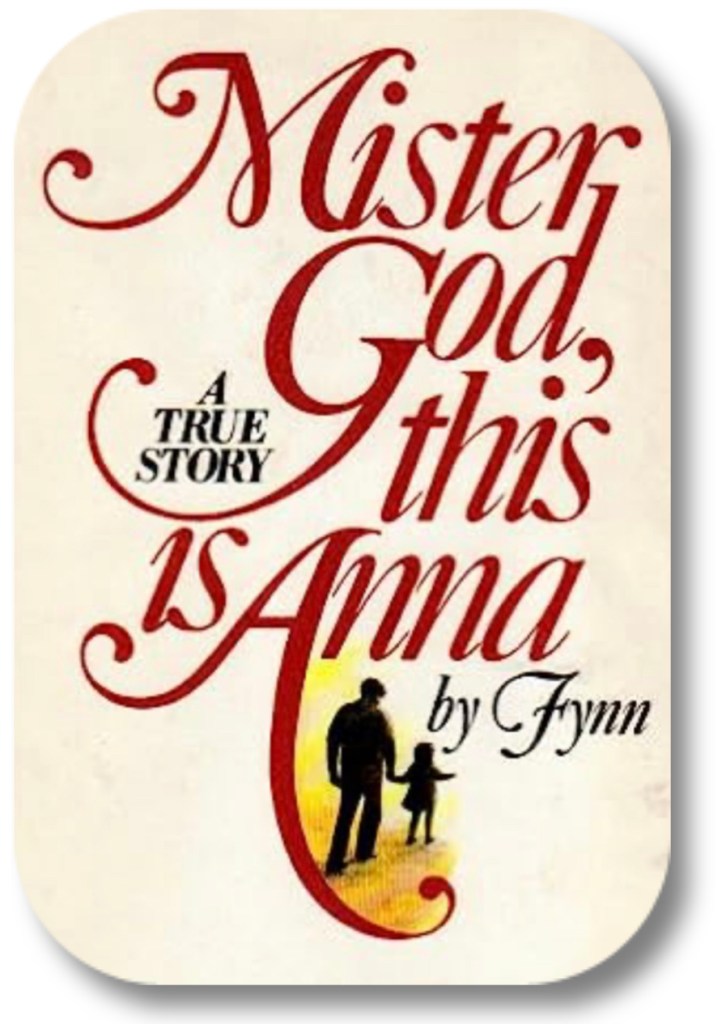
- Forward
The God we encounter here is in no sense simply another inhabitant of the universe who just happens to be more powerful than any other; nor is he an observer of the created scene from an advantaged position, reacting to our behaviour from outside. God is ‘more intimate to us than we to ourselves’, pressing with a steady loving urge to be manifest to us and so to change us. Anna echoes the incarnate God by saying over and over again, ‘Fear not’. He is so much more than any kind of lawgiver, and his being demands of us the utmost in both love and intellect. ~ Dr Rowan Williams Archbishop of Canterbury December 2003
- Introduction
Ah! Books are those which induce a fundamental change in the reader’s consciousness. For there is about Finn that transparent vulnerability which makes for a total and immediate correspondence with anyone who is prepared to throw prejudices to the wind and celebrate life as a lump of mysterious and joyful awe. He worked so with such deep insight and total acceptance that his attitude could only be described as love. Fynn has suffered: suffered not only physically, mentally, and emotionally; but has also suffered spiritually in that total solitariness, isolation, and abandonment which, however close one’s friends and relatives may be, becomes a terrifying experience for the lonely being. So Fynn is the author of this book. There is about him a touch of that engaging, wide-eyed, winsome innocence which mankind must have had before the Fall, and which would permit a youth and a young girl to snuggle up in bed together in a way which was completely innocent (there the word is again) of any sexuality. The truth, he wrote, is what makes you a better being. It is like that small mirror in the fairy tales – you glance in it and what you see is not yourself; for an instant you glimpse the Inaccessible. Fynn and Anna, with their mirror-book and all their other simple impedimenta, allow us to glimpse the Inaccessible.
- Chapter One
At five years Anna knew absolutely the purpose of being, knew the meaning of love and was a personal friend and helper of Mister God. At six Anna was a theologian, mathematician, philosopher, poet and gardener. She never made eight years, she died by an accident. She died with a grin on her beautiful face. She died saying, ‘I bet Mister God lets me get into heaven for this’, and I bet he did too. I knew Anna for just about three and a half years, my claim to fame. I knew her on her own terms, the way she demanded to be known: from the inside first. ‘Most of an angel is in the inside’, and this is the way I learned to know her – my first angel. My life with Anna began on a foggy night. I was sixteen at the time, prowling the streets and alleys with my usual supply of hot dogs. In those days children wandering the streets at night were no uncommon sight. We stayed there about three hours. I couldn’t see what she looked like except that she was very dirty. After some little time and a great deal of effort she managed ‘You love me, don’t you?’ I said ‘Yes’. She gave a little giggle, broke into some primitive gyration around the lamp-post, chanting ‘You love me. You love me. You love me.’ The next hour was filled with giggles and hot dogs, ginger-pop and chocolate raisins. She exclaimed, ‘I don’t live nowhere. I have runned away.’ ‘What about your Mum and Dad?’ I asked. ‘Oh, she’s a cow and he’s a sod. And I ain’t going to no bleeding cop shop. I’m going to live with you.’ ‘Right, I agree. You can come home with me and then we will have to see.’ ‘What’s your name, Tich?’ I asked her. ‘Anna. What’s yours?’ ‘Fynn,’ I said. We got into the scullery by the back-door and then into the kitchen. I lit the gas. For the very first time I saw Anna. She looked like a little savage, smears of various coloured paints all over her face and arms, the front of her frock a complete riot of colour. ‘Mum, come and see what I’ve got.’ One thing about Mum, she was never fussed about anything, she took everything in her stride. ‘The poor thing,’ she cried, ‘what have they done to you?’ With that, Mum flopped on to her knees and put her arms around Anna. She flung open the kitchen door, yelling, ‘Stan, Carol, come here quick!’ Stan’s my younger brother by two years; Carol was one of the waifs or strays that came and went. A bath appeared, kettles of water on gas-rings, towels, soap. And suddenly there she was, sitting cross-legged on the table as raw as the day she was born. That poor little body was bruised and sore. The four older people in the kitchen were ready to bash someone and for a time we were lost in our own anger. But Anna sat and grinned, a huge face-splitting grin. The bath completed, the soup downed and Anna resplendent in Stan’s old shirt, we all sat around the kitchen table and took stock of the situation. Stan and I made up a bed on an old black leather sofa next door to me. This little thing had the most splendid, the most beautiful, copper-coloured hair imaginable, and a face to match. No painted cherub on some church ceiling was this child, but a smiling, giggling, squirming, real live child, her face alight with some inner radiance. How could anyone fail to love this little thing? Before going to bed we prayed. I can’t remember much about her prayer except that it started off with ‘Dear Mister God, this is Anna talking,’ and she went on in such a familiar way of talking to Mister God that I had the creepy feeling that if I dared look behind me he would be standing there. I remember her saying, ‘Thank you for letting Fynn love me,’ and I remember being kissed goodnight, but how I got to bed I don’t know. ‘Can I get in?’ she said in a whisper – she didn’t wait for my answer, but slid in beside me and buried her head in my neck and cried silently, her tears warm and wet on my chest. There was nothing to say, nothing to do but to put my arm around her. I didn’t think I would sleep, but I did.
- Chapter Two
During the next few weeks we tried to find out by a bit of cunning questioning where Anna lived. It seemed quite possible that she had just dropped out of heaven. By this time Anna was a firm favourite down our street. Whenever the kids played team-games like four sticks everyone wanted Anna on their side. Our street was a nice street. Nobody had any money, but in all the years I lived there, I can never remember anyone’s front-door being shut in the daytime, or, for that matter, for most of the night either. Bossy (the cat) was a fighting tabby who regarded all humans as inferiors, but under Anna’s influence Bossy started to stay at home more often and very soon treated Anna as an equal. My work, which was in oils, was not more than five minutes’ walk away from home, so I was always home for dinner at about 12.30. I was seen off by Anna from the top of the street, kissed wetly, promising to be back about six in the evening. That walk home was a pleasure; every step was one step nearer. The top of our turning came into sight, and there she was. Anna was always there, not once did she miss this meeting, I doubt if ever lovers met more joyously. These were her own and very private moments which she chose to share with me, and I was honoured to share them with her. I could not comfort her, I would not have dared to trespass. All that I could do was to see as she saw, to be moved as she was moved. That kind of suffering you must bear alone. With Mum and Anna difficulties and adversities were merely occasions for doing something. Ugliness was the chance to make beautiful. Sadness was the chance to make glad. Mister God was always available to them. Anna had bypassed all the non-essentials and distilled centuries of learning into one sentence – ‘And God said love me, love them, and love it, and don’t forget to love yourself.’ The idea of collective worship went against her sense of private conversations with Mister God. You went to church to get the message when you were very little. Once you had got it, you went out and did something about it. Keeping on going to church was because you hadn’t got the message. One device, the oscilloscope, held all the magic of a fairy wand for Anna. We’d sit in this room for hours on end playing single notes on the piano, watching the green spot on the ‘scope do its glowing dance. The whole exercise of relating sounds that one heard with the ears to the visual shape of those sounds actively seen on the little tube’s face was a source of never-ending delight. The concepts of frequency and wavelength were meaningful to her. One summer afternoon all the kids were playing in the street when a large bumble-bee appeared on the scene. Slip-stick?’ In a moment or two she shouted out, ‘A bee flaps its wings such-and-such times a second.’ Nobody believed her, but she was only a few counts out. All these games led inevitably to making music. Each separate note had by this time been examined minutely, and a sound depended on how many times it wiggled per second. Soon she was making little melodies to which I added the harmonies. Little pieces of music entitled ‘Mummy’, ‘Mr Jether’s Dance’, and ‘Laughter’ soon began to echo around the house. Anna had begun to compose. ‘Fynn, you can love better than any people that ever was, and so can I, can’t I? But Mister God is different. You see, Fynn, people can only love outside and can only kiss outside, but Mister God can love you right inside, and Mister God can kiss you right inside, so it’s different. Mister God ain’t like us; we are a little bit like Mister God, but not much yet.’ ‘Fynn, that’s the difference. You see, everybody has got a point of view, but Mister God hasn’t. Mister God has only points to view.’ It seemed to me that she had taken the whole idea of God outside the limitation of time and placed him firmly in the realm of eternity. ‘Points to view’ was a clumsy term. She meant ‘viewing points’. Humanity in general had an infinite number of points of view, whereas Mister God had an infinite number of viewing points. That means that – God is everywhere. More and more I was learning to think along with Anna. I was beginning to understand the way she thought and the way she said things. Like any other child, Anna had her fears, but unlike most children she recognized them. It was some time towards the end of this first summer that she made two most startling discoveries. The first was seeds – that things grew from seeds, that all this beauty, these flowers, these trees, this lovely grass, came from seeds, and moreover that you could actually hold these seeds in your hands. Mister God went up about ten points in her estimation with regard to these seeds as she said, ‘Ain’t Mister God wonderful!’ The second major discovery was writing, that books and writing in general had a much more exciting aspect to them than merely being the machinery for telling stories. She saw writing as a portable memory, as a means of exchanging information.
- Chapter Three
It was a sentence that I was to hear more and more. ‘They don’t see it. They don’t see it.’ Anna was mourning. All the doors of her eyes and heart stood wide open and that lonely cell of her inmost being stood plain to see. And God made man in his own image, not in shape, not in intelligence, not in eyes or ears, not in hands or feet, but in this total inwardness. In here was the image of God. It isn’t the Devil in humanity that makes man a lonely creature, it’s his Godlikeness. It’s the fullness of the Good that can’t get out or can’t find its proper ‘other place’ that makes for loneliness. Mister God didn’t at all mind making himself small. People thought that Mister God was very big and that’s where they made a big mistake. ‘If he couldn’t be little, how could he know what it’s like to be a ladybird?’ After all, Mister God did not have only one point of view but an infinity of viewing points, and the whole purpose of living was to be like Mister God. Just imagine what kind of an ‘object’ Mister God must be if he accepts everything, if he reflects absolutely nothing back. This, said Anna, is being a REAL GOD. This is what we were being asked to do, throw away our pieces of coloured glass and see clearly. She very soon came to the conclusion that the most hazardous aspect of writing or talking was the use of descriptive words. She invented her own language. It took a little time for all this to sink in, but it was true.
- Chapter Four
I suppose to some extent all children have a touch of magic about them – like some mysterious living lens they seem to have the capacity to focus the light into the darkest and gloomiest of places – and this one had it in a very high degree. Perhaps it’s the very newness of the young, or perhaps it’s just because the shine hasn’t worn off. Letting your soul out of its cage and into the daylight is perhaps the hardest thing anyone can do.
Anna’s strangeness lay in the fact that her statements were so often right, and as time went by they became more and more often right. The fact however remained that Anna was so often right in her predictions that she appeared to be some sort of diminutive prophet, or East End oracle. Anna could see pattern where others just saw muddles, and this was Anna’s gift.
‘Then you know Mister God in my middle and your middle, and everything you know, every person you know, you know in your middle. Every person and everything that you know has got Mister God in their middle and so you have got their Mister God in your middle too – It’s easy.’ Trying to keep up with Anna and her ideas could be a very exhausting business, particularly because I had finished with my schooling, or so I thought. Here was I, all nicely stacked up with Ideas of what was what, and I was being made to unstack them again, and sometimes it wasn’t all that easy. Like the time I was introduced to the idea of sex! One of the great advantages of living in the East End was sex. The whole of the birds-and-bees saga was out, but definitely. Nobody was in any doubt as to their origins. Most of the kids were familiar with the good old-fashioned four-letter Anglo-Saxon words before they could even count to four or knew what a letter was. Perhaps it was because we learnt about it so early on in our lives that it rarely got snagged up. This is to do with Anna’s discovery of SEX, the kind that you spell with all capitals. One thing they all seemed to have in common was the fact that they were new, brand new; they were, as Anna said, ‘Borned’, If this were true, and it certainly appeared to be true, then what about ideas? what about stars? what about mountains, and such like? You couldn’t argue with the statement that words brought forth new ideas; could it be that words were something to do with sex?
‘Fynn, is church sex?’ ‘What do you mean, is church sex?’ ‘It puts seeds in your heart and makes new things come.’ ‘That’s why it’s Mister God and not Missis God.’ ‘Oh, is it?’ ‘Well, it might be. It might be.’ She went on, ‘I think lessons is sex too.’ She paused for a few moments. ‘Am I a lady?’ ‘Almost, I reckon.’ ‘I can’t have babies though, can I?’ ‘Well, not quite yet.’ ‘But I can have new ideas, can’t I?’ ‘You sure can!’ ‘So it’s like having a baby – a bit – ain’t it?’ ‘Could be.’ I got the idea that she was trying to put over. All the universe has got a SEX-like quality about it. It is seminal and productive at the same time. The seeds of words produce ideas. The seeds of ideas produce goodness knows what. The whole blessed thing is male and female at one and the same time. In fact, the whole thing is pure SEX.
- Chapter Five
At odd moments I find myself angered when I ask the question, ‘How much of what I was taught was a matter of convenience?’ So far as Anna was concerned one thing was absolutely certain. Mister God had made everything, there was nothing that God hadn’t made. When you began to see what it was all about, how things worked, how things were put together, then you were beginning to understand what Mister God was. Being outside Mister God and measuring him gave you properties, seemingly an unending list. The particular choice of properties that you made produced that particular kind of religion that you subscribed to. On the other hand, being inside Mister God gave you the function, and then we were all the same: no different churches, no temples, no mosques, etc., etc. We were all the same. What’s the function, did you say? Oh, the function of Mister God is another one of those simple things. The function of Mister God is to make you like him. The various religions merely measure the properties, or some of them, for you. It doesn’t really matter what colour you are, what creed you subscribe to, Mister God shows no preference in his function.
‘She said I can’t know everything.’ ‘Suppose your noddle’s not big enough.’ ‘That’s the outside.’ ‘Pardon me. I forgot.’ ‘I can know everything inside.’
We giggled together, both free, both now unfettered. We shared the same kind of world. We were warmed by the same kind of fire. We both stood on the same spot, on the same road, going the same way. Our relationship was now clear to me. We were fellow-searchers, companions, like spirits.
- Chapter Six
It was all very miraculous, not only miraculous but useful because we could see both sides of an object at one and the same time – well, more or less. All the Platonic figures were made out of mirrors, plus a few shapes that Plato never dreamed of. Ours were just that bit different; we got inside ours and saw things that language would be hard put to describe. One evening it was suggested that the mirror-book was something more – it was a miracle book. Mr Weekley’s dictionary told us that ‘mirror’ came from the Latin mirari, ‘to wonder at’, and that ‘miracle’ came from the Latin mirus, ‘wonderful’. We knew that Mister God had made man in his own image, so could it be, was it possible? We all know that Mister God made man in his own image and images are found in mirrors. Mirrors turned you back to front or left to right. Images were ‘take-away’ things. So putting it all together, Mister God was and Mister God is on one side of the mirror, Mister God was on the ‘add’ side. We were on the other side of the mirror so we were on the ‘take-away’ side. We ought to have known that. Occasionally Mister God sees fit to do something about somebody’s hole, he – well – he sort of fills it up for them. It was what we called a ‘mirror-cle’! So Mister God keeps on shedding bits all the way through your life until the time comes when you admit freely and honestly that you don’t understand Mister God at all. At this point you have let Mister God be his proper size and wham, there he is laughing at you.
- Chapter Seven
Anna got involved with everything and anything; her involvement was on such a deep level that very little ever frightened her. She was ready to meet everything on its own terms. God stuff behaved itself. True, God stuff was sometimes very difficult to grab hold of. Mister God had, it seemed, told the numbers just what they were and just how to behave. Numbers knew exactly where and how they belonged in the scheme of things. Things had shadows; having a shadow was a positive indication that something existed. A shadow lost you many of the things that you could not count, like redness and sweetness, and that was good, but it left you with shapes. Then it was reasonable to suppose that a shadow of a shadow would lose you some more. So it did, if, and only if, you held the shadow perpendicular to the screen, and then all shadows became straight lines. What all these diverse things had in common, the thing you really counted with, a number, was the shadow of a shadow of a shadow, which was a dot. Except, of course, that there was one thing in this universe that was so complex that it couldn’t become any more so. Even I guessed that one. None other than Mister God. Anna had reached the ends of an infinite series of dimensions. At one end of the series was a ‘dot’, at the other Mister God. You know what Jesus said, don’t you? “I am the Light”. First we have Mister God and we know that he is Light. Then we have an object and we know this is Mister God’s creation. And finally we have the screen on which shadows are formed. ‘Well, a fellow called Einstein has figured out that nothing can go faster than light.’ ‘All right, then, tell me what goes faster than light.’ ‘Shadows.’ In the first place I wasn’t at all sure myself what the RIGHT way was; so naturally Anna had to find out ways for herself. That’s what made it all so difficult for me.
- Chapter Eight
‘Whuh’ words were those words that began with ‘wh’, and these, so far as Anna was concerned, were question words. ‘What’, ‘which’, ‘where’, ‘why’, ‘who’, all question words, the well-behaved question words. The answer part had a certain satisfaction, but was nowhere near as important as the question part. You never quite knew where you were going to land. Language was hard put to it when trying to describe or explain the concept of heaven, but then language depended upon the senses. Whatever the description of heaven was, and that was really most unimportant, it didn’t describe a place but the inhabitants. Any place could be heaven where the senses were perfect. Mister God’s senses were perfect. Well, it stands to reason, to be able to see us over impossibly immense distances, to hear us, and to know our thoughts were not unreasonable characteristics of Mister God, or for that matter the angels either. Every minute of every day Anna lived, she totally accepted her life, and in accepting life, accepted death. Death was a fairly frequent topic of conversation with Anna – never morbid or anxious, simply something that would happen at some time or other. For Anna, death was the gateway to possibilities. ‘Why did Mister God rest on the seventh day?’ she began. ‘He didn’t rest because he was tired though.’ That’s the biggest miracle. Rest is. ‘Being dead is a rest,’ she went on. ‘Being dead, you can look back and get it all straight before you go on.’ Dying needed a certain amount of preparation and the only preparation for dying was real living. Granny Harding was glad to die; not because life had been too hard for her, but because she had been glad to live. She was glad that rest was near. Granny Harding died smiling, died in the middle of a description of Epping Forest on an early summer’s morning. She died happily because she had lived happily. What’s the answer then?’ ‘Let Mister God be. He lets us be.’ ‘Don’t we?’ ‘No. We put Mister God into little boxes.’ ‘Yes, all the time. Because we don’t really love him. We got to let Mister God be free. That’s what love is.’ We’re all playing the same chord but it seems we don’t know it. I call myself a Christian, what do you call yourself? I reckon Mister God must be pretty good at music, he knows all the names of the chords. Perhaps he doesn’t mind what you call it, as long as you play it.
- Chapter Nine
Mum never protected us from God’s works, as she called them. Staying out all night was for Mum something not to be missed. In all the times that we roamed the streets at night we never ever bumped into a ‘nasty’ or a ‘beasty,’ only nice people. ‘Mister God can’t be light.’ The words flew like stone chippings as Anna hacked away with her mental chisels. I could imagine Mister God edging forwards on his golden throne and peering down through the clouds, a little anxious to know what kind of a mould he was being forced into now. I had the itch to look upwards and say, ‘Relax, Mister God. Just relax, you’re in safe hands.’ I reckon Mister God must get a bit fed up now and again considering all the various shapes we’d pressed on him over the last umpteen thousand years, and I don’t suppose we’ve come to the end of it yet, not by a long chalk. ‘Yes,’ continued Anna, ‘the Mister God Light inside us is so’s we can see the Mister God Light outside us, and – and, Fynn,’ she jumped up and down with excitement as she rounded it all off, ‘the Mister God Light outside us is so’s we can see the Mister God Light inside us.’ ‘It’s really Mister God. That’s me, that’s inside me and that’s outside me, but it’s all Mister God.’
- Chapter Ten
Anna was talking to the flowers, to the earth. Humanity asking the rest of the world for forgiveness. I knew that she wasn’t all right. I knew that the horror of the impending war had struck deep down inside her. I realized how much I needed her assurance that she was all right, how much her sheer sanity protected me. How she managed it I truly don’t know, but in some manner she had scaled the walls of God’s majesty, his awe-inspiring nature, and was on the other side. Mister God was a ‘sweetie’. Mister God was fun, Mister God was lovable. Mister God was for Anna pretty straightforward. You could, if you wished, deny that Mister God existed, but then any denial didn’t alter the fact that Mister God was. God is our centre and yet it is we who acknowledge that he is the centre. That makes us somehow internal to Mister God. This is the curious nature of Mister God, that even while he is at the centre of all things he waits outside us and knocks to come in. It is we who open the door. Mister God doesn’t break it down and come in, no, he knocks and waits. Fancy Mister God ‘taking second place!’ ‘Oh! What’s he want me to do then?’ ‘Love everybody like you love yourself, and you’ve got to be full up with you to love yourself properly first.’ You don’t have to want things outside you to fill up the gaps inside you. You’re all of a piece, you’re what Mister God wants you to be. An ‘I am’, like he is. It didn’t dawn on me what Mister God was doing. All this time he had been working overtime trying to knock a bit of sense into my noddle, trying to turn an ‘It is’ into an ‘I am’. I got the message. A couple of peeks inside me and I realized that I was beginning to fill up.
- Chapter Eleven
Anna tried to rescue a kitten in a tree. Her fall had broken off the top part of one of the railings. A broken iron stump. I carried Anna home and put her to bed. The doctor came and dressed her wounds and left me with her. The pain flickered across her eyes but was chased away by a grin that slowly blossomed over her face. The grin won; the pain was hidden somewhere inside her. I wanted to hate God, wanted him out of my system, but he wouldn’t go. I found God more real, more strangely real than ever before. Hate wouldn’t come, but I despised him. God was an idiot, a cretin, a moron. He could have saved Anna, but he didn’t; he just let this most stupid of all things happen. This child, this beautiful child, had been cut off – cut off and not yet eight. Anna’s life hadn’t been cut short; far from it, it had been full, completely fulfilled. At the cemetery it took me a long time to find Anna’s grave. I knew that it had no headstone, just a simple wooden cross with the name on it, ‘Anna.’ I found it after about an hour. I stopped and gasped. This was it. The little cross leaned drunkenly, its paint peeling off, and there was the name ANNA. I wanted to laugh, but you don’t laugh in a cemetery, do you? Not only did I want to laugh, I had to laugh. It wouldn’t stay bottled up. I laughed till the tears ran down my face. I pulled up the little cross and threw it into a thicket. ‘The answer is “In my middle”.’ A finger of thrill went down my spine and I thought I heard her voice saying, ‘What’s that the answer to, Fynn?’ ‘That’s easy. The question is “Where’s Anna?”’ I had found her again – found her in my middle. I felt sure that somewhere Anna and Mister God were laughing.
 Hidden in Plain Sight