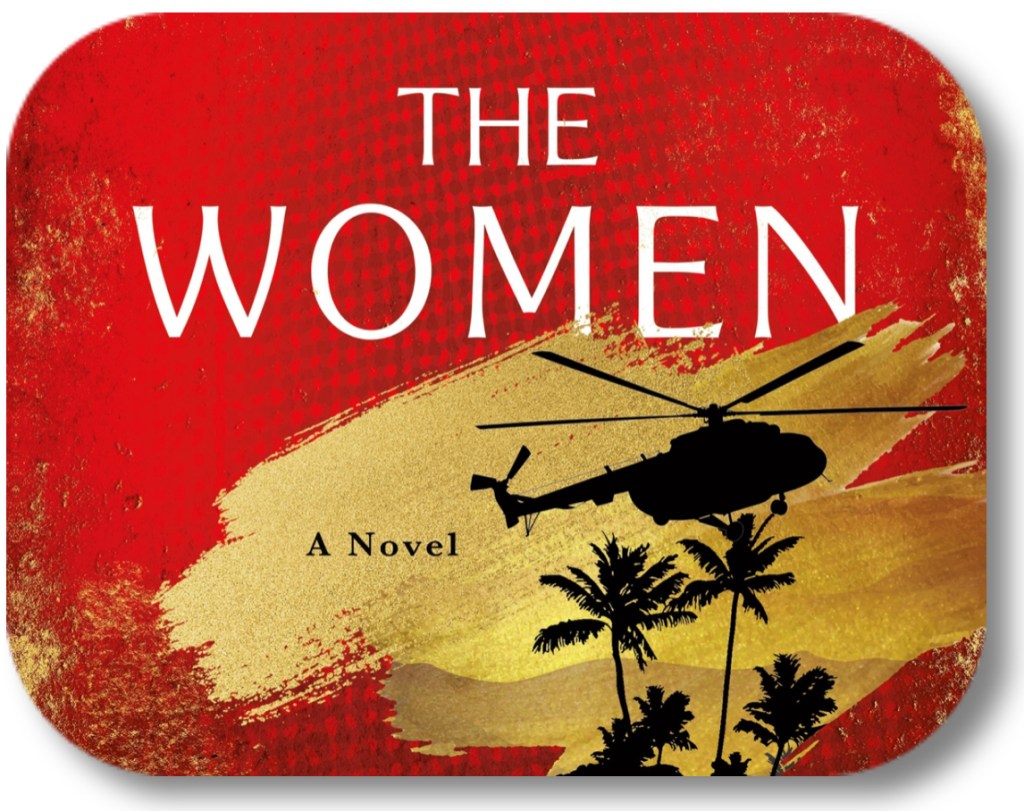
by Kristin Hannah (a summary by Pat Evert)
PART ONE
- One: Coronado Island, California. May 1966
“We are grateful that you have come to help us say bon voyage to our son, Finley.” Everyone loved Finley, but most agreed that he was a handful. “How come there are no pictures of women up here, except for the wedding pictures?” Rye asked. “It’s a heroes’ wall. To honor the sacrifices our family has made in service of the country.”“Women can be heroes. I mean it, Frankie. It’s 1966. The whole world is changing.” Why had it never occurred to Frankie that a girl, a woman, could have a place on her father’s office wall for doing something heroic or important, that a woman could invent something or discover something or be a nurse on the battlefield, could literally save lives? No one had ever suggested any future for Frankie beyond marriage and motherhood. Everyone said the same thing: Communism was an evil that had to be stopped; these were the Cold War years. Her brother was going to war.
- Two
She could see the outline of his legs, or his one leg, beneath the white blanket. “Don’t go. They’re sending me to a psych ward for trying to kill myself. Involuntary hold, or some bullshit. I made it three hundred and forty days in-country. Thought I was home free. That ain’t good. Bein’ a short-timer.” At Frankie’s obvious confusion, he said: “Vietnam.” He sighed. “Will you stay till I fall asleep, ma’am? I have these nightmares…” Women can be heroes. At that, Frankie felt a kind of reawakening, the emergence of a bold new ambition. “I could serve my country,” she said to the man whose hand she held. She let the idea soar, closed her eyes, imagined telling her parents that she’d joined the Navy and would be going to Vietnam, writing a letter to Finley: Drumroll, please, I’ve joined the Navy and will be shipping out to Vietnam! See you soon! If she did it now, they could be over there together. In-country. She could earn her place on the heroes’ wall, and not for marrying well. For saving lives in wartime. Wait. Think about it, Frankie. It could be dangerous. But the danger didn’t resonate. She’d be on a hospital ship, far from the fighting. By the time she let go of the soldier’s hand, she had decided. She knew what she wanted to do and she didn’t want anyone to dissuade her. A small clot of war protesters stood outside, yelling slogans and holding up signs that read WAR IS NOT HEALTHY FOR CHILDREN AND OTHER LIVING THINGS and BOMBING FOR PEACE IS LIKE SCREWING FOR VIRGINITY. At the Army recruiting station, she finally heard what she wanted to hear: Sure, ma’am. The Army Nurse Corps needs nurses. We could ship you right out after Basic. Frankie signed her name on the dotted line, and just like that, she was Second Lieutenant Frances McGrath.
- Three
“I remember when my father came home from the war. Broken. Stitches holding him together. He had nightmares. I swear it’s what killed him early.” Her voice broke. “And you think you’ll go over there and see your brother and have an adventure? How could you be so stupid?” Frankie could see that her mother was trying to corral her emotions, trying to look calm.
Sorry to inform you, ma’am, that Ensign Finley McGrath has been killed in action. Shot down … in a helicopter … No remains … all hands lost. Her big brother. Gone. “Don’t go,” Mom said quietly. “I’m right here, Mom.” Mom turned. “I mean … to Vietnam.” Vietnam. A car crash of a word now.
- Four
The colonel rifled through the paperwork. “Welcome to the Thirty-Sixth. We are a four-hundred-bed evac hospital on the coast about sixty miles from Saigon. You are one of nine female nurses on staff, in addition to male nurses and medics. We provide care for the VSI who are medevaced—Very seriously injured. Here you’ll see everything from leprosy to amputations to rat bites to what’s left of a soldier after a land mine. Most wounds require delayed primary closures—DPCs—which means we clear and debride wounds but don’t close. That will be your biggest job. From here, the lucky ones go to the Third Field Hospital in Saigon, for more specialized treatment; the unlucky ones go back to their units; and the really unlucky ones go home in a box. The woman led the way past a series of Quonset huts. “That’s the ER, Pre-Op, the two ORs, Post-Op, the ICU, and Neuro.” She kept going. “That’s the mess hall.” Patty smiled, then offered two bottles of pills. “Malaria and diarrhea. Take them religiously. Don’t drink the water unless it’s out of a Lister bag or jerry can.” “Crap,” Patty said. “Incoming. I guess you’re on your own, McGrath. Get settled in.”
- Five
An explosion rocked the O Club. The walls rattled. A red-alert siren blared across camp. A voice came out over the loudspeaker: Attention all personnel, take cover. Security Alert condition red. We are under rocket attack. Repeat: condition red. Take cover. He grabbed her, pulled her back. “You’re safe, McGrath,” the man whispered in her ear. She felt his breath on her neck. “At least as safe as anywhere in the damned country. Just breathe. I’ve got you.” She heard the rockets flare and explode, felt the ground shimmy under her feet. Frankie flinched at every explosion. “That’s the all clear,” he said. And when another explosion sounded, he laughed and said, “That’s us. Giving it back to them.” “What kind of host would I be if I shoved you out of your own party because of a little mortar attack? I’m Jamie Callahan. Chest cutter. “You’re a d-doctor?” she made herself say. “Yep. Ward Five. Surgical.” The crowd joined in, sang along, paired up and started dancing. Just like that, the party was back in full swing, with people smoking and drinking and laughing as if they hadn’t just been bombed.
- Six
The next morning, she was in her sauna-hot hooch, in Vietnam. With a pounding headache. She’d had two shots of whiskey last night. Two. And nothing to eat. Unarmed medevac helicopters that transported injured men off the field. Two of them hovered as the third lowered. A medic and two nurses appeared almost instantly and began off-loading men on litters. Medics ran in and out, carrying men on litters: one lay screaming, his own severed leg on his chest; another had no legs at all. Their uniforms were bloody; some of their faces were still smoking from burns the medics—or their friends—had put out. There were gaping chest wounds—one guy she could see had a broken rib sticking up. Ethel stood in the midst of the chaos like an Amazon goddess, directing traffic, positioning the casualties, pointing out what to do with the wounded. She seemed unaffected by the chaos. There were so many wounded that some had to be left outside, their litters set on sawhorses, waiting for space in the ER. “This is triage,” Ethel said. “We assess here. We decide who gets seen and when. We treat the ones we can save first. That screen over there in the back? We put the expectants there—men who probably aren’t going to make it. We see them last. We can treat five gutshot wounds or amputations in the time it takes to handle one head injury. You understand? “The expectants will be seen when we have time. We will save plenty of lives today, Frank. But not all of them. Never all of them.” It wasn’t the ache in her bones and muscles and feet that mattered. It was shame. “No one is ever ready for this. The worst part is that you’ll get used to it. Let’s clean up and fill our bellies and then head to the O Club to blow off some steam. You just survived your first MASCAL (mass casualty) in ’Nam.” You’re thinking you screwed up by signing up for ’Nam, thinking you don’t belong. But let me tell you, kid, it doesn’t matter where you’re from or how you grew up or what god you believe in, if you’re here, you’re among friends. We’ve got you.”
- Seven
“I heard you were as much help in the ER as a tiara,” the major said, and opened a manila folder. “A nursing degree from some small Catholic women’s college and almost no clinical experience. And you’re young. Anyway. You’re here. Unready, unprepared, but here. I’m assigning you to Neuro. Night shift.” Stryker frame beds, beds for paraplegics, for patients with pelvic fractures, burn patients, or others who couldn’t handle much manipulation. Two rows of beds were separated by a wide aisle. Metal tubing ran the length of each wall for hanging IVs. The amount of equipment at each bed was staggering: ventilators, cooling blankets, monitors, IVs. Frankie didn’t even recognize most of the machines. The overhead lights were blaringly bright. “Anyway, Frankie, every patient in here is brain-damaged. Most have no pupillary response. One soldier after another who lay naked beneath pale sheets, staring at nothing; most were on ventilators.
April 14, 1967 Dear Mom and Dad. I spend my shift shining bright lights into my patients’ eyes, marking down any pupil dilation, or lack thereof, changing surgical dressings, suctioning wounds, monitoring ventilators, changing IVs, turning paralyzed patients every few hours, pinching or poking places on the bodies to see if they can feel pain. Love you, Frankie.
Pain management was the task Frankie took the most seriously. Because her patients couldn’t speak, she took extra care with each one to assess—and assume—their pain levels. Now she stood at the bedside of nineteen-year-old Private Jorge Ruiz, a radio operator who had saved most of his platoon. Captain Smith had placed him in the back of the ward, which meant that he wasn’t expected to live long enough for transfer. “Hey, Private,” Frankie said, leaning down close, whispering directly into his ear. “I’m Frankie McGrath. I’m one of your nurses.” She leaned forward to smell the wound. All normal. No infection. “Looking good, Private Ruiz. A lot of the boys in this room would be envious of a healing like that,” she said as she re-bandaged the wound. Beside her, the ventilator rose and fell, whooshed and thunked, inflating and deflating his sunken chest. “Thank you, ma’am, for taking care of him. Could we take a picture of you with him? For his mama?”
“Rise and shine, princess.” “Go away, Ethel. I’m sleeping.” Frankie rolled onto her side. You’ve been hiding out with the gorks for six weeks. We haven’t seen you in the O Club in weeks. Who comes to ’Nam and plays with no one?” We’re going on a field trip. Bring your camera.” The medical team set up a makeshift clinic with a portable exam table in a bare hut with a thatched roof; another table was set up outside with a tub full of soapy water for scrubbing lice out of children’s hair and washing sores on their skin. The villagers, young and old, waited patiently to be seen for a variety of ailments. Frankie dispensed worming pills, antacids, aspirin, laxatives, and malaria tablets. Frankie smelled something rotten and foul … The girl was adolescent, thirteen maybe, with tangled black hair and sallow skin. Her left hand was wrapped in a dirty, bloody bandage. Frankie knelt beside the girl, who eyed her warily. “I won’t hurt you,” she said, lifting the bandaged hand and slowly unwrapping it. The smell of rot assailed her. The hand had been mangled beyond recognition. Amputation and antibiotics are the best chance she has to live. He administered a sedative. When the girl closed her eyes and went limp, Captain Smith said, “Hold her down, Frankie,” and pulled out a saw. Dr. Smith administered morphine. “Hold her by the forearm,” Captain Smith said. “Hard.” Frankie held on to the girl and did her best to help; the amputation was so brutal she had to look away several times, but when the surgery was over and the girl lay still, Frankie carefully treated the stump and wrapped it in clean white gauze. Hopefully, a girl would grow to adulthood because of their work on this day. Yes, the girl would join a generation of amputees who had survived war, but she could run and play and marry and hold a child in her arms.
- Eight
Dear Frances Grace, I can hardly believe you’ve been there for more than a month. In your absence, the country has gone mad. Sit-ins. Protests. Raised fists. Believe you me, more than a few of these free love girls are going to wake up in trouble, and where will their dirty-footed lovers be then? In prison or long gone, I’d say. The world changes for men, Frances. For women, it stays pretty much the same. With love, your mother.
She gave his hand a squeeze and then went from bed to bed, saying good night to each of her patients with a touch and a whispered, “You’re safe now. We will get you home.” It was all she could think of to say to men so broken.
“Come work in surgery with me. I need someone good to replace her. I want you, McGrath.” She’d learned what she could from Neuro. If she really loved nursing and wanted to be even better, it was time to take the next step. “Okay, Captain Callahan. Her first shift in the OR. Chaos. two medics carried a litter into the OR. On it, a soldier—a kid—was sitting up, yelling, “Where are my legs?” “Just breathe, McGrath,” Jamie said. “Delayed primary closure. Dirty wounds need to be cleaned. We close them later to prevent infection. This is a D and I. Debride and irrigate. That’s a frag wound. We need to stop the bleeding and remove the metal fragments and cut away the dead skin. Then we irrigate with saline. We make little holes out of big ones. Can you help me? No fear, McGrath. You can do this.” Jamie looked at Frankie. “She was great.” “I told you you could cut it,” Barb said to Frankie, giving her a hip bump. “There are men going home to their families because of us. That’s about all we can hope for.”
May 16, 1967 Dear Mom and Dad, I am training to be a surgical nurse now. I want to be good at this more than I’ve ever wanted anything. It’s a good feeling to love what you do. How’s life back in the world? Love you, F.
May 31, 1967 Dear Frances Grace. It is a strange world we are all in. Volatile and uncertain. We—Americans, I mean—can’t seem to talk to each other anymore, our disagreements seem insurmountable. I imagine it would feel wonderful to be good at something that mattered. That is something that too many of the women of my generation didn’t consider. With love, Your mother
- Nine
In the past month, they’d spent more hours together than some married couples spent together in a year. All of this hardship. Sometimes, over here, the only way to handle the emotional pain was to laugh—or cry. She fought her feelings for Jamie, but at night, alone in her cot, she thought of him, thought, What if. It might all be a mirage, this connection between them, brought on by proximity and the horror of what they saw every day, but it felt real. Sometimes they found themselves standing together, or sitting side by side, just staring at each other, saying nothing, both of them feeling too much for the other and knowing that words wouldn’t ease their longing. If one leaned forward, the other might, too. She had never wanted to kiss a man more. The love she felt for him caused a physical ache in her chest. She had to force herself to step back.
July 5, 1967 Dearest Frances Grace, I only want to write with good news, but the world has gone insane. The hippies aren’t so peaceful anymore, I can tell you. Apparently, some International War Crimes Tribunal found the U.S. guilty of bombing civilian targets, including schools—SCHOOLS, Frankie!—and churches and even a leper colony. Who knew there were even lepers left in the world? Love, your mother.
July 18, 1967 Dear Mom, in September, Ethel will be leaving Vietnam. Going home. I can’t imagine doing this without her. But I will, I guess. Over here
One room held a dozen or more cribs, where babies slept and cried. It broke Frankie’s heart to think of how many orphans were being made by this war. Who would care for these children and babies when it ended?
- Ten
The land between the helicopter and the river had been turned into Beach Party Central. A banner that read WE WILL MISS YOU, ETHEL, was strung between two bamboo poles. Beneath it, a stocky man in a Rolling Stones T-shirt stood at a barbecue, grilling burgers. A portable generator powered a stereo and “Purple Haze” blared through the speakers, loud enough to drown out the distant whine of the war.
At 0300 hours, a red alert siren blared through camp. Then came the sound of incoming choppers. A swarm of them. One Dust Off after another landed in the pouring rain, full of wounded. Frankie and Barb and Ethel stumbled out of bed and ran to the helipad, helping to offload them. Frankie spent the next eight hours at Jamie’s side, going from one surgery to the next, until she was so tired she could barely stand. There was more love in his eyes than should be there, and probably too much in hers. “I love you, McGrath. I know I’m not supposed to…” She longed to say it in return, but how could she? Words were creators of worlds; you had to be careful with them. He was going to meet his wife, see pictures of his son. “I’ll miss you,” she said instead. War was full of goodbyes, and most of them never really happened; you were always too early or too late. Like with Finley. She had said goodbye to her brother long after the words could have mattered to him. That was one thing this war had taught her; there was never enough time with the people who mattered.
The soldier on the litter wore a blood-soaked T-shirt and fatigues that had been cut off at the thigh. He’d lost his left leg at the knee, a medic had field-wrapped the bloody stump, but that injury was nothing compared to his chest wound. A thick layer of black-red blood covered his face. She picked up his dog tags. “Hey, Captain C—” Callahan. Jamie. “His bird was shot down, ma’am,” one of the medics said.
- Eleven
Jamie lay in a Stryker bed in Neuro, naked beneath a sheet, his face bandaged so completely that only one closed eye could be seen. A tube snaked into his nostril. A ventilator kept him breathing. Whoosh-thunk. Now Frankie sat by Jamie’s bed, held his hand. The heat of his skin indicated that an infection was already taking hold. “We’ll get you to the Third, Jamie. You hang on. You hear me?” Frankie’s mind played and replayed the last thing Jamie had said to her. I love you, McGrath. And she’d said nothing. God, she wished she’d told him the truth, wished they’d kissed, just once, so she could have that memory. She leaned over and kissed his bandaged cheek, felt the heat of his fever, and whispered, “I love you, Jamie.” “There’s something else,” Barb said. “I hate to bring it up now… My DEROS came today. I’m outta here on December twenty-sixth.” Finley. Ethel. Jamie. Barb. “I’m so tired of goodbyes,” Frankie said quietly.
September 30, 1967 Dear Ethel, I don’t know how to write this letter, but if I don’t say the words to someone, I’ll keep lying to myself. Jamie is gone. Love F
October 9, 1967 Dear Frank, Damn war. I remember how I felt when I lost Georgie. I don’t think there’s a word for that kind of grief. But you know what I’m going to say. It’s ’Nam. You meet people, you form these bonds that tighten around you. All of them go away, one way or another. Sending peace and love, girlfriend. E
October 13, 1967 Dear Ethel, Too damn many lessons to learn over here, but the one that’s for sure is this: life is short. I’m not sure I ever really believed that before. I do, now. Luv ya, F
“Are you okay, Major?” Frankie asked. “Rough few days,” the major said. “You’re being transferred to the Seventy-First Evac.” Frankie’s stomach dropped. “Pleiku?” “Yep. It’s near the Cambodian border. Central Highlands. Deep jungle.” She paused. “Heavy fighting.” Major Goldstein sighed heavily. “Losing you is pure shit from my end. I’ll get some newbie nurse to replace you, no doubt, but orders are orders. You’re a hell of a combat nurse.” She sighed again. “So, naturally, I lose you. It’s the Army way. Believe me, Lieutenant McGrath, you will not thank me for this.”
October 20, 1967 Dear Mom and Dad, My friend Ethel went home and Barb and I surely miss her. I never knew how intense wartime friendships could be. I’ve been at the 36th Evac Hospital for six months, and it seems that the brass wants me to move up north, into the Central Highlands, to the 71st. I’ll send you my address when I know what it is. Barb is going, too. I’m happy I came here. Even on bad days, even on the worst days, I believe this is what I’m meant to do and where I’m meant to be. Love to you both, F
- Twelve
There were more than 450,000 American men in Vietnam now and God knew how many deaths and casualties. Sometimes the pushes were so intense, the numbers of incoming and their injuries so bad, that Frankie and Barb and Hap and the rest of the doctors and nurses worked for eighteen hours straight on both soldiers and civilians, with barely a break for food or drink. There was no winning in war. Not this war, anyway. There was just pain and death and destruction; good men coming home either broken beyond repair or in body bags, and bombs dropping on civilians, and a generation of children being orphaned. How could all this death and destruction be the way to stop communism?
November 7, 1967 Dear Mom and Dad. If I chose to describe a mass casualty, you’d be horrified. I’m horrified, and I’m even more horrified that normally I can get through it. And it is not just American soldiers who are being killed. The Vietnamese people are suffering and dying, too. Men. Women. Children. Last week, an entire village was bombed and set on fire. Why? Because no one really knows who the enemy is over here and our boys are being killed by jungle snipers and they’re jumpy as hell. It’s dangerous to be scared all the time. Much love, F
All these young men who’d come here, most of them by choice, being shot at, ripped apart, broken into pieces. The majority were Black or Hispanic or poor, straight out of high school. They didn’t have parents who could pull strings to get them out of service or into the National Guard, or college classes to keep them safe, or girls who would marry them.
November 17, 1967 Dear Barbara Sue. Lord, I don’t know who to worry more about these days, you in harm’s way, or your brother in California. Ever since your brother got back from Vietnam, he’s been angry in a way that will get him killed. Those college white boys might get away with violence at their protests, but it won’t fly for Will and his Black Panther friends. Love, Mama
When Frankie looked in the mirror, she saw herself for the first time in eight months. Eyes still a vibrant blue, pale skin freckled by the sun, lips so chapped lipstick didn’t work, hair shaggy and grown out at different lengths.
- Thirteen
Women can be heroes. Those words—Rye’s words—to an impressionable twenty-year-old had led her inevitably to this room, this war. It felt like fate, them meeting here. War looked one way for those who saw it from a safe distance. Close up, the view was different. As a girl, she’d dreamed about this moment with him; as a woman, she knew how fragile dreams were and this war had taught her to dance while she could. She got to her feet. “When I danced with Jamie, I felt safe. Loved, I guess. It was like being home, but with Rye … when I was in his arms, I felt … I mean, the way he looked at me was … hungry. Almost scary.” “It’s called lust, Frankie, and it can rock your good-girl world.”
- Fourteen
December had been a hell of a month in the Highlands. The NVA had killed hundreds of South Vietnamese civilians at Dak To. The OR and the wards had been filled with kids who’d lost their parents, old men who’d lost their daughters, mothers who’d lost their sons. All she knew was that they were here in this faraway country, soldiers and sailors and airmen and Marines and volunteers, risking their lives, and their government could no longer be trusted to tell them the truth about why. “Thanks for this,” she said. “It was crazy and stupid and dangerous … and lovely.” “I didn’t want to think about you,” Rye said. She turned to him at last. Their gazes met, held. She felt her breathing speed up. Lust, Barb had said. Was it that simple? There was no reason to pretend she didn’t feel it. If she’d learned anything during her tour it was this: say what you meant while you could. “You’re engaged,” she said. “And I know it’s old-fashioned, but I can’t be the other woman. I couldn’t live with myself.” “You do know we’re at war,” he said. “Please tell me you aren’t going to try the we-could-die-tomorrow line on me.” He stepped back. “You’re right. I’m wrong. Merry Christmas Eve, Frankie. I won’t bother you again.” “You don’t need to go.” “Yes, I do. You … do something to me.” A group walked over to the Park, where Frankie had hung up a banner: BON VOYAGE, LT JOHNSON. WE WILL MISS YOUR SORRY ASS.
December 26, 1967 Dearest Frankie, Call me a coward. I should have wakened you when my bird showed up, but you were actually sleeping, and we both know how rare that is over here. I didn’t want you to see me crying. I love you. Happy forever seems a shitload to ask in a world on fire. Be cool. B
- Fifteen
January 5, 1968 Dear Frankie. I need to find a new path. I’m sick of being treated like a candy striper. There’s not a lot of love for us veterans here. I don’t know what I’ll do now. It’s hard to go from red alert sirens and saving lives to pantyhose and heels. The world might be changing, but we women are still second-class citizens. And Black women. Well. You do the math. Save some lives for me. B
On a quiet day in mid-January of 1968, Frankie’s DEROS came in. She tacked the paper up on the plywood wall above her cot and drew a big red circle around March 15 and an X through today. At 0400 hours, on January 31, a rocket hit the Seventy-First. Explosions ripped through the night. Frankie got the lights on, the tables ready. She sure wished Hap were still here, but he’d shipped out two months ago. Their newest doc had been here a week. It was going to be a tough night for him. She heard the first Dust Off arrive at 0430. “Where’s a goddamn doctor?” she yelled. Wounded streamed from triage into the OR. For hours, the evac hospital overflowed with casualties; all of the casualties had been operated on.
There was almost nothing left of a man who had been whole minutes ago. Field dressings were blood-soaked on three missing limbs. Blood and mud covered what remained of his face. “Hey, Albert,” she said softly. “Did you come by to show me that fine ass of yours again?” She leaned over the dying man, barely older than a boy, and placed a hand on his ruined chest. She lay down and closed her eyes, almost whispered, Stay until I’m asleep. But what would be the point? The Stars and Stripes called it the Tet Offensive: a massive coordinated attack across the country by the North Vietnamese in the early hours of January 31, 1968, the bloodiest day of the Vietnam War so far.
“Just think. You’re going home.” How could she go from red alert sirens and saving lives to butter knives and champagne glasses? “I don’t know how we’ll manage without you,” Margie said. There was no nurse here with the experience Frankie had. How could she leave this hospital and the casualties—American and South Vietnamese—who needed her? As much as she sometimes hated the war, she loved nursing more.
February 3, 1968 Dear Mom and Dad. It sounds crazy and absurd, but I have found my calling here in Vietnam. I love what I do, and I make a real difference. I am not coming home next month. I have signed up for another one-year tour of duty. I simply can’t leave my post when the men need me. There. I can hear you screaming. If you knew me now, you’d understand. I am a combat nurse. F
February 17, 1968 Dear Frances Grace, NO. NO. NO. Change your mind. Come home. Be safe. Your mother
“I’ve been informed that you have failed to take an R and R this tour. And your new tour starts in two weeks. You need a break.” “You think a little hula time will fix me?” “It won’t hurt. Either way, you leave tomorrow. Here’s your itinerary. Go. Rest. Drink cocktails that come with umbrellas. Sleep. I could be saving your life, McGrath. Trust me. I’ve been where you are. We all can break.”
- Sixteen
Frankie stumbled into the lobby of the Coco Palms Hotel on the island of Kauai, and checked in. Once in her room, without bothering to shower, she yanked the curtains closed and collapsed onto the softest bed she’d ever felt and fell asleep. When she woke, she heard birds singing. Birds. Singing. No mortars exploding or shells hammering the walls, no smell of blood or shit or smoke in the air, no screaming, no Dust Offs whirring overhead. The captain had been right; Frankie needed this respite. “So you’re the little bird who ratted me out. Why?” “To see you.” “Rye, I told you—” “I broke off my engagement.” That stopped her. “You did?” “I couldn’t pretend anymore, not after Tet. Life is short, and…” He paused. “There’s something between us, Frankie. Tell me you don’t feel it and I’ll walk away.” They had made it through hardship—death all around—to be here, sipping cocktails on a tropical island. Did it mean something? How would they know unless they dared to begin? They needed first to get to know each other. For the first time, she was the one who wanted more. In all the world, all the universe, they’d come together somehow, halfway around the world, and it felt like destiny.
Dear Barb, I only have time for a postcard. Sex was great. I was bold. And you were right. He knew what he was doing. F
Frankie became a new version of herself in Rye’s bed. They spent their days and nights exploring each other’s bodies, learning cues, and listening. She discovered a passion so deep it stripped away her shyness, dissolved the once-important rules of propriety, redefined her. Her desire for him felt endless, boundless, desperate. She already couldn’t sleep without touching him. She realized suddenly, sharply, how much passion changed things. He could break her heart in ways she couldn’t even imagine. “I’ve never felt this way before,” he said. “Honest to God. You … destroy me, Frankie. There’s no getting rid of me now, McGrath. I guess I’ll have to re-up, too. I’m not leaving my girl over here without me.”
- Seventeen
April 10, 1968 Dear Frankie, I don’t know how to write this. My brother, Will, was killed by the Oakland police this week. A shoot-out with the Black Panthers. He was shot ten times, even though he’d surrendered. I’m devastated. Heartbroken. Pissed off. I need my best friend here with me to keep me steady. Love you, B
April 24, 1968 Dear Barb, I know your grief. Losing a brother is losing a piece of yourself, your history. Love F
June 16, 1968 Dear Mom and Dad. I can’t believe that another Kennedy has been assassinated. What is wrong with the world? Things are getting worse over here, too. Morale among the troops is the worst I’ve ever seen it. Between the assassination of MLK and Robert Kennedy and the protests back home, everyone is mad as hell. If you wonder how we can lose a war, imagine how the guys fighting it feel. And LBJ just sends more and more untrained kids to fight. I see more and more soldiers stumbling in from the boonies, their minds broken, their nerves shot to hell. Love you, F
Constant fear turned a man inside out. She thought of other men who had grabbed her hand over the past few months, begged her to answer the question, Who will want me like this?, and it struck her that it wasn’t just physical wounds that soldiers would take home from Vietnam. From now on, all of them would have a deep understanding of both man’s cruelty and his heroism. Two minutes later, a flood of villagers hit the OR, most of whom had been burned beyond recognition. Frankie knew it was the same scene in the ICU and Pre-Op and on the wards. Napalm—a jellied firebomb used in flamethrowers by the U.S. to clear out foxholes and trenches, and dropped in bombs by U.S. planes. These burns were like nothing else on earth. The gel-fueled firebomb mixture stuck to its target and didn’t stop burning until nothing was left.
A banner hung over the bulletin board wall: CONGRATS 1ST LIEUTENANT MCGRATH! Major Goldstein from the Thirty-Sixth stepped forward, with Captain Miniver beside her. “This promotion is late in coming, but nothing happens on time in the Army,” Major Goldstein said. “We all know that. Congratulations.”
- Eighteen
On her last day in-country, March 14, 1969, Frankie woke up well before dawn. In war, she’d found out who she really was and who she wanted to be, and as tired as she was of all the death and destruction, she was also more than a little afraid to go home. What would life look like stateside? The protests were getting louder, longer, angrier. Even here, there was anger about the war. She wrote Margie a goodbye note that said in part, I know you’ll wish I’d wakened you for a goodbye. It won’t be long before you’ll know how hard it is. We are professionals at goodbye, and still it hurts. Stay tough. Thanks for sending my footlocker home for me. As bad as it had been in ’Nam, as frightened and angry and betrayed as she’d often felt by her government and the war, she’d also felt alive. Competent and important. A woman who made a difference in the world. Alone out here, she saw the way people stared at her. First there was a widening of the eyes—surprise at seeing a woman in uniform—and then the narrowing of mistrust or outright disgust. It took four hours and three bus changes for her to reach Coronado Island. By then, she had been spat on four times, flipped off more times than she could count, and become used to—or at least immune to—the way people looked at her. How often had she dreamed of this moment, of safety and love and comfort, of hot baths and fresh coffee and long, slow walks along the beach without an armed guard standing by?
“Don’t take it to heart,” Mom said lightly. “Ever since Finley’s … passing, and your leaving, he isn’t himself.” “Oh,” Frankie said. Had her mother just equated her war service to her brother’s death? She shouldn’t have surprised her parents. She’d caught them off guard. Tomorrow would be better.
- Nineteen
March 17 Dear Barb, I’m home. No one told me how tough it was, this re-entry. Love you, sis. Stay cool, F
“Your father said you were studying abroad.” “What?” Frankie turned to her mother. “Are you fucking kidding me?” Dr. Brenner left like a shot at the curse word. Mom looked around to see if they were being observed. “Sit down, Frances.” “You lied about where I was?” “Your father thought—” “He was ashamed of me? Ashamed of my service, after all those stories, all that hero talk?” “Am I embarrassing you?” And you think this is a scene? No, Mom. A scene is when a soldier comes in off the battlefield holding his own foot. It’s when—” It felt as if there were nothing left for her here, in this place she’d always loved.
March 22, 1969 My love, I miss you so much I can’t stand it. I’m counting the days until your return. Things at home are terrible. I don’t know what to do. My parents lied about my service in Vietnam. That’s how ashamed they are of me. It makes me mad in a way I’ve never felt before. Furious. I love you, F
March 24, 1969 Dear Rye. I’m angry all of the time. And hurt. My parents hardly speak to me and rarely to each other. They don’t want to hear anything about Vietnam. That’s not even the worst of it. I have these terrible nightmares of the war. I wake up feeling like I’ve been beaten up. Dreaming of you coming back, is holding me together. I love you, F
“I wanted to talk about throwing Rye a coming-home party. I’m—” “I know who you are, missy. And there ain’t gonna be a damned party for my son. You should know that.” Frankie stared down at the telegram. We regret to inform you … Lieutenant Commander Joseph Ryerson Walsh has been killed in action. The telegram shook in her hand. We regret to inform you. Rye. She thought of him carrying her to her hooch … the night he’d shown up in her OR, worrying about her … their first kiss … that night on the beach on Kauai where he’d shown her what love felt like. I’m afraid I’ll love you till I die … Rye. Her love. Gone. Frankie felt her heartbeat slow, felt vaguely that it might be physically breaking down and would be unable to beat in a world without Rye, in this body of hers that felt suddenly foreign.
- Twenty
Frankie turned her head, saw Ethel and Barb standing in her bedroom. Frankie thought about how she’d changed in the past two years, what she’d learned about herself and the world. About Jamie, and her certainty that she had to do the right thing, which meant that she’d never even kissed him; she thought about Rye and how their passion had transformed her, loosened her into a different, bolder version of herself. She thought about Fin and their idyllic childhood, the way he’d told her, It’s okay, and she’d believed him. All of them, the three men she’d loved, had awakened her, filled her heart, made her happy, but they couldn’t be everything.
I hear you have almost no hospital experience.” Nurses who know next to nothing do next to nothing. I will tell you when you can treat actual patients. For now, you may help patients to the restroom, refill their water, change bedpans, and man the phone at the nurses’ station.”
- Twenty-One
Frankie wrenched it away from her mother, turned it over to the article. Army nurse Sharon Lane is the first—and so far only—nurse to be killed by enemy fire, although seven nurses have been killed or died during the conflict to date. First Lt. Lane died almost instantly when a rocket fragment struck her during an attack at Chu Lai. “I wasn’t in Florence, Bex,” she said slowly, trying to calm down. “I was in Vietnam.” Silence. Then a titter of laughter. It broke the silence; the women all joined in. Becky looked relieved. “Ah. Funny joke, Frankie. You always were a card.” Frankie took a step closer, went toe to toe with her best friend from ninth grade. All the while she was thinking, Calm down, back off, at the same time she thought, Killed by enemy fire and almost instantly. “Believe me, Bex. It is not a joke. I’ve held men’s severed legs in my hands and tried to hold their chests together just long enough to get them into the OR. What’s happening in Vietnam is no joke. The joke is here. This.” She looked around. “You.” All she’d had to do was claim a need to leave and politely walk out of the party. Instead … Her anxiety and anger had surged, come out of nowhere, and suffocated her. Even now, hours later, it was still there, lying in wait, ready to lash out at a moment’s notice. It made her feel weak, shaky. Fragile. She had to do better, be better. No more putting herself in upsetting situations. No more telling people she’d been to Vietnam. They didn’t want to hear it, anyway. The message was clear: Don’t talk about it. She needed to do as everyone suggested and forget. She knew that enforced silence added to her anxiety, increased her anger, but it was undeniably true that even her own family was ashamed of her service and expected her to be ashamed, too.
Mrs. Henderson stood there, her arms crossed, her hair frizzed out around her white, starched cap, her forehead pleated, her mouth set in a grim line. “You could have killed that man.” “I saved him, ma’am.” “Who do you think you are?” “I’m a combat nurse. A good one.” “That may be,” Mrs. Henderson said, “but you’re also a loose cannon. You have just exposed this hospital to liability. You’re fired.”
- Twenty-Two
Her mind was a whirlwind: anger, fear, grief, sorrow. Every now and then she cried. Then she’d scream. Neither helped at all. “I saved a man’s life in the hospital tonight. Performed a tracheotomy.” “You?” her father said, one eyebrow cocked in disbelief. “Yes, Dad. Me.” She knew then what this was about, what it had always been about. His reputation. The man with his stupid heroes’ wall who knew nothing about heroism and lived in fear of that embarrassing truth being exposed. “If you don’t want to be seen as a liar, maybe you shouldn’t lie, Dad.” She saw all those pictures and mementos on the heroes’ wall, and without thinking, she went into the sacred space and started pulling the framed pictures off the wall, throwing them to the floor. She heard glass shatter. “What the hell do you think you’re doing?” Dad roared at her from the doorway. “This,” she said. “Your heroes’ wall. It’s a big fat lie, isn’t it, Dad? You wouldn’t know a hero if one bit you in the ass. Believe me, Dad. I’ve seen heroes.” “Your brother would be as ashamed of your behavior as we are,” Dad said. Mom appeared in the doorway, threw Dad a pleading look. “Connor, don’t.” “How dare you mention Finley?” Frankie said, her anger swooping back in. “You who got him killed. He went over there for you, to make you proud. I could tell him now not to bother, couldn’t I? Oh, but he’s dead.” “Out,” her father said in barely above a whisper. “Get out of this house and stay out.” “With pleasure,” Frankie hissed. She snagged the photograph of her brother and stormed out of the office. She felt like the last girl in a horror film, running for her life, but the danger wasn’t behind her, trying to catch up, it was inside her, trying to break out. She came to slowly, saw the crunched wreckage of the VW Bug’s hood. She’d hit a streetlamp, gone up onto the curb. She could have killed someone. “Jesus,” she said, in both relief and prayer. She boarded a city bus and exited a few miles later, then walked to the Veterans Administration Outpatient Clinic. I can’t seem to get a handle on my emotions since I got back. I’m always either banshee-angry or bursting into tears.” “You’ll be fine. Trust me. Go home. Go out with friends. Fall in love again. You’re young. Just forget about Vietnam.” Just forget. It was what everyone recommended. Why couldn’t she do it? Someone was pounding on the door. Barb and Ethel stood there, side by side, both with worried looks on their faces. “Where are we going?” Frankie asked. “My dad’s farm near Charlottesville,” Ethel said. “You two are moving into the bunkhouse. I’m going to finish school. Barb joined that new organization. Vietnam Veterans Against the War.” Thank God for girlfriends. In this crazy, chaotic, divided world that was run by men, you could count on the women. The three put their hands together. “Enough bad memories,” she said solemnly. “We won’t ever forget, God knows, but we move forward. Away from Vietnam. Into the future.”
PART II
- Twenty-three; Virginia, April 1971
At twenty-five, Frankie moved with the kind of caution that came with age; she was constantly on guard, aware that something bad could happen at any moment. She trusted neither the ground beneath her feet nor the sky above her head. Since coming home from war, she had learned how fragile she was, how easily upended her emotions could be. But time—and friendship—had done exactly as promised: pain and grief had grown soft in her hands, almost pliable. She found she could form them into something kinder if she was deliberate in thought and action. Frankie remembered, and often reread, that first letter from her mother: I am so grateful to your Army girlfriends for being there for you when your father and I were not. We love you, and if we don’t say it often enough, it is because we grew up in families where there was no such vocabulary. About your father and his … reticence about you and the war. All I can say is that something in him was broken by being unable to serve his country. All the men of his generation went to Europe, while he stayed home. Yes, he was proud of Finley and ashamed of you. But perhaps in truth he is ashamed of himself and worries that you judge him harshly, as he feared his friends had done …
Ethel was in her third year of veterinary school and worked part-time with her father. She kept her head down and did her job and said nothing controversial to her friends and neighbors. This war will be over soon, she always said, but I’ll always live here. My kids will be in 4-H, I’ll probably run the damned PTA. Barb was the opposite in every way. She’d become a vocal, participatory member of the Vietnam Veterans Against the War. She lobbied for passage of the Equal Rights Amendment. She marched for a woman’s right to a safe abortion and basic health care. When she wasn’t trying to change the world, she earned money by bartending. Frankie, on the other hand, had found her way back through nursing. But mostly it was being around the horses that calmed Frankie. Ethel had been right about that. Riding had steadied Frankie as much as friendship had.
Frankie didn’t want to march. She didn’t want to think about Vietnam and what it had cost her. She wanted to do what she’d been trying to do for more than two years: forget. It was dangerous, what Barb was asking of Frankie, an upsetting of an already precariously balanced peace in Frankie’s mind. She’d seen people hauled away by the police today, risking their freedom to protest a war many of them hadn’t even fought. Civilians were being arrested for exercising the fundamental American right to protest their government; at Kent State and in Jackson, they’d been shot for it. She didn’t know if protesting and marching and making signs could actually effect change, but she damn sure knew that America wasn’t preserving democracy or fighting communism in Vietnam, and it certainly wasn’t winning. Ultimately too many lives would be lost in pursuit of nothing. Frankie looked up. “I’m glad we marched. You were right.” Barb smiled. “Girlfriend, I am always right. You know that by now.” “But I think we can do more.”
- Twenty-Four
Hugh Downs reported that the Nixon administration had arrested thirteen thousand anti-war protesters in three days. The footage of the Gold Star Mothers and the medals being thrown filled the oval screen; after that came footage from Kent State, where the National Guard had killed unarmed students. “What a lovely woman your mother is. A tireless fundraiser even after … your brother’s death. Bette and I chaired a beautification committee a few years ago. No one does a better event. I was sorry to hear about her stroke.” Frankie had called the house a dozen times in the past twenty-four hours, but not once had anyone picked up the phone. She had no way of leaving a message, so she’d called her father’s office for the first time in years and found out from her father’s secretary that Mom was in the hospital. Ten minutes later, she was packed and ready to fly home. “It’s just the three of us now, Dad,” she said. He looked up, tears in his eyes at the reminder that they’d lost Finley, that any one of them could be lost in a moment, while you looked away, took a breath, stayed angry. He told Mom stories of their youth, retraced the steps of their love, laughed about the way her family had reacted. Frankie learned more about her dad, and the depth of his love for his family, than she’d learned in all the years before. He was sad, and Frankie knew every nuance of sorrow; he just didn’t know how to act without Mom, who to be, what to say. This locomotive of a man who’d rumbled so loudly through her childhood had derailed.
May 9, 1971 Dear Barb and Ethel, Hello from the bubble world of Coronado Island. The good news is that she’s out of the hospital. It will take some time for her to get full mobility, so I’m going to stay to help out. No idea how long. I’ve quit my job at the hospital in Charlottesville. I want you both to know how much you mean to me and that my years with you—both in Vietnam and Virginia—have been the best of times. I’ll get back to see you when I can. Love you both, F
May 14, 1971 Dear Frankie, You’re breaking up the band, girl, and I hate it, but I think it’s time, and this is the kick in the ass I needed. I’ve sent a résumé to Operation Breadbasket in Atlanta. Maybe I’ll meet Jesse Jackson! I’ll miss you! Keep in touch. B
“She knew you’d be back,” he said. Told me this cottage was to be your safe place. She put her foot down. I don’t think she’d ever said such a thing to me before. Or to anyone. Anyway, she had this cottage painted inside and furnished it with the bare essentials. Well, bare essentials as defined by your mother. The car is my contribution.”
- Twenty-Five
Writing letters on behalf of the League of Families and the Vietnam prisoners of war quickly became an obsession. It was slow going, recovery from a stroke, but her mother exerted her considerable will and pushed forward, sometimes to the point of exhaustion. The doctors were amazed at the speed of her recovery.
- Twenty-Six
No one believed America was winning the war anymore. The Fourth of July. Frankie dreaded the holiday. A party at her parents’ house was the last thing Frankie wanted to attend. “I’ve got you,” Henry said. She let him help her to her feet but couldn’t look at him. “Those idiots who get their firecrackers and bottle rockets from Mexico should be in jail,” he said. “Will you take me home?” she said. She heard the words and knew they sounded like an invitation, which wasn’t what she meant. She didn’t want him. Or maybe she did. She held on to his hand, led him into her bedroom. There, she let go, stood back, and faced him, wishing she had made her bed. There were clothes scattered on the floor. Empty glasses on the nightstand. Had she drunk too much last night and stumbled to bed? He took her by the hand and led her to the bed. He pulled her close. She softened in his embrace; their lips touched, tentatively, the kiss of strangers. It wasn’t love, but for a beautiful moment her body came alive, vibrated, hummed, and it was close enough. Henry knew about pain and loss; after the death of his wife, he said he’d fallen into darkness, drunk too much alcohol, and stumbled. They were lonely, both of them, and brokenhearted. They stopped saying the names, stopped talking about true love, and let almost-love—passion—into their lives. But she couldn’t stop it. After so many years of loneliness and grief, Henry brought sunlight into her life. And she was afraid to go back to the dark.
August 1, 1972 Dear Frankie, Enough is enough. Do you think I am an idiot? In case you answer incorrectly, I’m not. Your mother called me last night. She tells me that you’re acting even stranger than usual, and you’re wearing perfume again. I know what this means, girlfriend. Sex. Who are you getting it from and how is it? Luv ya, B
The three of them moved forward, holding hands, merging into the crowd in the park. Leading the march were wounded veterans: men in wheelchairs, on crutches, blind men being led by brothers who could see. They walked up Collins Avenue in silence, more than a thousand of them. Spectators lined the streets, witnessing the march. Barb put an arm around Frankie. “I am pretty sure he loves you.” “Why?” “Who drives a woman cross-country to make sure she marches in a protest and then says he doesn’t belong? Kind of a kick-ass move, in my book.” “He’s thirty-eight. Already been married.”
- Twenty-Seven
Pregnant. The word kept repeating itself. A baby. She wasn’t ready to be a mother, and yet, when she closed her eyes, just for a moment she pictured a whole different version of her life, one in which she loved unconditionally and was loved. In the four days since Dr. Massie had called with confirmation of the pregnancy, Frankie’s anxiety had increased daily. “I don’t…”—love you—“think I’m ready,” she said. He looked so deeply, genuinely committed that it stirred her heart, gave her a glimpse of hope. He was a good man. True. Honest. The kind of man who would stay, grow old with a woman, be there. She was surprised to find that the dream of motherhood was still there, wispy, uncertain, afraid, but there, tangled up with the hope she thought she’d lost. It hadn’t come the way she’d expected, or with the man she’d expected, but nonetheless, it was a miracle. “I’ve got you,” he said, taking her hand. “Trust me.” “Bette, we will have a son-in-law! Welcome to the family, Henry!” “This baby is a miracle, Frankie. Love in this screwed-up world is always worth celebrating. When Susannah died, I thought it was over for me.”
- Twenty-Eight
December 20, 1972 Dear Barb, Thanks for the birthday card! I’ll cut to the chase. I’m pregnant. Henry and I are getting married. I think I’ll learn to love him. Love ya- F
In the first week of the new year, 1973, they started a tradition of weekly dinners with Frankie’s parents. Dad and Henry never seemed to run out of topics to talk about, even though their political views differed. Suddenly the door to the office banged open. Henry stood there, holding a bottle of champagne. “It’s over,” he said. “Over?” Frankie said. “The war,” Henry said. “Nixon signed the Peace Accord.” The League of Families’ efforts changed from advocacy to preparing for the POWs’ return, some of whom had been gone for nearly a decade. A public that couldn’t wait to get past the war embraced the return of the heroes released from the Hoa Lo Prison, a place that was just beginning to be written about as hell on earth. Children were lined up and spit-polished; many were told stories of the fathers they’d never met. They’d been given a flyer: We don’t know what shape the men will be in, physically or emotionally. As you know, there have been reports of torture. For these reasons, we suggest you plan your reunions carefully, keep your husband in a quiet setting until he tells you he’s ready for more. No big parties, no magazine or television interviews, no loud noises or big expectations. Some of these men, as you well know, have lived in captivity, in harsh conditions, for up to eight years. This will have taken an extreme toll on their minds and bodies. Do not expect them to be themselves right away. We expect them to be sexually impotent and prone to hostility toward those they love. How could men come home after years of such treatment and be anything but hostile? They wondered aloud if the men they’d married would still love them. A man stepped out of the plane, saluted to the crowd gathered on the tarmac. Navy Lieutenant Commander Joseph Ryerson Walsh, shot down in March of 1969, presumed dead until a year ago … Frankie stood up, stared at the television, at Rye. The thudding of her heart was so loud she couldn’t hear anything else. He’s alive. Those two words shifted the world off its axis, upset the precarious balance she’d found in the last year. “I’m pregnant, my wedding is this weekend, and the love of my life just came back from the dead. How could I be okay?” Frankie glanced up, felt fear and joy in equal measure. Would he still love her—a different version of him meeting a different version of her? And then there he was—Rye—standing at the top of the ramp. He headed for a tall, curvy woman with a cascade of curly blond hair who stood to one side, holding on to a little girl’s hand. The child held up a sign that read WELCOME HOME, DADDY! He ran the last few steps forward, pulled the woman into his arms, and kissed her. Deeply. “He’s married,” Ethel said softly. “Son of a bitch.”
- Twenty-Nine
She remembered asking him the wrong question in Kauai, and his answer: I swear I’m not engaged. The words played over and over in her head. Hospital. The previous night came back to her in a rush—blood running down her legs, a terrible cramping, a young doctor saying, “I’m sorry, Mrs. Acevedo. There’s nothing I can do.” Frankie sat up, staring dry-eyed at the wall. “I’m not going to marry him,” she said. “It wouldn’t be fair. After losing my son.” Slowly, she took the engagement ring off her finger, gave it back to him. “I can’t marry you, Henry.” Her last, terrible thought was, He’s alive. And then: It was all a lie.
- Thirty
Frankie started to wake up on her bedroom floor again. She didn’t know why the brutal nightmares of Vietnam had come back now. All she knew was that there was no way for her to pretend she was okay and soldier on. Not this time. When she woke, she felt lethargic, unrested. She should eat something. When had she eaten last? Instead, she poured herself a drink and took another sleeping pill, hoping two would be enough to get her through the night. If not, she might take a third. Just this once. She survived one day at a time, by keeping to herself, not saying much. She got a prescription for the pills she needed, worked as many hours as humanly possible. As she stared out at the glittering blue waves, she remembered last night again, the way she’d frozen in the OR like some FNG fresh off the plane. She couldn’t go on like this. She needed to quit taking the pills and get her life back on track. But how? It was bad for her, maybe even dangerous, to watch Rye with his family, but she couldn’t get up, couldn’t stop looking at him and the easy, loving way he was with his daughter. He looked unhappy. She knew their true story now. This was stalking. Embarrassing. He didn’t love her. He was a liar. Still, she followed them, drawn by an obsessive need to see his life. If he was unhappy … Tomorrow she would get her act together. No more pills. And definitely no more stalking. “You shouldn’t be here.” “You shouldn’t have followed me home yesterday.” “I know.” She swallowed the lump in her throat. “Why are you here?” “I know why you followed me. It means you still—” “Don’t.” He pushed his way into her house, took the phone from her hand, set it on the counter. She felt robotic, confused. She couldn’t let him stay but she couldn’t seem to form the words to make him go. “Do you want me, Frankie?” The sadness in his voice ruined her resolve. She took his hand, felt the familiarity of his grasp. “What you’re asking … what you want,” she said, wanting it, too. “It would destroy me. Us. Your family.” In his eyes, she saw the same awakening in him, a reanimation of life. She saw, too, all that he’d been through in captivity, a red scar that cut across his temple in a jagged line, the bags beneath his eyes. The gray in his blond hair that underscored their lost years. At the first touch of his lips to hers, she knew she was doomed, damned. Whatever it was called, she knew it and didn’t care, couldn’t make herself care. She loved him. When he whispered, “Where’s the bedroom?,” she knew she should say, Stop, tell him to come back when he was divorced, but she couldn’t.
- Thirty-One
In love, Frankie learned to lie. It was one of two new constants in her life: lying and loving Rye throughout that long, lazy summer. She didn’t tell anyone she’d been suspended from nursing, and so she had hours when no one expected to hear from her. She lived frugally, on her savings. Her life alternated between two worlds—one of passion and the other of guilt. Day after day, she promised herself, No more. No more pills, no more Rye. He was as much a drug as the others. By summer’s end, Frankie was a knot of nerves; all of the waiting, the hoping, the hiding was tearing her to pieces. She got Barb’s excited phone call that she was getting married. Barb was smiling so brightly it made Frankie’s whole life look tawdry, sinful. It was almost ten months after Rye’s return from Vietnam. “I’m ready to go back to work, ma’am,” Frankie said. “I may soon even have some good news to share that will put your mind at ease.” Frankie pushed the door open just enough to see Melissa Walsh, sitting up in bed, surrounded by balloons and flowers and baskets of candy. A soccer ball balloon said IT’S A BOY! She had no idea what to do, where to go. She’d fallen for his lies again. Again. Melissa must have gotten pregnant soon after Rye’s return. With Frankie, he’d used condoms. Always. Never a mistake. The only person she hated more than Rye was herself. She hit the gas, rocketed forward; a stanchion of concrete in front of her, a wall of gray to her right, and then nothing but water. She turned the wheel, just a fraction of an inch. A man on a bicycle came out of nowhere. She slammed on the brakes, felt the car spiral out of control on the road, saw handlebars in her headlights. She yanked on the wheel, tried to turn the other way. Too late.
- Thirty-Two
Frankie woke in a hospital bed. She’s being charged with DUI. “The man I almost hit … you sure he’s okay? You’re not lying to me?” “He’s fine, Frankie. Bill Brightman. Coronado High principal.” Who had she become? A nothing woman, a ghost. No love, no child. How could she survive? Each of the losses had derailed her, but this, now, the guilt and shame of last night, destroyed her. She didn’t want to open her eyes and be in a world where she was this version of herself. Broken. A fallen woman. A liar. It was all so bad, an avalanche of bad. Finley. She heard his voice out there, beyond the door. In the darkness. Come on, Frankie. Be with me. All she’d wanted was to disappear, not … something else. “It was a dream. I thought Finley was here. I followed him.” “It’s those pills,” he said in a voice she barely recognized. “Your mother never should have given them to you. You took too many.” “Why am I in an ambulance? I’m fine now. I’ll be good. I promise.” Dad looked uncomfortable, embarrassed. Worse, he looked afraid. “Dad?” The ambulance came to a stop. The attendant jumped out, opened the back door. Frankie saw the words PSYCHIATRIC WARD. She shook her head, tried to sit up, found that she was bound to the bed at her wrists and feet. “No, please…” “Thirty-six hours,” Dad said. “A mandatory hold after a suicide attempt. They promised it would help you.”
- Thirty-Three
Had they drugged her? She felt sluggish. She walked to the door, half expecting it to be locked. Psych ward. “Hey, Frankie.” She looked up just in time to see Henry open his arms for a hug. He wrapped her in an embrace that was as stunning as it was familiar. “Your headache, by the way, it’s withdrawal. Withdrawal. “So, in addition to everything else, I’m officially a drug addict and an alcoholic. Yay.” “It’s called post-traumatic stress disorder. It’s a bit controversial, they haven’t added it to the APA manual yet, but we’re seeing similar symptoms in your fellow vets. What you’re experiencing is a familiar response to trauma.” Ashamed. It hit Frankie hard, that word. She had let herself become ashamed; maybe it had started when she’d been spat on in the airport, or when her mother asked her not to talk about the war, or maybe as news of the atrocities began coming out. Almost every civilian she’d met since coming home, including her own family, had subtly or overtly given her the message that what she’d done in Vietnam was shameful. She’d gone to war a patriot and come home a pariah. “How do I get back to who I was?” “There’s no going back, Frankie. You have to find a way to go forward, become the new you. In session after session, day after day, she exposed herself and her past, opening up her deepest wounds. Frankie held on to her best friend’s hand and listened to her stories, her pain, which was like her own. They talked for hours, until night fell slowly around them; the stars came out. Frankie had never known before that words could heal, at least be the beginning of healing. Truthfully, she wasn’t ready to think about her future yet, had no idea if she could believe in the idea of truly healing. I will be, she thought. She could feel strength growing in her, gathering like sunlight in the distance, beginning to warm her. If she stayed the course, worked the steps, believed in herself, she could heal, be a better version of herself. Someday, she thought.
- Thirty-Four
It was remarkable how quickly a turbulent world could calm. In early 1974, with the war over, the country seemed to release a great exhalation of relief. The fight for rights went on, of course: Civil rights and women’s rights were a constant battle and the Stonewall riots had put gay rights in the news, too. As Henry and Dr. Alden each reminded her often, regrets were a waste of time. If only was the bend in a troubling road. It had never been real love for Rye. Oh, he’d shown up in Kauai to romance her, thinking that she was leaving the military within weeks and their affair would be a bit of fun before she left. She’d believed every moment with him. The thing she still grappled most violently with was Vietnam. Those were the nightmares that haunted her. Ask for help when you need it. Count on the people who love you and, mostly, count on yourself. One day at a time. “You deserve to be loved, Frankie. In that forever kind of way. Don’t forget that.” Having discovered her own failings, she was less inclined to judge others. Now it was time to actually go in search of her life. A few miles out of Missoula, Montana, the wide blue Clark Fork river meandering by. FOR SALE. 27 ACRES.
- Thirty-Five
You’re invited to a reunion of the 36th Evac Hospital staff following the unveiling of the new Vietnam Veterans Memorial in Washington, D.C., on November 13, 1982
In the late seventies she’d sat here in her living room and watched a fellow Vietnam vet claim on television that Agent Orange had given him—and thousands like him—cancer. I died in Vietnam; I just didn’t know it, he’d said. Not long after that, the world had learned that the herbicide also caused miscarriages and birth defects. Most likely it had caused Frankie’s miscarriage. The government hadn’t moved to honor the veterans of Vietnam. The vets themselves had had to make this happen. Those who remained honoring those who had fallen. Donna had worked here at the ranch for more than seven years now. Frankie still remembered the cold day Donna had driven up to the front door, her fake black hair every which way, her skin pale from alcoholism, her voice barely above a whisper. I’m a nurse, she’d said. Cu Chi, ’68. I got your name from the VA. I can’t … Sleep, Frankie remembered saying. Using the money from the Coronado cottage sale they made improvements. In Missoula, both of them took nursing jobs at a local hospital. After work hours, Frankie attended night classes at the college toward a degree in clinical psychology, and a year later Donna did the same. When they weren’t studying to become counselors or working shifts at the hospital, they remodeled the house and repaired the outbuildings and attended regular meetings. As soon as they got their master’s degrees, Frankie and Donna put up flyers at the nearest Veterans Administration office that said: To the women of Vietnam: We lived through it over there. We can live through it here. Join us. A year later, Janet had shown up, her face blackened by bruising, her quick laugh too sharp to be anything but a substitute for crying. Janet stayed for almost a year. From then on, the ranch they called the Last Best Place became a haven for the women who’d served in Vietnam. She loved this place fiercely, loved the life she’d forged in the wilderness, loved the women who came to her for help and helped her in return. She woke up each morning with hope. And each summer, her friends and family showed up to spend as much vacation time as possible on the ranch. It became a haven for them, too. The Last Best Place Ranch now boasted a whitewashed farmhouse with three bedrooms and two bathrooms. Here, women had painted through their pain and left images on the walls, a kind of graffiti. One wall—Frankie called it the heroes’ wall—was filled with photographs of the women who’d served, those who’d come through the ranch, and others, their friends. In the center was the picture of Barb, Ethel, and Frankie standing in front of the O Club at the Thirty-Sixth Evac. Across the top of it all, Frankie had painted in bold black script: THE WOMEN. The barn was still a little undone, but the roof was solid now and seven horses lived in the stalls. Frankie had learned how beneficial caring for animals and riding could be for women in crisis. “You know, I wasn’t afraid to go to war, and I should have been. I am afraid to go to the memorial, and I shouldn’t be. People made us think we’d done something wrong, shameful, didn’t they? We were forgotten; all of us Vietnam vets, but the women most of all.” “You’re right, Gwyn. Most of us have made too many decisions based on other people. We need to do what we need to do. “I had four miscarriages,” Liz said, tears bright in her eyes. “A baby might have saved me, us, you know. And all that time, they were spraying that shit, killing us all slowly.” We lost who we were, who we wanted to be. But I’m living proof that it can get better. You can get better. It starts here. In Montana, on the land where she had found herself, her calling, and her passion. She didn’t have children, imagined now that she would never have children, but she had her ranch, and the women who came to her. She had friends and family and a purpose.
Vietnam veterans gathered; thousands of men, dressed in uniforms and fatigues, leather jackets with military patches on the sleeves, and torn jeans. There were veterans in wheelchairs and on crutches, some blinded and being helped along by friends. Thousands and thousands of Vietnam veterans. Even from here, she could see the endless etchings on the stone. More than fifty-eight thousand names. A generation of men. And eight women. Nurses, all of them. Names of the fallen. “Jamie.” He pulled her into his arms, whispering, “McGrath,” again, into her ear. “I saw you die.” “I died lots of times,” he said. “They kept dragging me back. I was in bad shape for a long time. They’d been young once together, but weren’t anymore, there were scars on both of them. Wounds that remained, seen and unseen. Remembering you got me through.

According to the Vietnam Women’s Memorial Foundation statement, approximately 10,000 American military women were stationed in Vietnam during the war.
 Hidden in Plain Sight